

80 Ground improvement by deep vibratory methods
with
N is the number of weeks
K is an empirical constant, dependent on the average air temperature T
measured in °C according to Equation 3.29
K =
⋅
⋅
0 04 10
0 5
.
. T
(3.29)
(q c ) 1 is the normalized q c after 1 week
(q c ) N is the normalized q c after N weeks
The temperature-dependent relationship indicates that chemical reactions
may support intergranular chemical bonds developing with time between
particles and being responsible for this strength increase.
3.5 SUITABLE SOILS AND METHOD LIMITATIONS
It can be regarded a prerequisite that the need for compaction of loose
soils or soils with varying density is established by a site investigation. As a
rule, soils suitable for vibro compaction should be granular in nature with
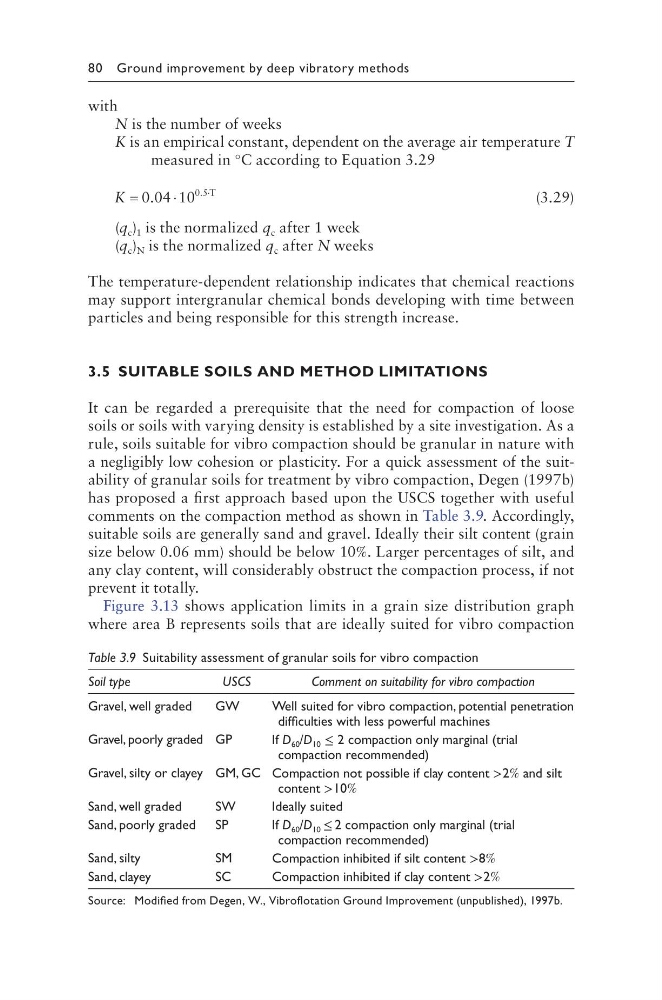
a negligibly low cohesion or plasticity. For a quick assessment of the suitability of granular soils for treatment by vibro compaction, Degen (1997b)
has proposed a first approach based upon the USCS together with useful
comments on the compaction method as shown in Table 3.9. Accordingly,
suitable soils are generally sand and gravel. Ideally their silt content (grain
size below 0.06 mm) should be below 10%. Larger percentages of silt, and
any clay content, will considerably obstruct the compaction process, if not
prevent it totally.
Figure 3.13 shows application limits in a grain size distribution graph
where area B represents soils that are ideally suited for vibro compaction
Table 3.9 Suitability assessment of granular soils for vibro compaction
Soil type
USCS
Comment on suitability for vibro compaction
Gravel, well graded
GW
Well suited for vibro compaction, potential penetration
difficulties with less powerful machines
Gravel, poorly graded GP
If D 60 /D 10 ≤ 2 compaction only marginal (trial
compaction recommended)
Gravel, silty or clayey GM, GC Compaction not possible if clay content >2% and silt
content >10%
Sand, well graded
SW
Ideally suited
Sand, poorly graded SP
If D 60 /D 10 ≤ 2 compaction only marginal (trial
compaction recommended)
Sand, silty
SM
Compaction inhibited if silt content >8%
Sand, clayey
SC
Compaction inhibited if clay content >2%
Source: Modified from Degen, W., Vibroflotation Ground Improvement (unpublished), 1997b.
with
N is the number of weeks
K is an empirical constant, dependent on the average air temperature T
measured in °C according to Equation 3.29
K =
⋅
⋅
0 04 10
0 5
.
. T
(3.29)
(q c ) 1 is the normalized q c after 1 week
(q c ) N is the normalized q c after N weeks
The temperature-dependent relationship indicates that chemical reactions
may support intergranular chemical bonds developing with time between
particles and being responsible for this strength increase.
3.5 SUITABLE SOILS AND METHOD LIMITATIONS
It can be regarded a prerequisite that the need for compaction of loose
soils or soils with varying density is established by a site investigation. As a
rule, soils suitable for vibro compaction should be granular in nature with
a negligibly low cohesion or plasticity. For a quick assessment of the suitability of granular soils for treatment by vibro compaction, Degen (1997b)
has proposed a first approach based upon the USCS together with useful
comments on the compaction method as shown in Table 3.9. Accordingly,
suitable soils are generally sand and gravel. Ideally their silt content (grain
size below 0.06 mm) should be below 10%. Larger percentages of silt, and
any clay content, will considerably obstruct the compaction process, if not
prevent it totally.
Figure 3.13 shows application limits in a grain size distribution graph
where area B represents soils that are ideally suited for vibro compaction
Table 3.9 Suitability assessment of granular soils for vibro compaction
Soil type
USCS
Comment on suitability for vibro compaction
Gravel, well graded
GW
Well suited for vibro compaction, potential penetration
difficulties with less powerful machines
Gravel, poorly graded GP
If D 60 /D 10 ≤ 2 compaction only marginal (trial
compaction recommended)
Gravel, silty or clayey GM, GC Compaction not possible if clay content >2% and silt
content >10%
Sand, well graded
SW
Ideally suited
Sand, poorly graded SP
If D 60 /D 10 ≤ 2 compaction only marginal (trial
compaction recommended)
Sand, silty
SM
Compaction inhibited if silt content >8%
Sand, clayey
SC
Compaction inhibited if clay content >2%
Source: Modified from Degen, W., Vibroflotation Ground Improvement (unpublished), 1997b.