

78 Ground improvement by deep vibratory methods
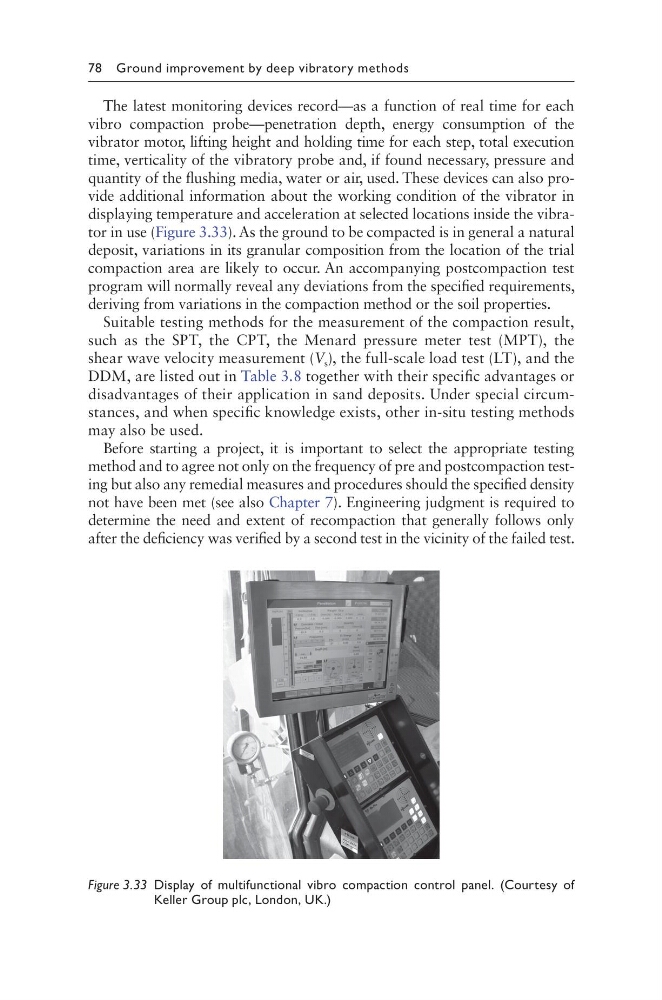
The latest monitoring devices record—as a function of real time for each
vibro compaction probe—penetration depth, energy consumption of the
vibrator motor, lifting height and holding time for each step, total execution
time, verticality of the vibratory probe and, if found necessary, pressure and
quantity of the flushing media, water or air, used. These devices can also provide additional information about the working condition of the vibrator in
displaying temperature and acceleration at selected locations inside the vibrator in use (Figure 3.33). As the ground to be compacted is in general a natural
deposit, variations in its granular composition from the location of the trial
compaction area are likely to occur. An accompanying postcompaction test
program will normally reveal any deviations from the specified requirements,
deriving from variations in the compaction method or the soil properties.
Suitable testing methods for the measurement of the compaction result,
such as the SPT, the CPT, the Menard pressure meter test (MPT), the
shear wave velocity measurement (V s ), the full-scale load test (LT), and the
DDM, are listed out in Table 3.8 together with their specific advantages or
disadvantages of their application in sand deposits. Under special circumstances, and when specific knowledge exists, other in-situ testing methods
may also be used.
Before starting a project, it is important to select the appropriate testing
method and to agree not only on the frequency of pre and postcompaction testing but also any remedial measures and procedures should the specified density
not have been met (see also Chapter 7). Engineering judgment is required to
determine the need and extent of recompaction that generally follows only
after the deficiency was verified by a second test in the vicinity of the failed test.
Figure 3.33 Display of multifunctional vibro compaction control panel. (Courtesy of
Keller Group plc, London, UK.)
The latest monitoring devices record—as a function of real time for each
vibro compaction probe—penetration depth, energy consumption of the
vibrator motor, lifting height and holding time for each step, total execution
time, verticality of the vibratory probe and, if found necessary, pressure and
quantity of the flushing media, water or air, used. These devices can also provide additional information about the working condition of the vibrator in
displaying temperature and acceleration at selected locations inside the vibrator in use (Figure 3.33). As the ground to be compacted is in general a natural
deposit, variations in its granular composition from the location of the trial
compaction area are likely to occur. An accompanying postcompaction test
program will normally reveal any deviations from the specified requirements,
deriving from variations in the compaction method or the soil properties.
Suitable testing methods for the measurement of the compaction result,
such as the SPT, the CPT, the Menard pressure meter test (MPT), the
shear wave velocity measurement (V s ), the full-scale load test (LT), and the
DDM, are listed out in Table 3.8 together with their specific advantages or
disadvantages of their application in sand deposits. Under special circumstances, and when specific knowledge exists, other in-situ testing methods
may also be used.
Before starting a project, it is important to select the appropriate testing
method and to agree not only on the frequency of pre and postcompaction testing but also any remedial measures and procedures should the specified density
not have been met (see also Chapter 7). Engineering judgment is required to
determine the need and extent of recompaction that generally follows only
after the deficiency was verified by a second test in the vicinity of the failed test.
Figure 3.33 Display of multifunctional vibro compaction control panel. (Courtesy of
Keller Group plc, London, UK.)