

Vibro compaction of granular soils 75
the cyclic shear strain and the number of strain cycles. It is insignificantly
affected by the degree of the vertical stress. At a given depth in the soil, the
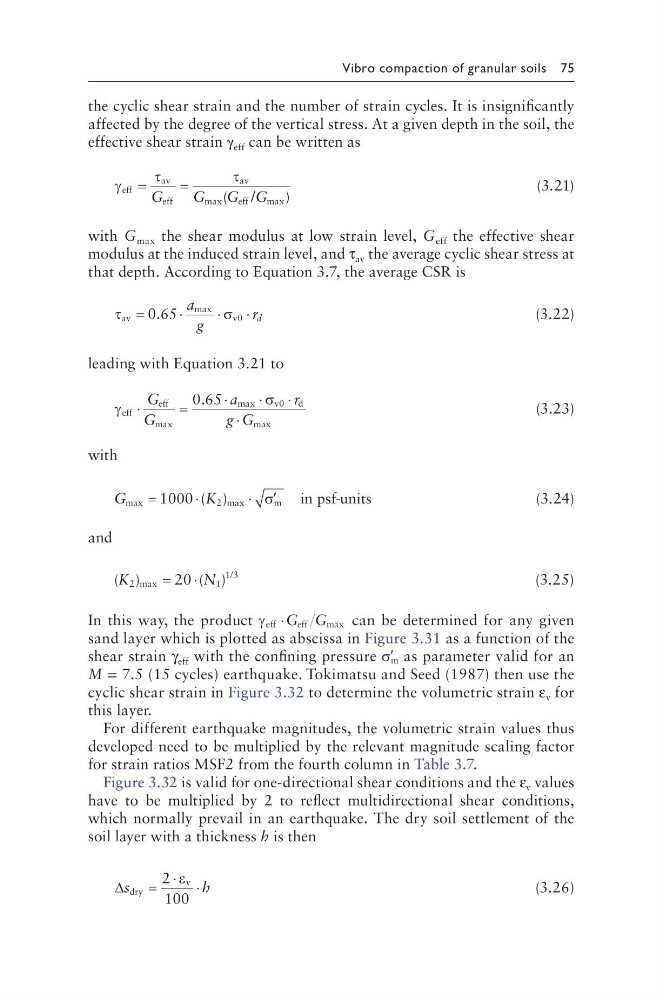
effective shear strain γ eff can be written as
γ eff =
=
τ
τ
av
eff
av
max
eff
max
/
G
G G G
(
)
(3.21)
with G max the shear modulus at low strain level, G eff the effective shear
modulus at the induced strain level, and τ av the average cyclic shear stress at
that depth. According to Equation 3.7, the average CSR is
τ
σ
av
max
v0
=
⋅
⋅
⋅
0 65
.
a
g
r d
(3.22)
leading with Equation 3.21 to
γ
σ
eff
eff
max
max
v 0 d
max
⋅
=
⋅
⋅
⋅
⋅
G
G
a
r
g G
0 65
.
(3.23)
with
G
K
max
2 max
m
1000 ( )
in psf-units
=
⋅
⋅ ′
σ
(3.24)
and
( )
( )
max
/
K
N
2
1
1 3
20
=
⋅
(3.25)
In this way, the product γ eff e ff max
⋅ G G
can be determined for any given
sand layer which is plotted as abscissa in Figure 3.31 as a function of the
shear strain γ eff with the confining pressure ′
σ m as parameter valid for an
M = 7.5 (15 cycles) earthquake. Tokimatsu and Seed (1987) then use the
cyclic shear strain in Figure 3.32 to determine the volumetric strain ε v for
this layer.
For different earthquake magnitudes, the volumetric strain values thus
developed need to be multiplied by the relevant magnitude scaling factor
for strain ratios MSF2 from the fourth column in Table 3.7.
Figure 3.32 is valid for one-directional shear conditions and the ε v values
have to be multiplied by 2 to reflect multidirectional shear conditions,
which normally prevail in an earthquake. The dry soil settlement of the
soil layer with a thickness h is then
∆
=
⋅ ⋅
s
h
dry
v
100
2 ε
(3.26)
the cyclic shear strain and the number of strain cycles. It is insignificantly
affected by the degree of the vertical stress. At a given depth in the soil, the
effective shear strain γ eff can be written as
γ eff =
=
τ
τ
av
eff
av
max
eff
max
/
G
G G G
(
)
(3.21)
with G max the shear modulus at low strain level, G eff the effective shear
modulus at the induced strain level, and τ av the average cyclic shear stress at
that depth. According to Equation 3.7, the average CSR is
τ
σ
av
max
v0
=
⋅
⋅
⋅
0 65
.
a
g
r d
(3.22)
leading with Equation 3.21 to
γ
σ
eff
eff
max
max
v 0 d
max
⋅
=
⋅
⋅
⋅
⋅
G
G
a
r
g G
0 65
.
(3.23)
with
G
K
max
2 max
m
1000 ( )
in psf-units
=
⋅
⋅ ′
σ
(3.24)
and
( )
( )
max
/
K
N
2
1
1 3
20
=
⋅
(3.25)
In this way, the product γ eff e ff max
⋅ G G
can be determined for any given
sand layer which is plotted as abscissa in Figure 3.31 as a function of the
shear strain γ eff with the confining pressure ′
σ m as parameter valid for an
M = 7.5 (15 cycles) earthquake. Tokimatsu and Seed (1987) then use the
cyclic shear strain in Figure 3.32 to determine the volumetric strain ε v for
this layer.
For different earthquake magnitudes, the volumetric strain values thus
developed need to be multiplied by the relevant magnitude scaling factor
for strain ratios MSF2 from the fourth column in Table 3.7.
Figure 3.32 is valid for one-directional shear conditions and the ε v values
have to be multiplied by 2 to reflect multidirectional shear conditions,
which normally prevail in an earthquake. The dry soil settlement of the
soil layer with a thickness h is then
∆
=
⋅ ⋅
s
h
dry
v
100
2 ε
(3.26)