

74 Ground improvement by deep vibratory methods
As can be seen in Figure 3.29, the earthquake-induced volumetric strain
can range well over 3% in loose sand and is insignificant when dense conditions prevail. To use this figure also for earthquakes other than M = 7.5,
the values of the cyclic stress ratio have to be multiplied by the magnitude
scaling factor MFS as obtained from Figure 3.26 and using:
τ
σ
τ
σ
av
0 M M
av
0 M 7.5
′
= ′
⋅
=
=
MSF
(3.19)
The studies of Tokimatsu and Seed (1987) also revealed that, for conditions
of incomplete liquefaction, only small amounts of settlements will occur,
which are generally represented by volumetric strains well below 1% (dashed
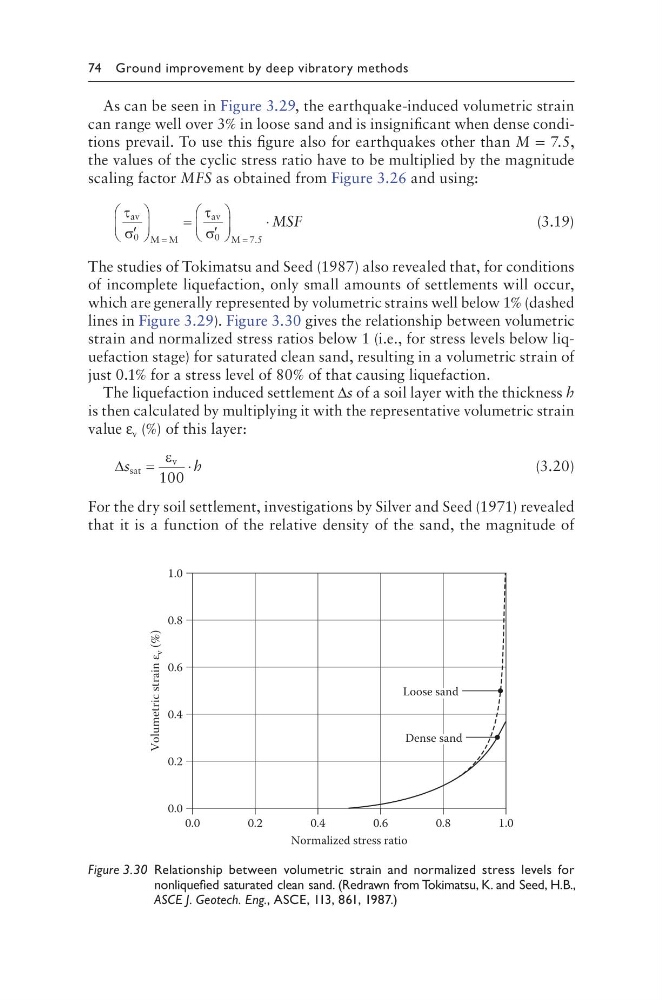
lines in Figure 3.29). Figure 3.30 gives the relationship between volumetric
strain and normalized stress ratios below 1 (i.e., for stress levels below liquefaction stage) for saturated clean sand, resulting in a volumetric strain of
just 0.1% for a stress level of 80% of that causing liquefaction.
The liquefaction induced settlement Δs of a soil layer with the thickness h
is then calculated by multiplying it with the representative volumetric strain
value ε v (%) of this layer:
∆s
h
sat
v
100
=
⋅
ε
(3.20)
For the dry soil settlement, investigations by Silver and Seed (1971) revealed
that it is a function of the relative density of the sand, the magnitude of
Normalized stress ratio
Volumetric strain ε
v (%)
0.0
0.2
0.4
0.6
0.8
1.0
0.6
0.4
0.0
0.8
0.2
1.0
Dense sand
Loose sand
Figure 3.30 Relationship between volumetric strain and normalized stress levels for
nonliquefied saturated clean sand. (Redrawn from Tokimatsu, K. and Seed, H.B.,
ASCE J. Geotech. Eng., ASCE, 113, 861, 1987.)
As can be seen in Figure 3.29, the earthquake-induced volumetric strain
can range well over 3% in loose sand and is insignificant when dense conditions prevail. To use this figure also for earthquakes other than M = 7.5,
the values of the cyclic stress ratio have to be multiplied by the magnitude
scaling factor MFS as obtained from Figure 3.26 and using:
τ
σ
τ
σ
av
0 M M
av
0 M 7.5
′
= ′
⋅
=
=
MSF
(3.19)
The studies of Tokimatsu and Seed (1987) also revealed that, for conditions
of incomplete liquefaction, only small amounts of settlements will occur,
which are generally represented by volumetric strains well below 1% (dashed
lines in Figure 3.29). Figure 3.30 gives the relationship between volumetric
strain and normalized stress ratios below 1 (i.e., for stress levels below liquefaction stage) for saturated clean sand, resulting in a volumetric strain of
just 0.1% for a stress level of 80% of that causing liquefaction.
The liquefaction induced settlement Δs of a soil layer with the thickness h
is then calculated by multiplying it with the representative volumetric strain
value ε v (%) of this layer:
∆s
h
sat
v
100
=
⋅
ε
(3.20)
For the dry soil settlement, investigations by Silver and Seed (1971) revealed
that it is a function of the relative density of the sand, the magnitude of
Normalized stress ratio
Volumetric strain ε
v (%)
0.0
0.2
0.4
0.6
0.8
1.0
0.6
0.4
0.0
0.8
0.2
1.0
Dense sand
Loose sand
Figure 3.30 Relationship between volumetric strain and normalized stress levels for
nonliquefied saturated clean sand. (Redrawn from Tokimatsu, K. and Seed, H.B.,
ASCE J. Geotech. Eng., ASCE, 113, 861, 1987.)