

72 Ground improvement by deep vibratory methods
3.3.3.2 Settlement estimation of sands
due to earthquake shaking
Besides the potential catastrophic effects of liquefaction to structures, and
their possible avoidance by soil improvement measures, the foreseeable
extent of earthquake-induced deformations in granular soils is of particular interest in seismic zones. It is well-known that sand tends to compact
and settle when subjected to earthquake shaking. The degree of deformation depends, of course, primarily on the initial density of the sand deposit
and the earthquake magnitude, and ranges generally between less than 1%
volumetric strain for dense sand and up to 5% for very loose sand.
To estimate the probable settlement as a result of earthquake shaking,
Tokimatsu and Seed (1987) proposed that the calculations be divided into
saturated sand settlement below groundwater, where generally liquefaction
would occur, and settlement for dry or unsaturated sand above, with the
sum of both representing the total earthquake-induced settlement.
It is recommended to base these calculations on SPT values and to convert
any other in-situ density measurements, such as CPT results, into normalized
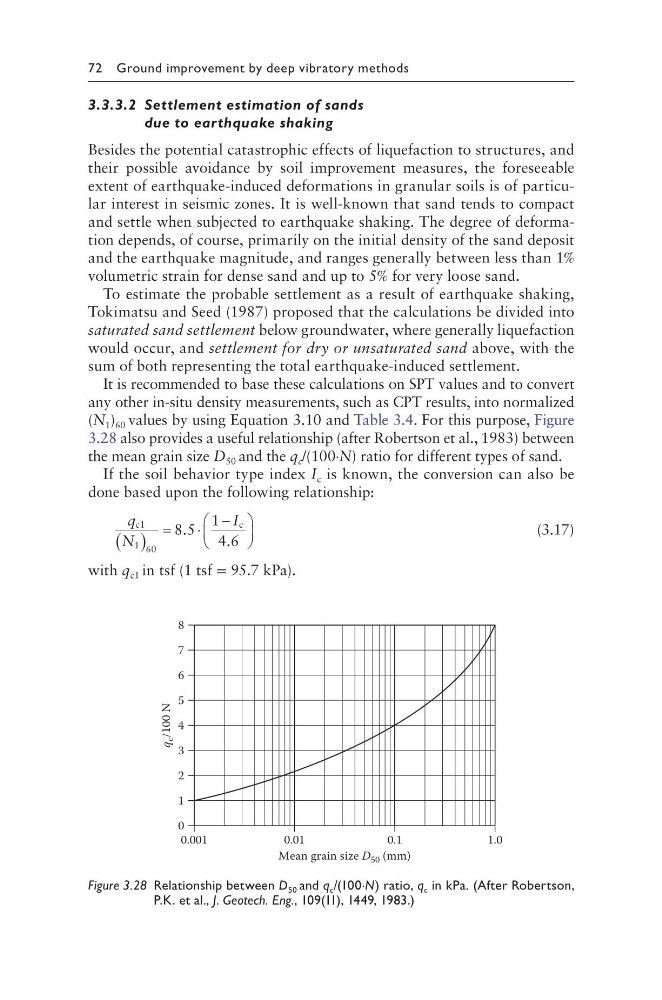
(N 1 ) 60 values by using Equation 3.10 and Table 3.4. For this purpose, Figure
3.28 also provides a useful relationship (after Robertson et al., 1983) between
the mean grain size D 50 and the q c /(100·N) ratio for different types of sand.
If the soil behavior type index I c is known, the conversion can also be
done based upon the following relationship:
q
N
I
c
c
1
1 60
8 5
1
4 6
( )
=
⋅
−
.
.
(3.17)
with q c1 in tsf (1 tsf = 95.7 kPa).
0.001
8
6
4
2
0
0.01
Mean grain size D 50 (mm)
0.1
q
c /100 N
7
5
3
1
1.0
Figure 3.28 Relationship between D 50 and q c /(100·N) ratio, q c in kPa. (After Robertson,
P.K. et al., J. Geotech. Eng., 109(11), 1449, 1983.)
3.3.3.2 Settlement estimation of sands
due to earthquake shaking
Besides the potential catastrophic effects of liquefaction to structures, and
their possible avoidance by soil improvement measures, the foreseeable
extent of earthquake-induced deformations in granular soils is of particular interest in seismic zones. It is well-known that sand tends to compact
and settle when subjected to earthquake shaking. The degree of deformation depends, of course, primarily on the initial density of the sand deposit
and the earthquake magnitude, and ranges generally between less than 1%
volumetric strain for dense sand and up to 5% for very loose sand.
To estimate the probable settlement as a result of earthquake shaking,
Tokimatsu and Seed (1987) proposed that the calculations be divided into
saturated sand settlement below groundwater, where generally liquefaction
would occur, and settlement for dry or unsaturated sand above, with the
sum of both representing the total earthquake-induced settlement.
It is recommended to base these calculations on SPT values and to convert
any other in-situ density measurements, such as CPT results, into normalized
(N 1 ) 60 values by using Equation 3.10 and Table 3.4. For this purpose, Figure
3.28 also provides a useful relationship (after Robertson et al., 1983) between
the mean grain size D 50 and the q c /(100·N) ratio for different types of sand.
If the soil behavior type index I c is known, the conversion can also be
done based upon the following relationship:
q
N
I
c
c
1
1 60
8 5
1
4 6
( )
=
⋅
−
.
.
(3.17)
with q c1 in tsf (1 tsf = 95.7 kPa).
0.001
8
6
4
2
0
0.01
Mean grain size D 50 (mm)
0.1
q
c /100 N
7
5
3
1
1.0
Figure 3.28 Relationship between D 50 and q c /(100·N) ratio, q c in kPa. (After Robertson,
P.K. et al., J. Geotech. Eng., 109(11), 1449, 1983.)