

Vibro compaction of granular soils 71
The factor of safety (FS) against liquefaction can now be written as a function of the CSR, the CRR for 7.5 magnitude earthquakes CRR 7.5 and the
magnitude scaling factor MSF as follows:
FS
CRR
CSR
MSF
=
⋅
7 5
.
(3.16)
We have seen from Figure 3.21 that the CRR values, as developed from
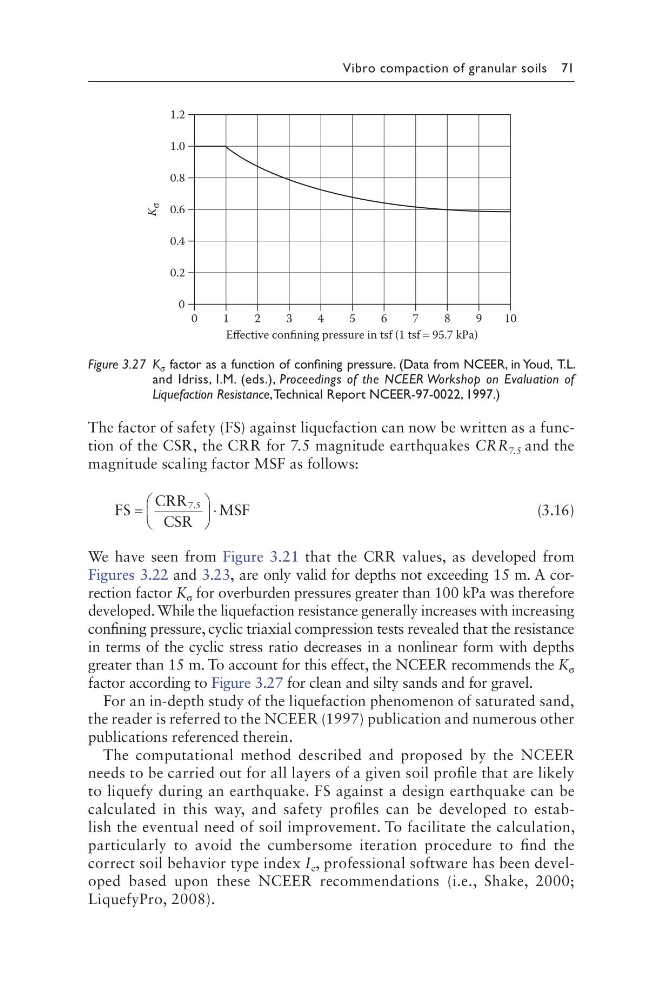
Figures 3.22 and 3.23, are only valid for depths not exceeding 15 m. A correction factor K σ for overburden pressures greater than 100 kPa was therefore
developed. While the liquefaction resistance generally increases with increasing
confining pressure, cyclic triaxial compression tests revealed that the resistance
in terms of the cyclic stress ratio decreases in a nonlinear form with depths
greater than 15 m. To account for this effect, the NCEER recommends the K σ
factor according to Figure 3.27 for clean and silty sands and for gravel.
For an in-depth study of the liquefaction phenomenon of saturated sand,
the reader is referred to the NCEER (1997) publication and numerous other
publications referenced therein.
The computational method described and proposed by the NCEER
needs to be carried out for all layers of a given soil profile that are likely
to liquefy during an earthquake. FS against a design earthquake can be
calculated in this way, and safety profiles can be developed to establish the eventual need of soil improvement. To facilitate the calculation,
particularly to avoid the cumbersome iteration procedure to find the
correct soil behavior type index I c , professional software has been developed based upon these NCEER recommendations (i.e., Shake, 2000;
LiquefyPro, 2008).
Effective confining pressure in tsf (1 tsf = 95.7 kPa)
K σ
1
0
0.8
0.4
0
1.2
0.6
0.2
1.0
2
3
4
5
6
7
8
9
10
Figure 3.27 K σ factor as a function of confining pressure. (Data from NCEER, in Youd, T.L.
and Idriss, I.M. (eds.), Proceedings of the NCEER Workshop on Evaluation of
Liquefaction Resistance, Technical Report NCEER-97-0022, 1997.)
The factor of safety (FS) against liquefaction can now be written as a function of the CSR, the CRR for 7.5 magnitude earthquakes CRR 7.5 and the
magnitude scaling factor MSF as follows:
FS
CRR
CSR
MSF
=
⋅
7 5
.
(3.16)
We have seen from Figure 3.21 that the CRR values, as developed from
Figures 3.22 and 3.23, are only valid for depths not exceeding 15 m. A correction factor K σ for overburden pressures greater than 100 kPa was therefore
developed. While the liquefaction resistance generally increases with increasing
confining pressure, cyclic triaxial compression tests revealed that the resistance
in terms of the cyclic stress ratio decreases in a nonlinear form with depths
greater than 15 m. To account for this effect, the NCEER recommends the K σ
factor according to Figure 3.27 for clean and silty sands and for gravel.
For an in-depth study of the liquefaction phenomenon of saturated sand,
the reader is referred to the NCEER (1997) publication and numerous other
publications referenced therein.
The computational method described and proposed by the NCEER
needs to be carried out for all layers of a given soil profile that are likely
to liquefy during an earthquake. FS against a design earthquake can be
calculated in this way, and safety profiles can be developed to establish the eventual need of soil improvement. To facilitate the calculation,
particularly to avoid the cumbersome iteration procedure to find the
correct soil behavior type index I c , professional software has been developed based upon these NCEER recommendations (i.e., Shake, 2000;
LiquefyPro, 2008).
Effective confining pressure in tsf (1 tsf = 95.7 kPa)
K σ
1
0
0.8
0.4
0
1.2
0.6
0.2
1.0
2
3
4
5
6
7
8
9
10
Figure 3.27 K σ factor as a function of confining pressure. (Data from NCEER, in Youd, T.L.
and Idriss, I.M. (eds.), Proceedings of the NCEER Workshop on Evaluation of
Liquefaction Resistance, Technical Report NCEER-97-0022, 1997.)