

Vibro compaction of granular soils 59
For foundations on sand with a smallest width of more than 1.5 m, settlement is normally the key criterion for the design rather than bearing
capacity. A reliable in-situ determination of the sand stiffness is of great
importance because of the difficulties of measuring the deformation modulus in the laboratory on undisturbed samples obtained from the field as they
are extremely difficult to retrieve from granular soils. However, to determine stiffness data for sand from in-situ penetration tests is also rather
complex because of their dependence on stress levels, stress history, drainage, and sand characteristics.
For normally consolidated, unaged and uncemented predominantly silica
sands, the constrained modulus M can be obtained from the following relations based on CPT results after Lunne and Christophersen (1983):
M
q
q
M
q
q
M
= ⋅
= ⋅ + (
)
4
1 0
2
20
1 0
50
c
c
c
c
for below MPa
MPa
for between and MPa
= = 120
50
MPa
f or above MPa
c
q
(3.4)
28
32
36
40
44
40
60
80
20
100
0
Relative density D r (%)
Triaxial peak drained friction angle φ′
(°)
U n i f o r m
fi n e s a n d
U n if o r m g r a v e l
W e ll - g r a d e d g r a v e l— s a n d — s il t
U n if o r m c o a r s e s a n d
W e ll - g r a d e d m e d iu m s a n d
U n i f o r m
m e d i u m
s a n d
W e l l - g r a d e d fi n e s a n d
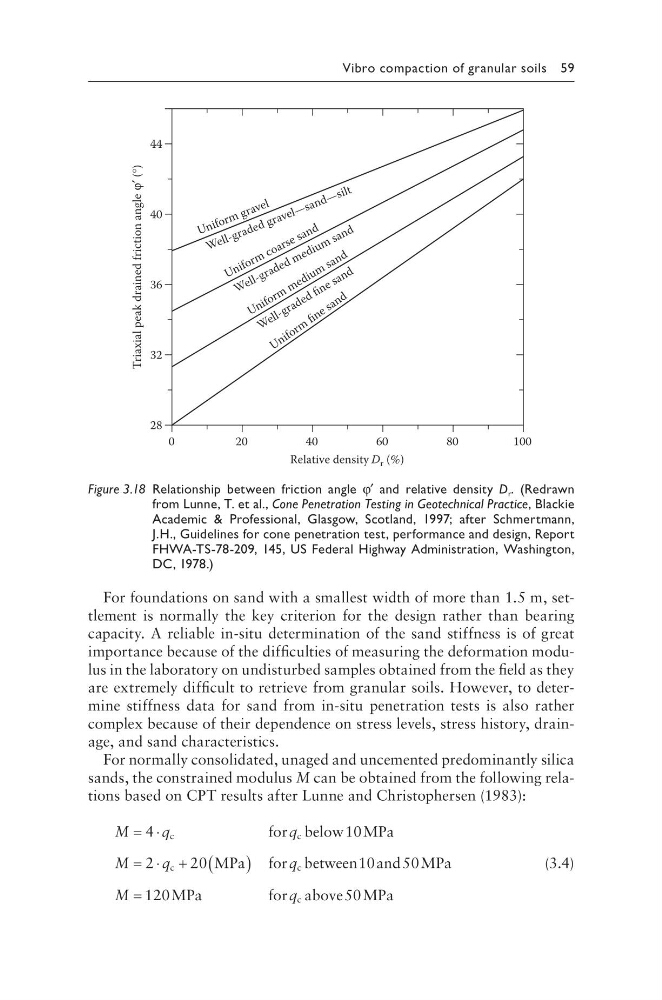
Figure 3.18 Relationship between friction angle φ′ and relative density D r . (Redrawn
from Lunne, T. et al., Cone Penetration Testing in Geotechnical Practice, Blackie
Academic & Professional, Glasgow, Scotland, 1997; after Schmertmann,
J.H., Guidelines for cone penetration test, performance and design, Report
FHWA-TS-78-209, 145, US Federal Highway Administration, Washington,
DC, 1978.)
For foundations on sand with a smallest width of more than 1.5 m, settlement is normally the key criterion for the design rather than bearing
capacity. A reliable in-situ determination of the sand stiffness is of great
importance because of the difficulties of measuring the deformation modulus in the laboratory on undisturbed samples obtained from the field as they
are extremely difficult to retrieve from granular soils. However, to determine stiffness data for sand from in-situ penetration tests is also rather
complex because of their dependence on stress levels, stress history, drainage, and sand characteristics.
For normally consolidated, unaged and uncemented predominantly silica
sands, the constrained modulus M can be obtained from the following relations based on CPT results after Lunne and Christophersen (1983):
M
q
q
M
q
q
M
= ⋅
= ⋅ + (
)
4
1 0
2
20
1 0
50
c
c
c
c
for below MPa
MPa
for between and MPa
= = 120
50
MPa
f or above MPa
c
q
(3.4)
28
32
36
40
44
40
60
80
20
100
0
Relative density D r (%)
Triaxial peak drained friction angle φ′
(°)
U n i f o r m
fi n e s a n d
U n if o r m g r a v e l
W e ll - g r a d e d g r a v e l— s a n d — s il t
U n if o r m c o a r s e s a n d
W e ll - g r a d e d m e d iu m s a n d
U n i f o r m
m e d i u m
s a n d
W e l l - g r a d e d fi n e s a n d
Figure 3.18 Relationship between friction angle φ′ and relative density D r . (Redrawn
from Lunne, T. et al., Cone Penetration Testing in Geotechnical Practice, Blackie
Academic & Professional, Glasgow, Scotland, 1997; after Schmertmann,
J.H., Guidelines for cone penetration test, performance and design, Report
FHWA-TS-78-209, 145, US Federal Highway Administration, Washington,
DC, 1978.)