

44 Ground improvement by deep vibratory methods
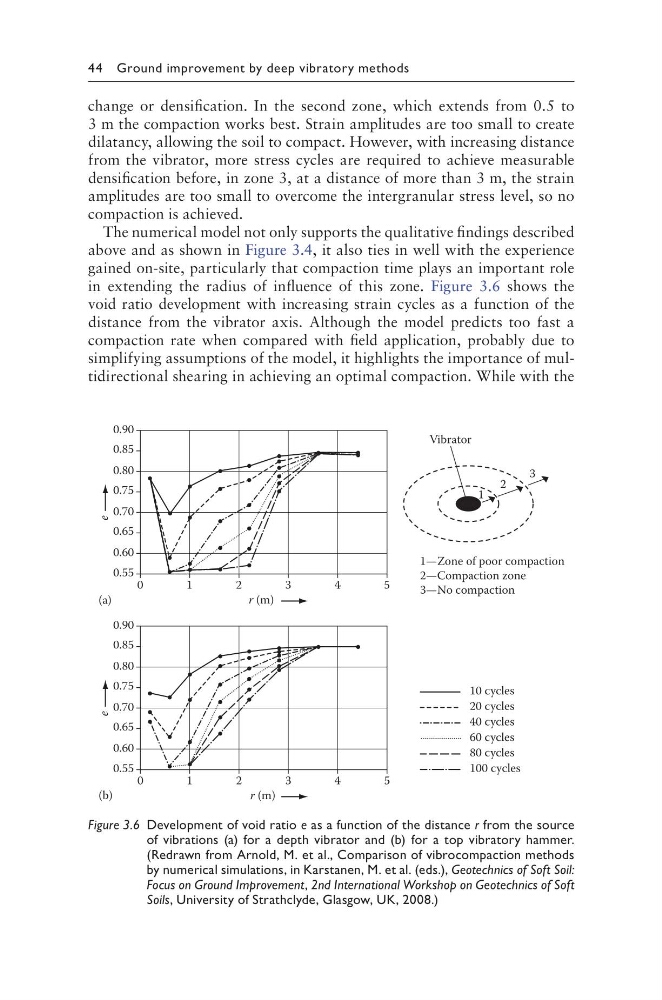
change or densification. In the second zone, which extends from 0.5 to
3 m the compaction works best. Strain amplitudes are too small to create
dilatancy, allowing the soil to compact. However, with increasing distance
from the vibrator, more stress cycles are required to achieve measurable
densification before, in zone 3, at a distance of more than 3 m, the strain
amplitudes are too small to overcome the intergranular stress level, so no
compaction is achieved.
The numerical model not only supports the qualitative findings described
above and as shown in Figure 3.4, it also ties in well with the experience
gained on-site, particularly that compaction time plays an important role
in extending the radius of influence of this zone. Figure 3.6 shows the
void ratio development with increasing strain cycles as a function of the
distance from the vibrator axis. Although the model predicts too fast a
compaction rate when compared with field application, probably due to
simplifying assumptions of the model, it highlights the importance of multidirectional shearing in achieving an optimal compaction. While with the
0.55
0.90
0.85
0.80
0.75
0.70
0.65
0.60
r (m)
r (m)
0
1
2
3
4
5
e
0.55
0.90
0.85
0.80
0.75
0.70
0.65
0.60
0
1
2
3
4
5
e
10 cycles
20 cycles
40 cycles
60 cycles
80 cycles
100 cycles
(a)
(b)
3
2
Vibrator
1—Zone of poor compaction
2—Compaction zone
3—No compaction
1
Figure 3.6 Development of void ratio e as a function of the distance r from the source
of vibrations (a) for a depth vibrator and (b) for a top vibratory hammer.
(Redrawn from Arnold, M. et al., Comparison of vibrocompaction methods
by numerical simulations, in Karstanen, M. et al. (eds.), Geotechnics of Soft Soil:
Focus on Ground Improvement, 2nd International Workshop on Geotechnics of Soft
Soils, University of Strathclyde, Glasgow, UK, 2008.)
change or densification. In the second zone, which extends from 0.5 to
3 m the compaction works best. Strain amplitudes are too small to create
dilatancy, allowing the soil to compact. However, with increasing distance
from the vibrator, more stress cycles are required to achieve measurable
densification before, in zone 3, at a distance of more than 3 m, the strain
amplitudes are too small to overcome the intergranular stress level, so no
compaction is achieved.
The numerical model not only supports the qualitative findings described
above and as shown in Figure 3.4, it also ties in well with the experience
gained on-site, particularly that compaction time plays an important role
in extending the radius of influence of this zone. Figure 3.6 shows the
void ratio development with increasing strain cycles as a function of the
distance from the vibrator axis. Although the model predicts too fast a
compaction rate when compared with field application, probably due to
simplifying assumptions of the model, it highlights the importance of multidirectional shearing in achieving an optimal compaction. While with the
0.55
0.90
0.85
0.80
0.75
0.70
0.65
0.60
r (m)
r (m)
0
1
2
3
4
5
e
0.55
0.90
0.85
0.80
0.75
0.70
0.65
0.60
0
1
2
3
4
5
e
10 cycles
20 cycles
40 cycles
60 cycles
80 cycles
100 cycles
(a)
(b)
3
2
Vibrator
1—Zone of poor compaction
2—Compaction zone
3—No compaction
1
Figure 3.6 Development of void ratio e as a function of the distance r from the source
of vibrations (a) for a depth vibrator and (b) for a top vibratory hammer.
(Redrawn from Arnold, M. et al., Comparison of vibrocompaction methods
by numerical simulations, in Karstanen, M. et al. (eds.), Geotechnics of Soft Soil:
Focus on Ground Improvement, 2nd International Workshop on Geotechnics of Soft
Soils, University of Strathclyde, Glasgow, UK, 2008.)