

A history of vibratory deep compaction 15
Of much greater importance in the development of the vibro compaction
method were observations made in 1942 in connection with the foundation
of an I.G. Farben facility at Rolingheten in Norway. Here fine-grained, loose
partially silty to very silty sand was to be compacted at high groundwater
table to carry heavy structural loads. The works were supervised by Degebo
(1942), which recommended a rather close spacing of 2.5 m 2 per compaction probe in this case. However, a satisfactory compaction of the sand was
only possible through the addition of gravely medium sand as backfill material during execution (Figure 2.9). Backfill material amounted to 20% of the
compacted sand volume. Site investigation carried out after compaction
revealed for the first time that the core of the compaction consisted primarily of the coarse backfill material, which was compacted to 100% relative
density. In the surrounding fine-grained soil between the compaction cores,
a relative density of 60% was measured. With today’s perception, this compaction work was probably for the first time close to what today is called
vibro replacement, whereby, as will be shown later, the in-situ fine-grained
material cannot be satisfactorily compacted by the vibratory motion alone
and coarse backfill material needs to be added. In the Norwegian example,
load tests carried out on, and between, the compaction probes revealed an
allowable bearing pressure of 6 kg/cm 2 (600 kPa). The effect of the compaction work was quite impressive: “although even light vehicles could not
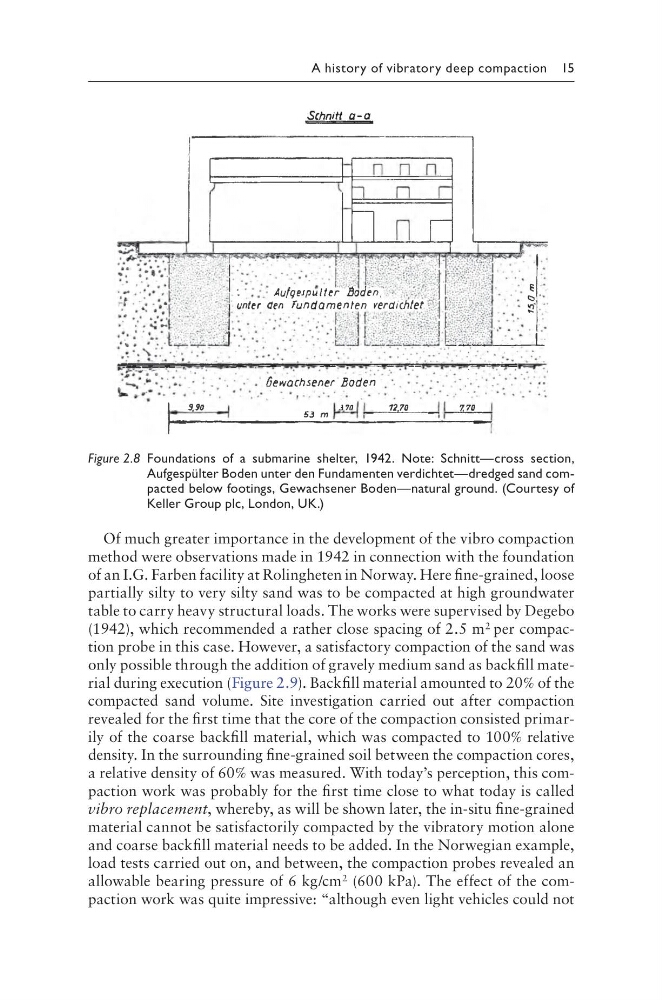
Figure 2.8 Foundations of a submarine shelter, 1942. Note: Schnitt—cross section,
Aufgespülter Boden unter den Fundamenten verdichtet—dredged sand compacted below footings, Gewachsener Boden—natural ground. (Courtesy of
Keller Group plc, London, UK.)
S ch n itt a - a
■ ■ ■
m '
i ' 1 = M
75.0 m
* .
A u fg e sp u lte r B o d e n ,' ■
unter den F u n d a m e n te n v e rd ic h te t ■
G e w a ch se n e r B o d e n
S3 m
3 70
12.70
7.70
3.90
Of much greater importance in the development of the vibro compaction
method were observations made in 1942 in connection with the foundation
of an I.G. Farben facility at Rolingheten in Norway. Here fine-grained, loose
partially silty to very silty sand was to be compacted at high groundwater
table to carry heavy structural loads. The works were supervised by Degebo
(1942), which recommended a rather close spacing of 2.5 m 2 per compaction probe in this case. However, a satisfactory compaction of the sand was
only possible through the addition of gravely medium sand as backfill material during execution (Figure 2.9). Backfill material amounted to 20% of the
compacted sand volume. Site investigation carried out after compaction
revealed for the first time that the core of the compaction consisted primarily of the coarse backfill material, which was compacted to 100% relative
density. In the surrounding fine-grained soil between the compaction cores,
a relative density of 60% was measured. With today’s perception, this compaction work was probably for the first time close to what today is called
vibro replacement, whereby, as will be shown later, the in-situ fine-grained
material cannot be satisfactorily compacted by the vibratory motion alone
and coarse backfill material needs to be added. In the Norwegian example,
load tests carried out on, and between, the compaction probes revealed an
allowable bearing pressure of 6 kg/cm 2 (600 kPa). The effect of the compaction work was quite impressive: “although even light vehicles could not
Figure 2.8 Foundations of a submarine shelter, 1942. Note: Schnitt—cross section,
Aufgespülter Boden unter den Fundamenten verdichtet—dredged sand compacted below footings, Gewachsener Boden—natural ground. (Courtesy of
Keller Group plc, London, UK.)
S ch n itt a - a
■ ■ ■
m '
i ' 1 = M
75.0 m
* .
A u fg e sp u lte r B o d e n ,' ■
unter den F u n d a m e n te n v e rd ic h te t ■
G e w a ch se n e r B o d e n
S3 m
3 70
12.70
7.70
3.90