

210 Ground improvement by deep vibratory methods
groundwater in which they are used. However, this view would be shortsighted if their carbon dioxide emissions were not addressed. Since researchers, most prominently Stern (2006), published reports on the impact of
climate change on the world economy, strategies have been developed in
some countries for the abatement of carbon dioxide emission, setting targets for 2050 by which global concentration of greenhouse gases could be
stabilized at a level to avoid further dramatic global temperature rises.
Although buildings, including their construction and maintenance,
account for almost half of a European country’s total CO 2 emission (Egan
and Slocombe, 2010) only a few countries have introduced regulatory rules
that could help to reduce the environmental impact of the construction
industry by controlling the energy demand, the generation of greenhouse
gases, and the production of waste on construction projects. Egan and
Slocombe show in their investigation the environmental advantages of the
deep vibro compaction and replacement methods over conventional piling
methods by applying the principle of reduce, reuse, and recycle, not only
qualitatively to a number of real construction projects but quantitatively by
calculating the embodied CO 2 for different foundation solutions.
The comparison was made on a like-for-like basis for ground conditions
that allowed both the execution of a standard piling solution and a vibro
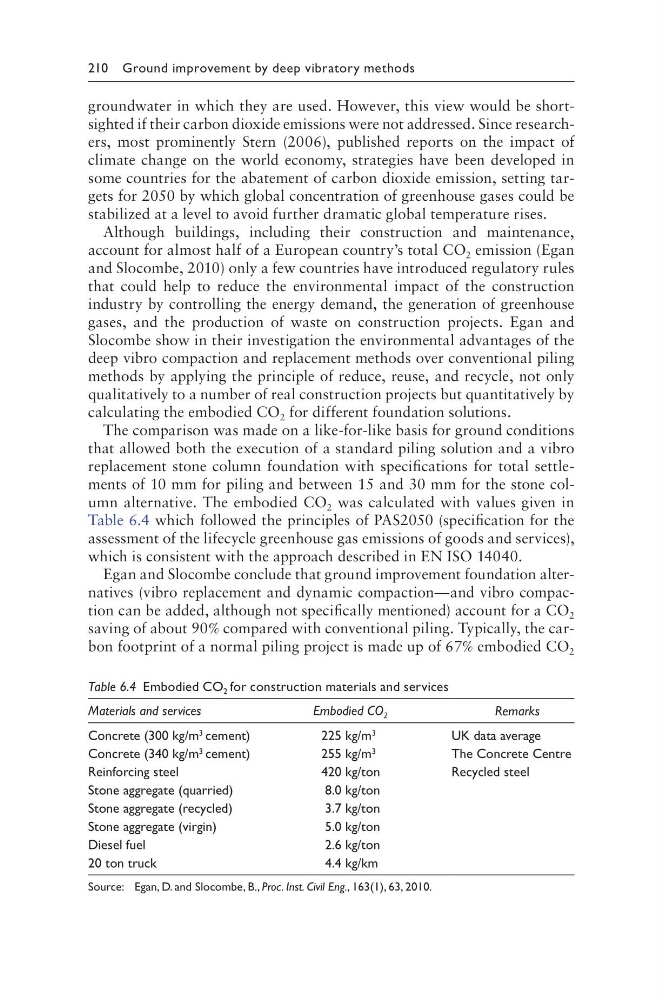
replacement stone column foundation with specifications for total settlements of 10 mm for piling and between 15 and 30 mm for the stone column alternative. The embodied CO 2 was calculated with values given in
Table 6.4 which followed the principles of PAS2050 (specification for the
assessment of the lifecycle greenhouse gas emissions of goods and services),
which is consistent with the approach described in EN ISO 14040.
Egan and Slocombe conclude that ground improvement foundation alternatives (vibro replacement and dynamic compaction—and vibro compaction can be added, although not specifically mentioned) account for a CO 2
saving of about 90% compared with conventional piling. Typically, the carbon footprint of a normal piling project is made up of 67% embodied CO 2
Table 6.4 Embodied CO 2 for construction materials and services
Materials and services
Embodied CO 2
Remarks
Concrete (300 kg/m 3 cement)
225 kg/m 3
UK data average
Concrete (340 kg/m 3 cement)
255 kg/m 3
The Concrete Centre
Reinforcing steel
420 kg/ton
Recycled steel
Stone aggregate (quarried)
8.0 kg/ton
Stone aggregate (recycled)
3.7 kg/ton
Stone aggregate (virgin)
5.0 kg/ton
Diesel fuel
2.6 kg/ton
20 ton truck
4.4 kg/km
Source: Egan, D. and Slocombe, B., Proc. Inst. Civil Eng., 163(1), 63, 2010.
groundwater in which they are used. However, this view would be shortsighted if their carbon dioxide emissions were not addressed. Since researchers, most prominently Stern (2006), published reports on the impact of
climate change on the world economy, strategies have been developed in
some countries for the abatement of carbon dioxide emission, setting targets for 2050 by which global concentration of greenhouse gases could be
stabilized at a level to avoid further dramatic global temperature rises.
Although buildings, including their construction and maintenance,
account for almost half of a European country’s total CO 2 emission (Egan
and Slocombe, 2010) only a few countries have introduced regulatory rules
that could help to reduce the environmental impact of the construction
industry by controlling the energy demand, the generation of greenhouse
gases, and the production of waste on construction projects. Egan and
Slocombe show in their investigation the environmental advantages of the
deep vibro compaction and replacement methods over conventional piling
methods by applying the principle of reduce, reuse, and recycle, not only
qualitatively to a number of real construction projects but quantitatively by
calculating the embodied CO 2 for different foundation solutions.
The comparison was made on a like-for-like basis for ground conditions
that allowed both the execution of a standard piling solution and a vibro
replacement stone column foundation with specifications for total settlements of 10 mm for piling and between 15 and 30 mm for the stone column alternative. The embodied CO 2 was calculated with values given in
Table 6.4 which followed the principles of PAS2050 (specification for the
assessment of the lifecycle greenhouse gas emissions of goods and services),
which is consistent with the approach described in EN ISO 14040.
Egan and Slocombe conclude that ground improvement foundation alternatives (vibro replacement and dynamic compaction—and vibro compaction can be added, although not specifically mentioned) account for a CO 2
saving of about 90% compared with conventional piling. Typically, the carbon footprint of a normal piling project is made up of 67% embodied CO 2
Table 6.4 Embodied CO 2 for construction materials and services
Materials and services
Embodied CO 2
Remarks
Concrete (300 kg/m 3 cement)
225 kg/m 3
UK data average
Concrete (340 kg/m 3 cement)
255 kg/m 3
The Concrete Centre
Reinforcing steel
420 kg/ton
Recycled steel
Stone aggregate (quarried)
8.0 kg/ton
Stone aggregate (recycled)
3.7 kg/ton
Stone aggregate (virgin)
5.0 kg/ton
Diesel fuel
2.6 kg/ton
20 ton truck
4.4 kg/km
Source: Egan, D. and Slocombe, B., Proc. Inst. Civil Eng., 163(1), 63, 2010.