

Environmental considerations 209
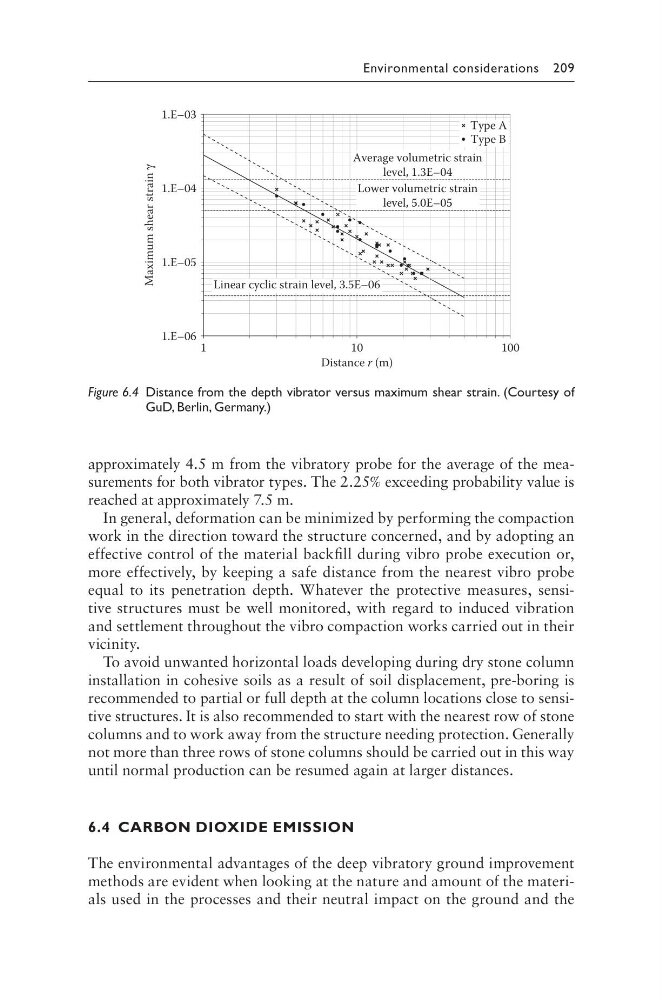
approximately 4.5 m from the vibratory probe for the average of the measurements for both vibrator types. The 2.25% exceeding probability value is
reached at approximately 7.5 m.
In general, deformation can be minimized by performing the compaction
work in the direction toward the structure concerned, and by adopting an
effective control of the material backfill during vibro probe execution or,
more effectively, by keeping a safe distance from the nearest vibro probe
equal to its penetration depth. Whatever the protective measures, sensitive structures must be well monitored, with regard to induced vibration
and settlement throughout the vibro compaction works carried out in their
vicinity.
To avoid unwanted horizontal loads developing during dry stone column
installation in cohesive soils as a result of soil displacement, pre-boring is
recommended to partial or full depth at the column locations close to sensitive structures. It is also recommended to start with the nearest row of stone
columns and to work away from the structure needing protection. Generally
not more than three rows of stone columns should be carried out in this way
until normal production can be resumed again at larger distances.
6.4 CARBON DIOXIDE EMISSION
The environmental advantages of the deep vibratory ground improvement
methods are evident when looking at the nature and amount of the materials used in the processes and their neutral impact on the ground and the
Linear cyclic strain level, 3.5E–06
Lower volumetric strain
level, 5.0E–05
Average volumetric strain
level, 1.3E–04
1.E–06
1.E–05
1.E–04
1.E–03
10
100
1
Maximum shear strain γ
Distance r (m)
Type A
Type B
Figure 6.4 Distance from the depth vibrator versus maximum shear strain. (Courtesy of
GuD, Berlin, Germany.)
approximately 4.5 m from the vibratory probe for the average of the measurements for both vibrator types. The 2.25% exceeding probability value is
reached at approximately 7.5 m.
In general, deformation can be minimized by performing the compaction
work in the direction toward the structure concerned, and by adopting an
effective control of the material backfill during vibro probe execution or,
more effectively, by keeping a safe distance from the nearest vibro probe
equal to its penetration depth. Whatever the protective measures, sensitive structures must be well monitored, with regard to induced vibration
and settlement throughout the vibro compaction works carried out in their
vicinity.
To avoid unwanted horizontal loads developing during dry stone column
installation in cohesive soils as a result of soil displacement, pre-boring is
recommended to partial or full depth at the column locations close to sensitive structures. It is also recommended to start with the nearest row of stone
columns and to work away from the structure needing protection. Generally
not more than three rows of stone columns should be carried out in this way
until normal production can be resumed again at larger distances.
6.4 CARBON DIOXIDE EMISSION
The environmental advantages of the deep vibratory ground improvement
methods are evident when looking at the nature and amount of the materials used in the processes and their neutral impact on the ground and the
Linear cyclic strain level, 3.5E–06
Lower volumetric strain
level, 5.0E–05
Average volumetric strain
level, 1.3E–04
1.E–06
1.E–05
1.E–04
1.E–03
10
100
1
Maximum shear strain γ
Distance r (m)
Type A
Type B
Figure 6.4 Distance from the depth vibrator versus maximum shear strain. (Courtesy of
GuD, Berlin, Germany.)