

Environmental considerations 203
into the neighborhood may become necessary and will help increasing
acceptability of a valued foundation engineering solution (O’Hara and
Davison, 2004).
6.3 VIBRATION NUISANCE AND POTENTIAL
DAMAGES TO ADJACENT STRUCTURES
Vibration nuisance is generally measured by the peak particle velocity
(PPV) of the shear waves emanating from the depth vibrator where potential damage to structures in the vicinity of the compaction works is concerned. Such structures can be normal buildings at ground surface but also
infrastructure facilities below ground. As we saw in Section 3.2.1 these
vibrations may also have a direct influence on the density of granular,
noncohesive soils depending on the generated ground acceleration, which
can cause settlement and subsequent damage to the structure. Loose sands
below groundwater are particularly sensitive to this effect if a critical acceleration of 0.3–0.5 g is exceeded.
For a steady-state vibration with a frequency f, PPV and peak particle acceleration (PPA) are connected with each other by the following
expression:
PPA
f PPV
=
⋅ ⋅
2π
(6.2)
Different national codes and regulations, such as the German DIN 4150-3
and the Swiss SN 640312a, provide maximum horizontal or resultant PPV
values, respectively, for different types of structures (Tables 6.1 and 6.2).
Distance from source (m)
Jet engine
Safe
Critical
Harmful
Propeller aircraft
Rock drill
Heavy truck
Very busy traffic
Ordinary
conversation
Sound pressure level (dB[A])
50
130
100
10
1
120
110
100
90
80
70
60
140
Vibro
Dynamic compaction
Driven piling
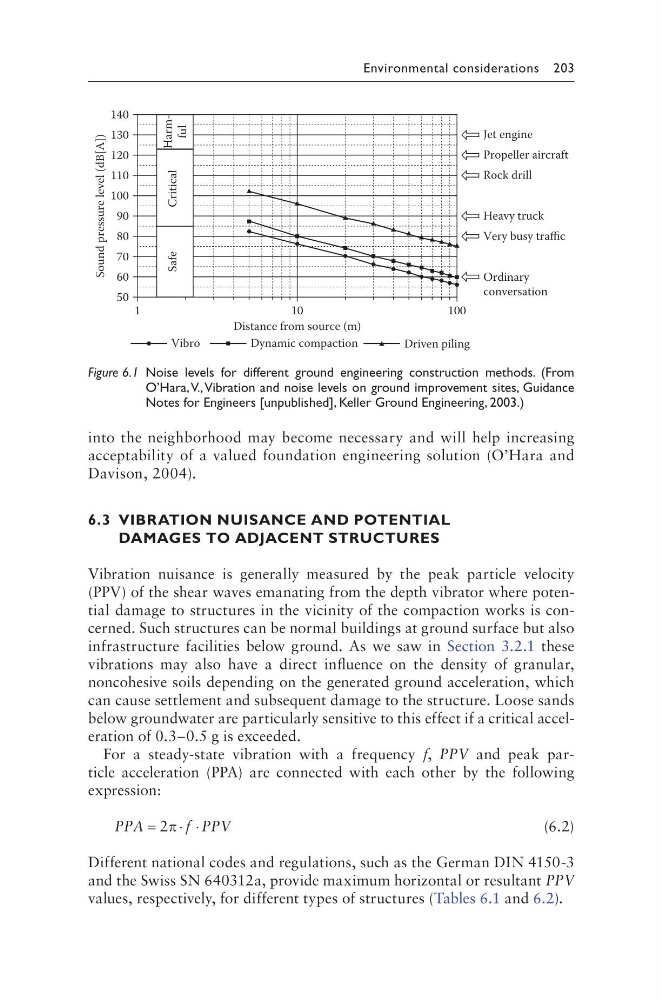
Figure 6.1 Noise levels for different ground engineering construction methods. (From
O’Hara, V., Vibration and noise levels on ground improvement sites, Guidance
Notes for Engineers [unpublished], Keller Ground Engineering, 2003.)
into the neighborhood may become necessary and will help increasing
acceptability of a valued foundation engineering solution (O’Hara and
Davison, 2004).
6.3 VIBRATION NUISANCE AND POTENTIAL
DAMAGES TO ADJACENT STRUCTURES
Vibration nuisance is generally measured by the peak particle velocity
(PPV) of the shear waves emanating from the depth vibrator where potential damage to structures in the vicinity of the compaction works is concerned. Such structures can be normal buildings at ground surface but also
infrastructure facilities below ground. As we saw in Section 3.2.1 these
vibrations may also have a direct influence on the density of granular,
noncohesive soils depending on the generated ground acceleration, which
can cause settlement and subsequent damage to the structure. Loose sands
below groundwater are particularly sensitive to this effect if a critical acceleration of 0.3–0.5 g is exceeded.
For a steady-state vibration with a frequency f, PPV and peak particle acceleration (PPA) are connected with each other by the following
expression:
PPA
f PPV
=
⋅ ⋅
2π
(6.2)
Different national codes and regulations, such as the German DIN 4150-3
and the Swiss SN 640312a, provide maximum horizontal or resultant PPV
values, respectively, for different types of structures (Tables 6.1 and 6.2).
Distance from source (m)
Jet engine
Safe
Critical
Harmful
Propeller aircraft
Rock drill
Heavy truck
Very busy traffic
Ordinary
conversation
Sound pressure level (dB[A])
50
130
100
10
1
120
110
100
90
80
70
60
140
Vibro
Dynamic compaction
Driven piling
Figure 6.1 Noise levels for different ground engineering construction methods. (From
O’Hara, V., Vibration and noise levels on ground improvement sites, Guidance
Notes for Engineers [unpublished], Keller Ground Engineering, 2003.)