

202 Ground improvement by deep vibratory methods
6.2 NOISE EMISSION
Most countries have issued national laws or regulations for noise emission
of construction sites to protect residents living in the vicinity—for example,
in the UK BS 5228, and in Germany DIN EN ISO 3744. These regulations generally contain permitted values of noise levels for different types
of neighborhood: commercial and industrial areas, housing areas, and
hospitals and nursing homes. Allowable sound levels are generally specified
in dB(A) and are based on the well-established fact that human mental and
physical well being is negatively influenced if continuous sound levels are in
excess of (Maurer, 2008b):
• 50–55 dB(A) outside buildings during the day
• 35–45 dB(A) outside buildings by night
• 30–35 dB(A) inside buildings during the day
• 25–30 dB(A) inside buildings by night
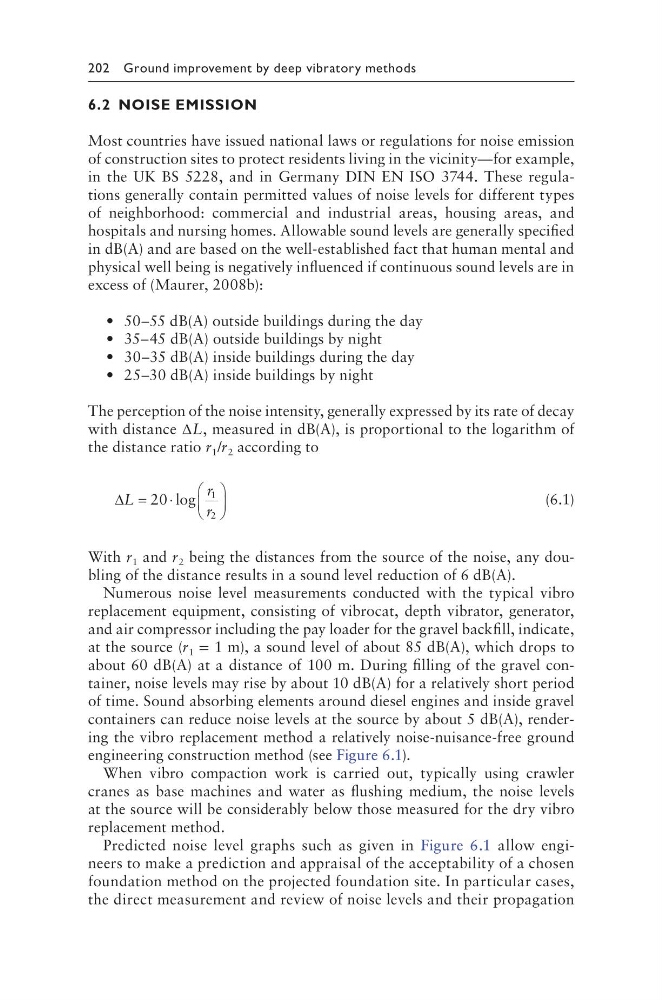
The perception of the noise intensity, generally expressed by its rate of decay
with distance ∆L, measured in dB(A), is proportional to the logarithm of
the distance ratio r 1 /r 2 according to
∆ =
⋅
L
r
r
20
1
2
log
(6.1)
With r 1 and r 2 being the distances from the source of the noise, any doubling of the distance results in a sound level reduction of 6 dB(A).
Numerous noise level measurements conducted with the typical vibro
replacement equipment, consisting of vibrocat, depth vibrator, generator,
and air compressor including the pay loader for the gravel backfill, indicate,
at the source (r 1 = 1 m), a sound level of about 85 dB(A), which drops to
about 60 dB(A) at a distance of 100 m. During filling of the gravel container, noise levels may rise by about 10 dB(A) for a relatively short period
of time. Sound absorbing elements around diesel engines and inside gravel
containers can reduce noise levels at the source by about 5 dB(A), rendering the vibro replacement method a relatively noise-nuisance-free ground
engineering construction method (see Figure 6.1).
When vibro compaction work is carried out, typically using crawler
cranes as base machines and water as flushing medium, the noise levels
at the source will be considerably below those measured for the dry vibro
replacement method.
Predicted noise level graphs such as given in Figure 6.1 allow engineers to make a prediction and appraisal of the acceptability of a chosen
foundation method on the projected foundation site. In particular cases,
the direct measurement and review of noise levels and their propagation
6.2 NOISE EMISSION
Most countries have issued national laws or regulations for noise emission
of construction sites to protect residents living in the vicinity—for example,
in the UK BS 5228, and in Germany DIN EN ISO 3744. These regulations generally contain permitted values of noise levels for different types
of neighborhood: commercial and industrial areas, housing areas, and
hospitals and nursing homes. Allowable sound levels are generally specified
in dB(A) and are based on the well-established fact that human mental and
physical well being is negatively influenced if continuous sound levels are in
excess of (Maurer, 2008b):
• 50–55 dB(A) outside buildings during the day
• 35–45 dB(A) outside buildings by night
• 30–35 dB(A) inside buildings during the day
• 25–30 dB(A) inside buildings by night
The perception of the noise intensity, generally expressed by its rate of decay
with distance ∆L, measured in dB(A), is proportional to the logarithm of
the distance ratio r 1 /r 2 according to
∆ =
⋅
L
r
r
20
1
2
log
(6.1)
With r 1 and r 2 being the distances from the source of the noise, any doubling of the distance results in a sound level reduction of 6 dB(A).
Numerous noise level measurements conducted with the typical vibro
replacement equipment, consisting of vibrocat, depth vibrator, generator,
and air compressor including the pay loader for the gravel backfill, indicate,
at the source (r 1 = 1 m), a sound level of about 85 dB(A), which drops to
about 60 dB(A) at a distance of 100 m. During filling of the gravel container, noise levels may rise by about 10 dB(A) for a relatively short period
of time. Sound absorbing elements around diesel engines and inside gravel
containers can reduce noise levels at the source by about 5 dB(A), rendering the vibro replacement method a relatively noise-nuisance-free ground
engineering construction method (see Figure 6.1).
When vibro compaction work is carried out, typically using crawler
cranes as base machines and water as flushing medium, the noise levels
at the source will be considerably below those measured for the dry vibro
replacement method.
Predicted noise level graphs such as given in Figure 6.1 allow engineers to make a prediction and appraisal of the acceptability of a chosen
foundation method on the projected foundation site. In particular cases,
the direct measurement and review of noise levels and their propagation