

Improvement of fine-grained and cohesive soils 183
restrict our considerations on estimating the safety factor against liquefaction of the sand and silt material between the large diameter bored piles
during an earthquake event which would cause intolerable horizontal loads
on the piles where no ground improvement would be performed.
We have seen in Sections 3.3.3 and 4.3.4 that soils losing strength during an earthquake as a result of the pore water pressure increase can be
strengthened by stone columns, which provide efficient and short drainage
passes for quick pore water pressure relief. We have also seen that vibro
stone columns will
• Shorten the drainage path
• Increase the soil strength
• Increase the density of granular soils by the vibratory forces
The design was structured in seven steps:
1. Determination of the geotechnical design profile. Necessary information required is
• SPT values (N)
• Shear wave velocity or dynamic shear modulus (G dyn )
• Unit weight (γ,γ′)
• Horizontal permeability (k h )
• Coefficient of compressibility (m v )
• Design water table
• Strength parameters (ϕ,c)
• Relative density (D r )
Variable
8 m
10 m
12 m
Fill
Sand
Silty sand
Silt and clay
Basalt
Footing
Working platform for piles
Working platform for vibro
stone columns
Stone column
Bored pile
2.5 m
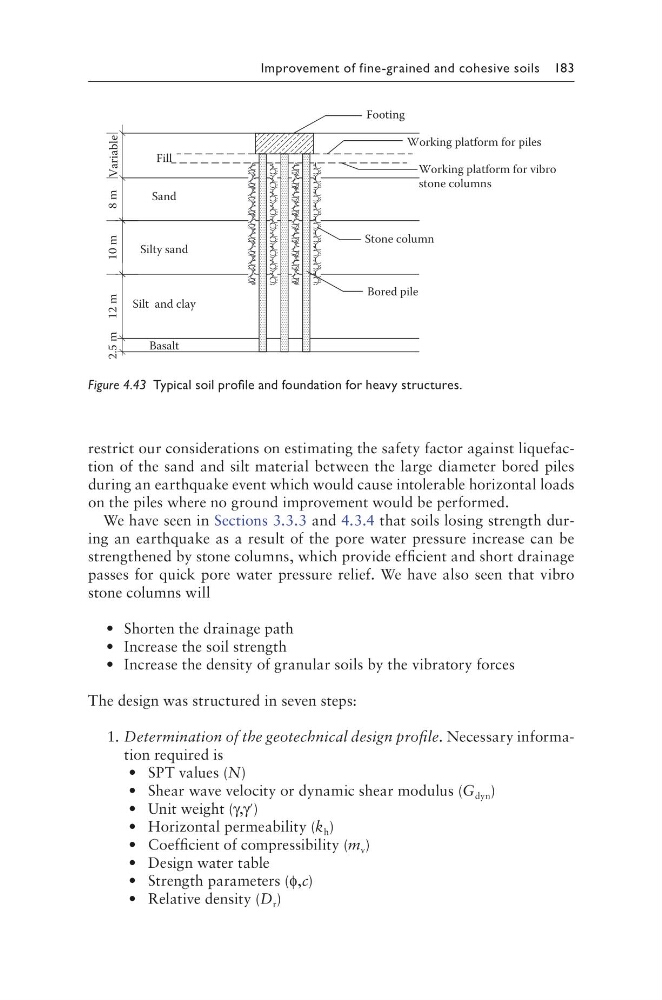
Figure 4.43 Typical soil profile and foundation for heavy structures.
restrict our considerations on estimating the safety factor against liquefaction of the sand and silt material between the large diameter bored piles
during an earthquake event which would cause intolerable horizontal loads
on the piles where no ground improvement would be performed.
We have seen in Sections 3.3.3 and 4.3.4 that soils losing strength during an earthquake as a result of the pore water pressure increase can be
strengthened by stone columns, which provide efficient and short drainage
passes for quick pore water pressure relief. We have also seen that vibro
stone columns will
• Shorten the drainage path
• Increase the soil strength
• Increase the density of granular soils by the vibratory forces
The design was structured in seven steps:
1. Determination of the geotechnical design profile. Necessary information required is
• SPT values (N)
• Shear wave velocity or dynamic shear modulus (G dyn )
• Unit weight (γ,γ′)
• Horizontal permeability (k h )
• Coefficient of compressibility (m v )
• Design water table
• Strength parameters (ϕ,c)
• Relative density (D r )
Variable
8 m
10 m
12 m
Fill
Sand
Silty sand
Silt and clay
Basalt
Footing
Working platform for piles
Working platform for vibro
stone columns
Stone column
Bored pile
2.5 m
Figure 4.43 Typical soil profile and foundation for heavy structures.