

158 Ground improvement by deep vibratory methods
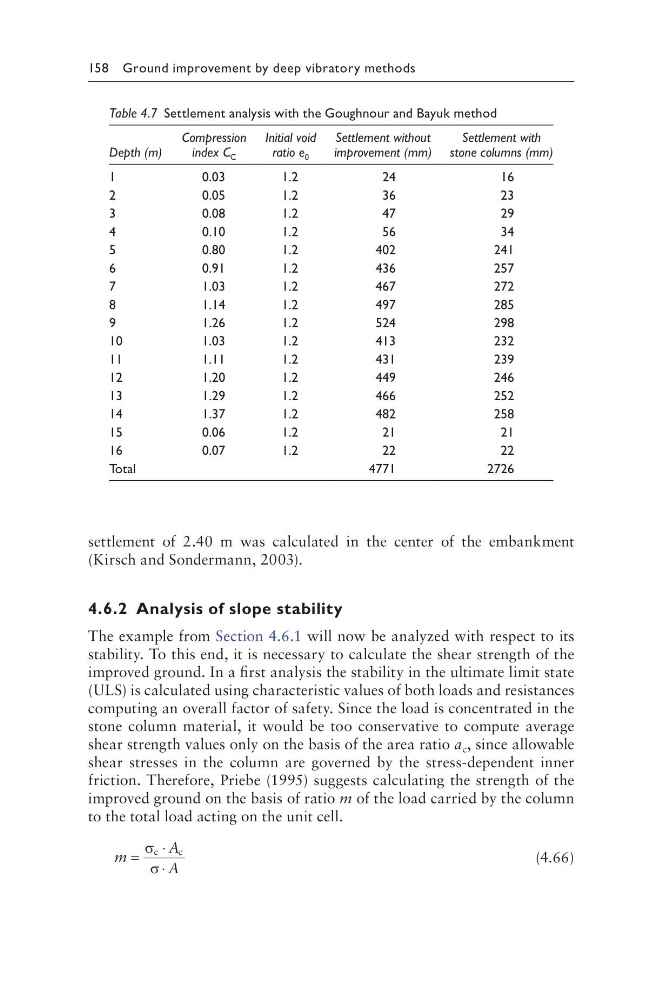
settlement of 2.40 m was calculated in the center of the embankment
(Kirsch and Sondermann, 2003).
4.6.2 Analysis of slope stability
The example from Section 4.6.1 will now be analyzed with respect to its
stability. To this end, it is necessary to calculate the shear strength of the
improved ground. In a first analysis the stability in the ultimate limit state
(ULS) is calculated using characteristic values of both loads and resistances
computing an overall factor of safety. Since the load is concentrated in the
stone column material, it would be too conservative to compute average
shear strength values only on the basis of the area ratio a c , since allowable
shear stresses in the column are governed by the stress-dependent inner
friction. Therefore, Priebe (1995) suggests calculating the strength of the
improved ground on the basis of ratio m of the load carried by the column
to the total load acting on the unit cell.
m
A
A
=
⋅
⋅
σ
σ
c
c
(4.66)
Table 4.7 Settlement analysis with the Goughnour and Bayuk method
Depth (m)
Compression
index C C
Initial void
ratio e 0
Settlement without
improvement (mm)
Settlement with
stone columns (mm)
1
0.03
1.2
24
16
2
0.05
1.2
36
23
3
0.08
1.2
47
29
4
0.10
1.2
56
34
5
0.80
1.2
402
241
6
0.91
1.2
436
257
7
1.03
1.2
467
272
8
1.14
1.2
497
285
9
1.26
1.2
524
298
10
1.03
1.2
413
232
11
1.11
1.2
431
239
12
1.20
1.2
449
246
13
1.29
1.2
466
252
14
1.37
1.2
482
258
15
0.06
1.2
21
21
16
0.07
1.2
22
22
Total
4771
2726
settlement of 2.40 m was calculated in the center of the embankment
(Kirsch and Sondermann, 2003).
4.6.2 Analysis of slope stability
The example from Section 4.6.1 will now be analyzed with respect to its
stability. To this end, it is necessary to calculate the shear strength of the
improved ground. In a first analysis the stability in the ultimate limit state
(ULS) is calculated using characteristic values of both loads and resistances
computing an overall factor of safety. Since the load is concentrated in the
stone column material, it would be too conservative to compute average
shear strength values only on the basis of the area ratio a c , since allowable
shear stresses in the column are governed by the stress-dependent inner
friction. Therefore, Priebe (1995) suggests calculating the strength of the
improved ground on the basis of ratio m of the load carried by the column
to the total load acting on the unit cell.
m
A
A
=
⋅
⋅
σ
σ
c
c
(4.66)
Table 4.7 Settlement analysis with the Goughnour and Bayuk method
Depth (m)
Compression
index C C
Initial void
ratio e 0
Settlement without
improvement (mm)
Settlement with
stone columns (mm)
1
0.03
1.2
24
16
2
0.05
1.2
36
23
3
0.08
1.2
47
29
4
0.10
1.2
56
34
5
0.80
1.2
402
241
6
0.91
1.2
436
257
7
1.03
1.2
467
272
8
1.14
1.2
497
285
9
1.26
1.2
524
298
10
1.03
1.2
413
232
11
1.11
1.2
431
239
12
1.20
1.2
449
246
13
1.29
1.2
466
252
14
1.37
1.2
482
258
15
0.06
1.2
21
21
16
0.07
1.2
22
22
Total
4771
2726