

Improvement of fine-grained and cohesive soils 157
A second analysis shows the application of the method after Goughnour
and Bayuk (1979b). It follows the flowchart as shown in Figure 4.15.
As mentioned there, the algorithm consists of an iterative approach, which
is best solved by using a computer routine.
The analytical procedure of Goughnour and Bayuk requires the definition of the initial void ratio e 0 and the compression index C C . In order to
ensure comparability with the above analysis, e 0 and C C were chosen to fit
the constrained modulus E oed as shown in Table 4.4 in terms of settlements
of the unimproved ground. Therefore the compression index was calculated
from an assumed initial porosity e 0 = 1.2 by
C
e
E
C
v,0
n
= +
(
) ( )
1
1 0
0 l
σ
(4.65)
with the Young’s modulus E and the initial vertical stress σ v,0 . All other
parameters and the geometry were kept identical.
The Goughnour and Bayuk method calculates total settlements of the
improved ground to be approximately 2.70 m (see Table 4.7) which is about
140% of the settlements calculated with the Priebe method. With a fully
three-dimensional finite element analysis of the situation, a maximum
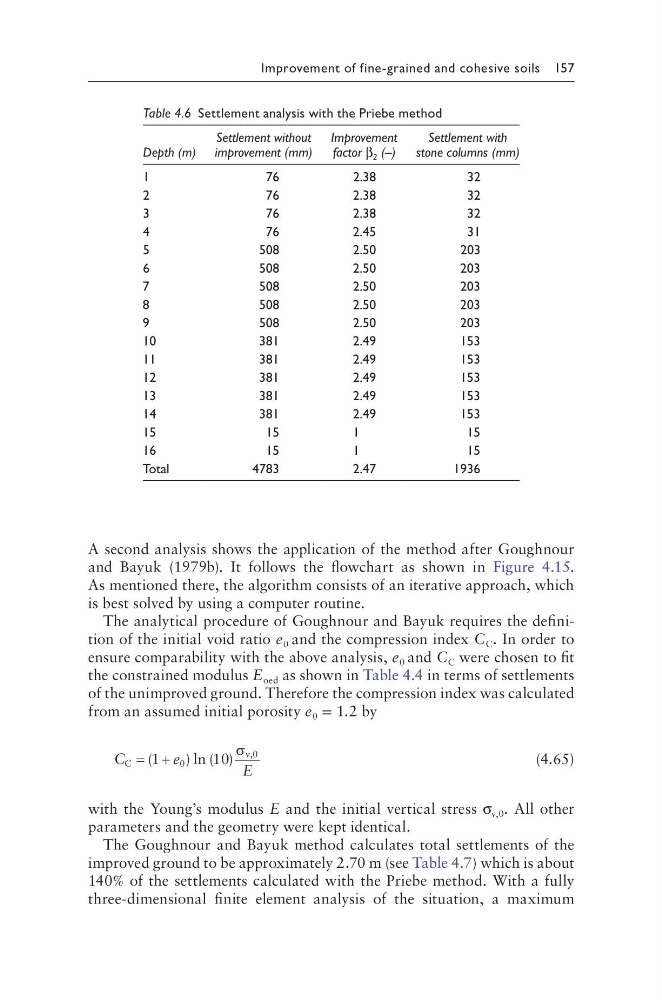
Table 4.6 Settlement analysis with the Priebe method
Depth (m)
Settlement without
improvement (mm)
Improvement
factor β 2 (–)
Settlement with
stone columns (mm)
1
76
2.38
32
2
76
2.38
32
3
76
2.38
32
4
76
2.45
31
5
508
2.50
203
6
508
2.50
203
7
508
2.50
203
8
508
2.50
203
9
508
2.50
203
10
381
2.49
153
11
381
2.49
153
12
381
2.49
153
13
381
2.49
153
14
381
2.49
153
15
15
1
15
16
15
1
15
Total
4783
2.47
1936
A second analysis shows the application of the method after Goughnour
and Bayuk (1979b). It follows the flowchart as shown in Figure 4.15.
As mentioned there, the algorithm consists of an iterative approach, which
is best solved by using a computer routine.
The analytical procedure of Goughnour and Bayuk requires the definition of the initial void ratio e 0 and the compression index C C . In order to
ensure comparability with the above analysis, e 0 and C C were chosen to fit
the constrained modulus E oed as shown in Table 4.4 in terms of settlements
of the unimproved ground. Therefore the compression index was calculated
from an assumed initial porosity e 0 = 1.2 by
C
e
E
C
v,0
n
= +
(
) ( )
1
1 0
0 l
σ
(4.65)
with the Young’s modulus E and the initial vertical stress σ v,0 . All other
parameters and the geometry were kept identical.
The Goughnour and Bayuk method calculates total settlements of the
improved ground to be approximately 2.70 m (see Table 4.7) which is about
140% of the settlements calculated with the Priebe method. With a fully
three-dimensional finite element analysis of the situation, a maximum
Table 4.6 Settlement analysis with the Priebe method
Depth (m)
Settlement without
improvement (mm)
Improvement
factor β 2 (–)
Settlement with
stone columns (mm)
1
76
2.38
32
2
76
2.38
32
3
76
2.38
32
4
76
2.45
31
5
508
2.50
203
6
508
2.50
203
7
508
2.50
203
8
508
2.50
203
9
508
2.50
203
10
381
2.49
153
11
381
2.49
153
12
381
2.49
153
13
381
2.49
153
14
381
2.49
153
15
15
1
15
16
15
1
15
Total
4783
2.47
1936