

Improvement of fine-grained and cohesive soils 127
settlement contributions from layers of differing depths, properties, and
stresses. This settlement s without soil improvement is then divided by the
improvement factor β as taken from Figure 4.14 for the respective replacement ratio a c and the column friction angle φ c . The settlement with soil
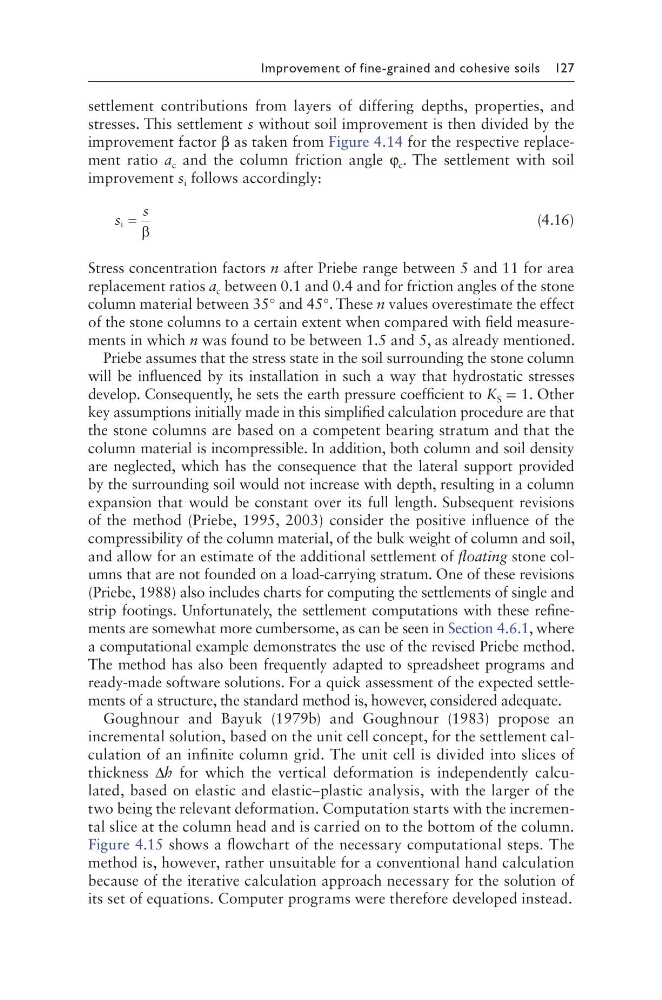
improvement s i follows accordingly:
s
s
i = β
(4.16)
Stress concentration factors n after Priebe range between 5 and 11 for area
replacement ratios a c between 0.1 and 0.4 and for friction angles of the stone
column material between 35° and 45°. These n values overestimate the effect
of the stone columns to a certain extent when compared with field measurements in which n was found to be between 1.5 and 5, as already mentioned.
Priebe assumes that the stress state in the soil surrounding the stone column
will be influenced by its installation in such a way that hydrostatic stresses
develop. Consequently, he sets the earth pressure coefficient to K S = 1. Other
key assumptions initially made in this simplified calculation procedure are that
the stone columns are based on a competent bearing stratum and that the
column material is incompressible. In addition, both column and soil density
are neglected, which has the consequence that the lateral support provided
by the surrounding soil would not increase with depth, resulting in a column
expansion that would be constant over its full length. Subsequent revisions
of the method (Priebe, 1995, 2003) consider the positive influence of the
compressibility of the column material, of the bulk weight of column and soil,
and allow for an estimate of the additional settlement of floating stone columns that are not founded on a load-carrying stratum. One of these revisions
(Priebe, 1988) also includes charts for computing the settlements of single and
strip footings. Unfortunately, the settlement computations with these refinements are somewhat more cumbersome, as can be seen in Section 4.6.1, where
a computational example demonstrates the use of the revised Priebe method.
The method has also been frequently adapted to spreadsheet programs and
ready-made software solutions. For a quick assessment of the expected settlements of a structure, the standard method is, however, considered adequate.
Goughnour and Bayuk (1979b) and Goughnour (1983) propose an
incremental solution, based on the unit cell concept, for the settlement calculation of an infinite column grid. The unit cell is divided into slices of
thickness Δh for which the vertical deformation is independently calculated, based on elastic and elastic–plastic analysis, with the larger of the
two being the relevant deformation. Computation starts with the incremental slice at the column head and is carried on to the bottom of the column.
Figure 4.15 shows a flowchart of the necessary computational steps. The
method is, however, rather unsuitable for a conventional hand calculation
because of the iterative calculation approach necessary for the solution of
its set of equations. Computer programs were therefore developed instead.
settlement contributions from layers of differing depths, properties, and
stresses. This settlement s without soil improvement is then divided by the
improvement factor β as taken from Figure 4.14 for the respective replacement ratio a c and the column friction angle φ c . The settlement with soil
improvement s i follows accordingly:
s
s
i = β
(4.16)
Stress concentration factors n after Priebe range between 5 and 11 for area
replacement ratios a c between 0.1 and 0.4 and for friction angles of the stone
column material between 35° and 45°. These n values overestimate the effect
of the stone columns to a certain extent when compared with field measurements in which n was found to be between 1.5 and 5, as already mentioned.
Priebe assumes that the stress state in the soil surrounding the stone column
will be influenced by its installation in such a way that hydrostatic stresses
develop. Consequently, he sets the earth pressure coefficient to K S = 1. Other
key assumptions initially made in this simplified calculation procedure are that
the stone columns are based on a competent bearing stratum and that the
column material is incompressible. In addition, both column and soil density
are neglected, which has the consequence that the lateral support provided
by the surrounding soil would not increase with depth, resulting in a column
expansion that would be constant over its full length. Subsequent revisions
of the method (Priebe, 1995, 2003) consider the positive influence of the
compressibility of the column material, of the bulk weight of column and soil,
and allow for an estimate of the additional settlement of floating stone columns that are not founded on a load-carrying stratum. One of these revisions
(Priebe, 1988) also includes charts for computing the settlements of single and
strip footings. Unfortunately, the settlement computations with these refinements are somewhat more cumbersome, as can be seen in Section 4.6.1, where
a computational example demonstrates the use of the revised Priebe method.
The method has also been frequently adapted to spreadsheet programs and
ready-made software solutions. For a quick assessment of the expected settlements of a structure, the standard method is, however, considered adequate.
Goughnour and Bayuk (1979b) and Goughnour (1983) propose an
incremental solution, based on the unit cell concept, for the settlement calculation of an infinite column grid. The unit cell is divided into slices of
thickness Δh for which the vertical deformation is independently calculated, based on elastic and elastic–plastic analysis, with the larger of the
two being the relevant deformation. Computation starts with the incremental slice at the column head and is carried on to the bottom of the column.
Figure 4.15 shows a flowchart of the necessary computational steps. The
method is, however, rather unsuitable for a conventional hand calculation
because of the iterative calculation approach necessary for the solution of
its set of equations. Computer programs were therefore developed instead.