

100 Ground improvement by deep vibratory methods
with SPT sampling and laboratory gradation test results. However, the
clay content in sands has more impact on their densification and liquefaction behavior than the mere percentage of fines passing the 200# sieve
(0.07 mm). Although less expressive, Figure 3.49b indicates that sands with
a soil fines content interpolated from CPT in excess of 30% do not respond
anymore to vibratory compaction.
3.6.6 Trial compaction in quartz sand to establish
compaction probe spacing
The foundation of a multistory office building in Berlin required densification of the underlying subsoil existing of loose medium silicate sand (SW)
of glacial origin with a percentage of fines below 5%. Considerations concerning the allowable settlement of the building required a stratum of about
6.0 m thickness below the structure to have an average relative density of
D r = 75%, corresponding to the existing circumstances with a static CPT
resistance value of 20 MN/m 2 . CPT values of the natural ground before any
compaction were generally below 12 MN/m 2 .
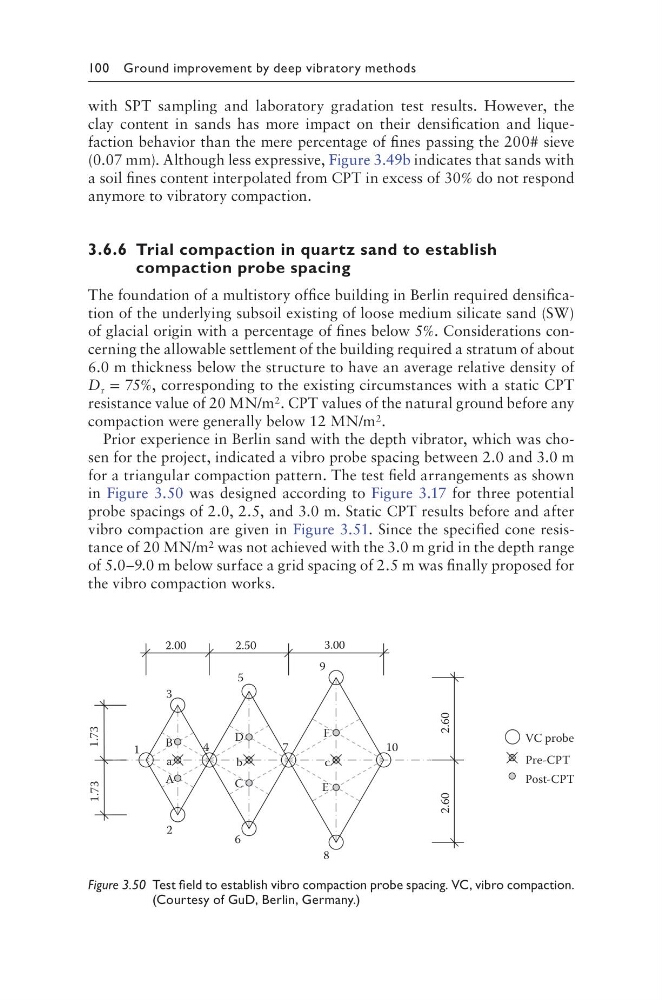
Prior experience in Berlin sand with the depth vibrator, which was chosen for the project, indicated a vibro probe spacing between 2.0 and 3.0 m
for a triangular compaction pattern. The test field arrangements as shown
in Figure 3.50 was designed according to Figure 3.17 for three potential
probe spacings of 2.0, 2.5, and 3.0 m. Static CPT results before and after
vibro compaction are given in Figure 3.51. Since the specified cone resistance of 20 MN/m 2 was not achieved with the 3.0 m grid in the depth range
of 5.0–9.0 m below surface a grid spacing of 2.5 m was finally proposed for
the vibro compaction works.
E
F
5
2.50
2.00
1.73
2.60
2.60
1.73
3.00
9
3
1
B
a
A
2
b
D
C
c
10
7
4
8
Post-CPT
Pre-CPT
VC probe
6
Figure 3.50 Test field to establish vibro compaction probe spacing. VC, vibro compaction.
(Courtesy of GuD, Berlin, Germany.)
with SPT sampling and laboratory gradation test results. However, the
clay content in sands has more impact on their densification and liquefaction behavior than the mere percentage of fines passing the 200# sieve
(0.07 mm). Although less expressive, Figure 3.49b indicates that sands with
a soil fines content interpolated from CPT in excess of 30% do not respond
anymore to vibratory compaction.
3.6.6 Trial compaction in quartz sand to establish
compaction probe spacing
The foundation of a multistory office building in Berlin required densification of the underlying subsoil existing of loose medium silicate sand (SW)
of glacial origin with a percentage of fines below 5%. Considerations concerning the allowable settlement of the building required a stratum of about
6.0 m thickness below the structure to have an average relative density of
D r = 75%, corresponding to the existing circumstances with a static CPT
resistance value of 20 MN/m 2 . CPT values of the natural ground before any
compaction were generally below 12 MN/m 2 .
Prior experience in Berlin sand with the depth vibrator, which was chosen for the project, indicated a vibro probe spacing between 2.0 and 3.0 m
for a triangular compaction pattern. The test field arrangements as shown
in Figure 3.50 was designed according to Figure 3.17 for three potential
probe spacings of 2.0, 2.5, and 3.0 m. Static CPT results before and after
vibro compaction are given in Figure 3.51. Since the specified cone resistance of 20 MN/m 2 was not achieved with the 3.0 m grid in the depth range
of 5.0–9.0 m below surface a grid spacing of 2.5 m was finally proposed for
the vibro compaction works.
E
F
5
2.50
2.00
1.73
2.60
2.60
1.73
3.00
9
3
1
B
a
A
2
b
D
C
c
10
7
4
8
Post-CPT
Pre-CPT
VC probe
6
Figure 3.50 Test field to establish vibro compaction probe spacing. VC, vibro compaction.
(Courtesy of GuD, Berlin, Germany.)