

Vibro compaction of granular soils 87
below quay walls or inside and outside coffer dams is a typical requirement
that can best be achieved by this method (Figure 3.38).
The quayside unloading and breakwater facilities of the Merak harbor
in West Java, Indonesia, serving the delivery of material for a pulp and
paper manufacturing plant, are shown in Figure 3.39 with a typical cross
section through the quay wall. The fill material is a fine to medium sand
with basically no fines with a D 60 /D 10 = 4. About 50% of its grains are
silica sand, 20% shells and 30% other fragments with an overall specific
gravity of 2.82.
Structural stability and the reduction of the liquefaction potential
required the hydraulic sand fill in the areas shown to be compacted to a
relative density of 70%. In total, some 1.3 million m 3 of sand fill needed
treatment to up to 25 m depth. The layout of the compaction probes was
chosen after a trial compaction before the start of the works as a 3 m
square grid.
Quality control consisted of continuous measurement and recording
of vibrator motor current over depth as a function of real time, together
with postcompaction tests carried out as CPTs, 10 days after completion
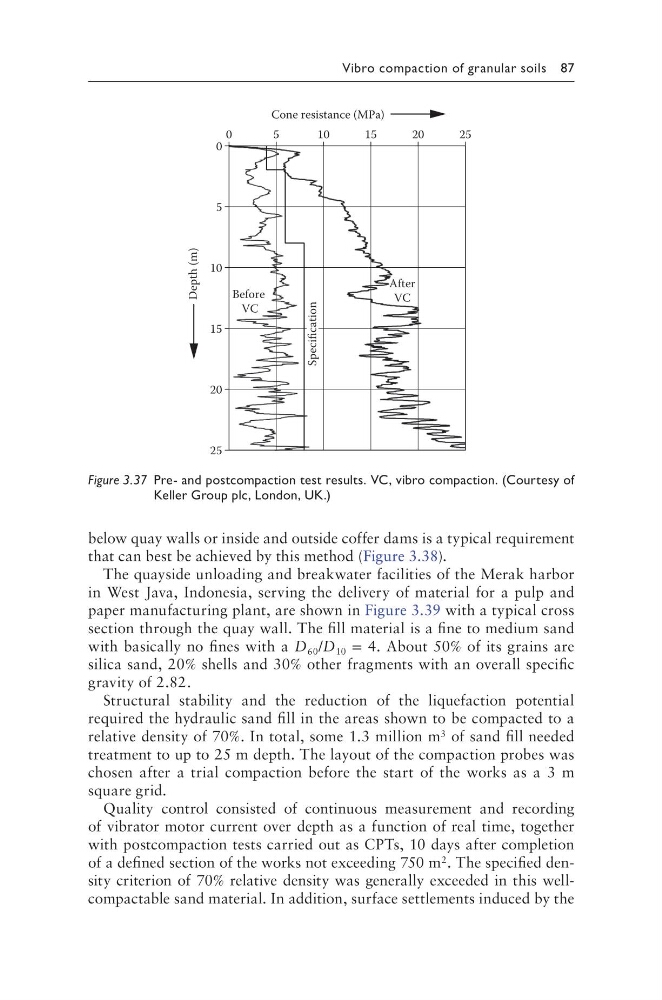
of a defined section of the works not exceeding 750 m 2 . The specified density criterion of 70% relative density was generally exceeded in this wellcompactable sand material. In addition, surface settlements induced by the
20
15
10
5
0
0
5
10
15
20
25
25
After
VC
Before
VC
Depth (m)
Cone resistance (MPa)
Specification
Figure 3.37 Pre- and postcompaction test results. VC, vibro compaction. (Courtesy of
Keller Group plc, London, UK.)
below quay walls or inside and outside coffer dams is a typical requirement
that can best be achieved by this method (Figure 3.38).
The quayside unloading and breakwater facilities of the Merak harbor
in West Java, Indonesia, serving the delivery of material for a pulp and
paper manufacturing plant, are shown in Figure 3.39 with a typical cross
section through the quay wall. The fill material is a fine to medium sand
with basically no fines with a D 60 /D 10 = 4. About 50% of its grains are
silica sand, 20% shells and 30% other fragments with an overall specific
gravity of 2.82.
Structural stability and the reduction of the liquefaction potential
required the hydraulic sand fill in the areas shown to be compacted to a
relative density of 70%. In total, some 1.3 million m 3 of sand fill needed
treatment to up to 25 m depth. The layout of the compaction probes was
chosen after a trial compaction before the start of the works as a 3 m
square grid.
Quality control consisted of continuous measurement and recording
of vibrator motor current over depth as a function of real time, together
with postcompaction tests carried out as CPTs, 10 days after completion
of a defined section of the works not exceeding 750 m 2 . The specified density criterion of 70% relative density was generally exceeded in this wellcompactable sand material. In addition, surface settlements induced by the
20
15
10
5
0
0
5
10
15
20
25
25
After
VC
Before
VC
Depth (m)
Cone resistance (MPa)
Specification
Figure 3.37 Pre- and postcompaction test results. VC, vibro compaction. (Courtesy of
Keller Group plc, London, UK.)