

497
exert strong influences, and their relevance might vary according to the climate
characteristics of future scenarios. In addition, future climatic scenarios may influence dormancy through maternal effects. Another relevant characteristic of
Nothofagus spp. is their seed-masting habit (Richardson et al. 2005), which represents a concentrated sporadic reproductive effort. Masting/dormancy dynamics may
change in future climatic scenarios.
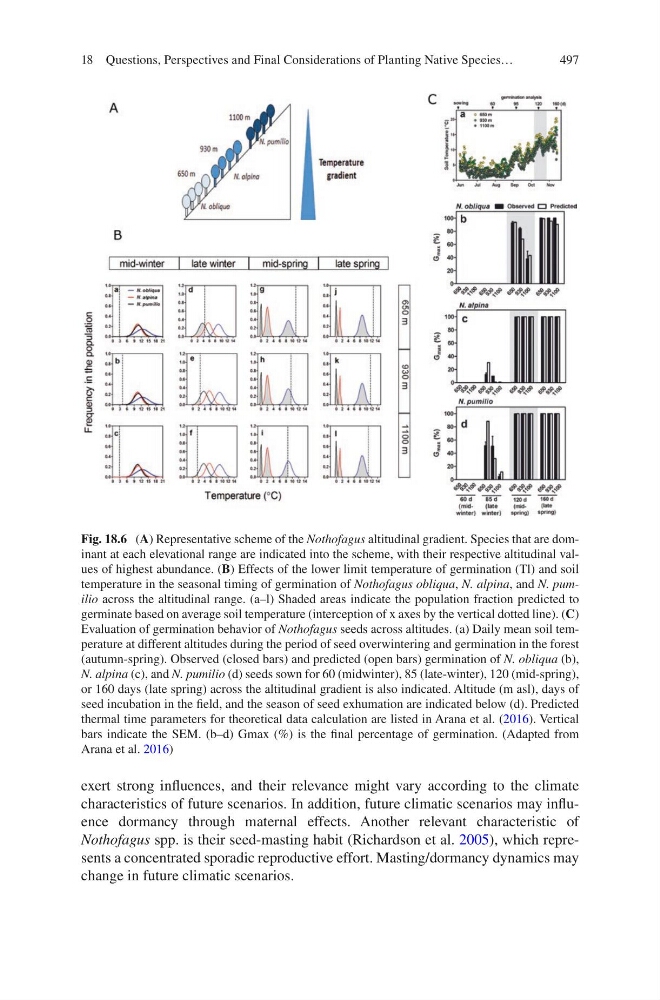
Fig. 18.6 (A) Representative scheme of the Nothofagus altitudinal gradient. Species that are dominant at each elevational range are indicated into the scheme, with their respective altitudinal values of highest abundance. (B) Effects of the lower limit temperature of germination (Tl) and soil
temperature in the seasonal timing of germination of Nothofagus obliqua, N. alpina, and N. pumilio across the altitudinal range. (a–l) Shaded areas indicate the population fraction predicted to
germinate based on average soil temperature (interception of x axes by the vertical dotted line). (C)
Evaluation of germination behavior of Nothofagus seeds across altitudes. (a) Daily mean soil temperature at different altitudes during the period of seed overwintering and germination in the forest
(autumn-spring). Observed (closed bars) and predicted (open bars) germination of N. obliqua (b),
N. alpina (c), and N. pumilio (d) seeds sown for 60 (midwinter), 85 (late-winter), 120 (mid-spring),
or 160 days (late spring) across the altitudinal gradient is also indicated. Altitude (m asl), days of
seed incubation in the field, and the season of seed exhumation are indicated below (d). Predicted
thermal time parameters for theoretical data calculation are listed in Arana et al. (2016). Vertical
bars indicate the SEM. (b–d) Gmax (%) is the final percentage of germination. (Adapted from
Arana et al. 2016)
18 Questions, Perspectives and Final Considerations of Planting Native Species…
exert strong influences, and their relevance might vary according to the climate
characteristics of future scenarios. In addition, future climatic scenarios may influence dormancy through maternal effects. Another relevant characteristic of
Nothofagus spp. is their seed-masting habit (Richardson et al. 2005), which represents a concentrated sporadic reproductive effort. Masting/dormancy dynamics may
change in future climatic scenarios.
Fig. 18.6 (A) Representative scheme of the Nothofagus altitudinal gradient. Species that are dominant at each elevational range are indicated into the scheme, with their respective altitudinal values of highest abundance. (B) Effects of the lower limit temperature of germination (Tl) and soil
temperature in the seasonal timing of germination of Nothofagus obliqua, N. alpina, and N. pumilio across the altitudinal range. (a–l) Shaded areas indicate the population fraction predicted to
germinate based on average soil temperature (interception of x axes by the vertical dotted line). (C)
Evaluation of germination behavior of Nothofagus seeds across altitudes. (a) Daily mean soil temperature at different altitudes during the period of seed overwintering and germination in the forest
(autumn-spring). Observed (closed bars) and predicted (open bars) germination of N. obliqua (b),
N. alpina (c), and N. pumilio (d) seeds sown for 60 (midwinter), 85 (late-winter), 120 (mid-spring),
or 160 days (late spring) across the altitudinal gradient is also indicated. Altitude (m asl), days of
seed incubation in the field, and the season of seed exhumation are indicated below (d). Predicted
thermal time parameters for theoretical data calculation are listed in Arana et al. (2016). Vertical
bars indicate the SEM. (b–d) Gmax (%) is the final percentage of germination. (Adapted from
Arana et al. 2016)
18 Questions, Perspectives and Final Considerations of Planting Native Species…