

444
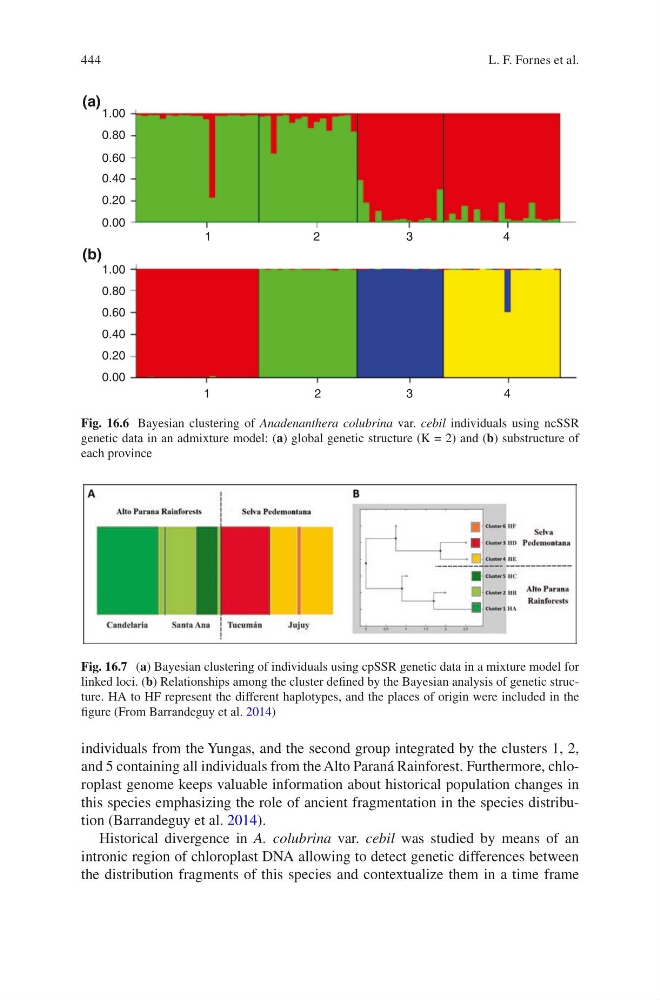
individuals from the Yungas, and the second group integrated by the clusters 1, 2,
and 5 containing all individuals from the Alto Paraná Rainforest. Furthermore, chloroplast genome keeps valuable information about historical population changes in
this species emphasizing the role of ancient fragmentation in the species distribution (Barrandeguy et al. 2014).
Historical divergence in A. colubrina var. cebil was studied by means of an
intronic region of chloroplast DNA allowing to detect genetic differences between
the distribution fragments of this species and contextualize them in a time frame
1.00
0.80
0.60
0.40
0.20
0.00
1
2
3
4
(a)
1.00
0.80
0.60
0.40
0.20
0.00
1
2
3
4
(b)
Fig. 16.6 Bayesian clustering of Anadenanthera colubrina var. cebil individuals using ncSSR
genetic data in an admixture model: (a) global genetic structure (K = 2) and (b) substructure of
each province
Fig. 16.7 (a) Bayesian clustering of individuals using cpSSR genetic data in a mixture model for
linked loci. (b) Relationships among the cluster defined by the Bayesian analysis of genetic structure. HA to HF represent the different haplotypes, and the places of origin were included in the
figure (From Barrandeguy et al. 2014)
L. F. Fornes et al.
individuals from the Yungas, and the second group integrated by the clusters 1, 2,
and 5 containing all individuals from the Alto Paraná Rainforest. Furthermore, chloroplast genome keeps valuable information about historical population changes in
this species emphasizing the role of ancient fragmentation in the species distribution (Barrandeguy et al. 2014).
Historical divergence in A. colubrina var. cebil was studied by means of an
intronic region of chloroplast DNA allowing to detect genetic differences between
the distribution fragments of this species and contextualize them in a time frame
1.00
0.80
0.60
0.40
0.20
0.00
1
2
3
4
(a)
1.00
0.80
0.60
0.40
0.20
0.00
1
2
3
4
(b)
Fig. 16.6 Bayesian clustering of Anadenanthera colubrina var. cebil individuals using ncSSR
genetic data in an admixture model: (a) global genetic structure (K = 2) and (b) substructure of
each province
Fig. 16.7 (a) Bayesian clustering of individuals using cpSSR genetic data in a mixture model for
linked loci. (b) Relationships among the cluster defined by the Bayesian analysis of genetic structure. HA to HF represent the different haplotypes, and the places of origin were included in the
figure (From Barrandeguy et al. 2014)
L. F. Fornes et al.