

429
Brazil, Paraguay, Bolivia, and Argentina (von Von Reis 1964). In the Yungas
Rainforest it is distributed in the Selva Pedemontana community at the piedmont of
the Andes and extends toward the ecotone with the western Chaco, where it also
appears frequently. In the northernmost boundary of the Yungas, it can be found in
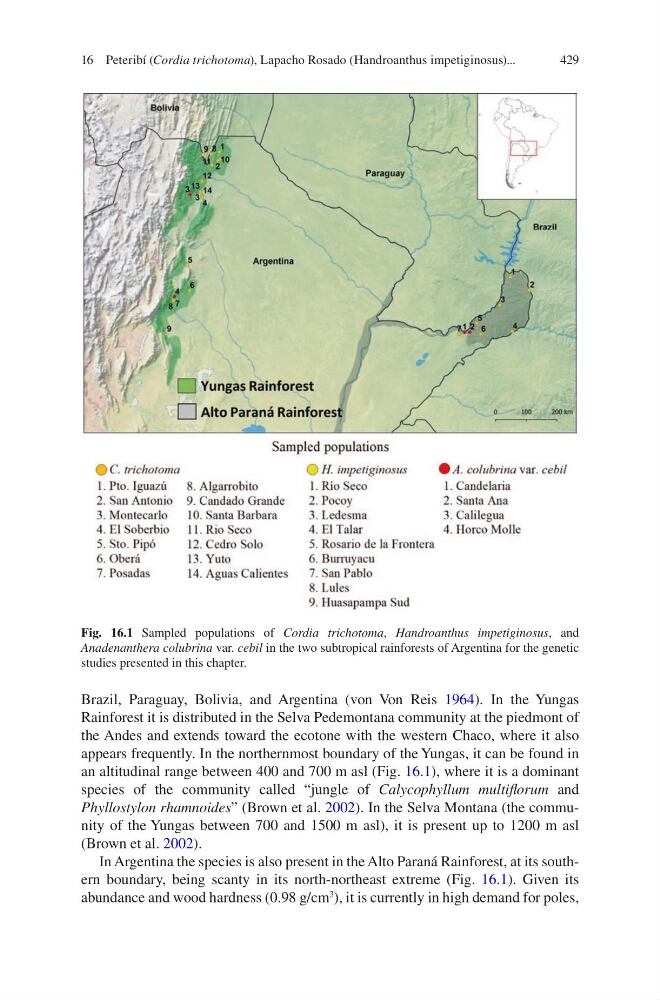
an altitudinal range between 400 and 700 m asl (Fig. 16.1), where it is a dominant
species of the community called “jungle of Calycophyllum multiflorum and
Phyllostylon rhamnoides” (Brown et al. 2002). In the Selva Montana (the community of the Yungas between 700 and 1500 m asl), it is present up to 1200 m asl
(Brown et al. 2002).
In Argentina the species is also present in the Alto Paraná Rainforest, at its southern boundary, being scanty in its north-northeast extreme (Fig. 16.1). Given its
abundance and wood hardness (0.98 g/cm
3
), it is currently in high demand for poles,
Fig. 16.1 Sampled populations of Cordia trichotoma, Handroanthus impetiginosus, and
Anadenanthera colubrina var. cebil in the two subtropical rainforests of Argentina for the genetic
studies presented in this chapter.
16 Peteribí (Cordia trichotoma), Lapacho Rosado (Handroanthus impetiginosus)...
Brazil, Paraguay, Bolivia, and Argentina (von Von Reis 1964). In the Yungas
Rainforest it is distributed in the Selva Pedemontana community at the piedmont of
the Andes and extends toward the ecotone with the western Chaco, where it also
appears frequently. In the northernmost boundary of the Yungas, it can be found in
an altitudinal range between 400 and 700 m asl (Fig. 16.1), where it is a dominant
species of the community called “jungle of Calycophyllum multiflorum and
Phyllostylon rhamnoides” (Brown et al. 2002). In the Selva Montana (the community of the Yungas between 700 and 1500 m asl), it is present up to 1200 m asl
(Brown et al. 2002).
In Argentina the species is also present in the Alto Paraná Rainforest, at its southern boundary, being scanty in its north-northeast extreme (Fig. 16.1). Given its
abundance and wood hardness (0.98 g/cm
3
), it is currently in high demand for poles,
Fig. 16.1 Sampled populations of Cordia trichotoma, Handroanthus impetiginosus, and
Anadenanthera colubrina var. cebil in the two subtropical rainforests of Argentina for the genetic
studies presented in this chapter.
16 Peteribí (Cordia trichotoma), Lapacho Rosado (Handroanthus impetiginosus)...