

417
and natural pruning. A total of 39 stands were screened, and 302 individuals were
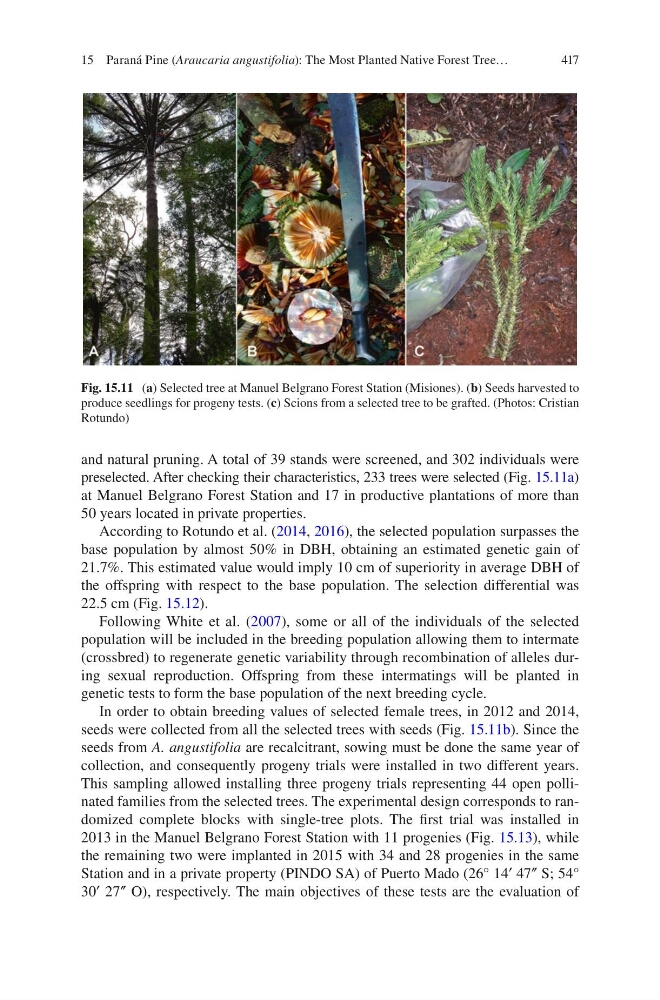
preselected. After checking their characteristics, 233 trees were selected (Fig. 15.11a)
at Manuel Belgrano Forest Station and 17 in productive plantations of more than
50 years located in private properties.
According to Rotundo et al. (2014, 2016), the selected population surpasses the
base population by almost 50% in DBH, obtaining an estimated genetic gain of
21.7%. This estimated value would imply 10 cm of superiority in average DBH of
the offspring with respect to the base population. The selection differential was
22.5 cm (Fig. 15.12).
Following White et al. (2007), some or all of the individuals of the selected
population will be included in the breeding population allowing them to intermate
(crossbred) to regenerate genetic variability through recombination of alleles during sexual reproduction. Offspring from these intermatings will be planted in
genetic tests to form the base population of the next breeding cycle.
In order to obtain breeding values of selected female trees, in 2012 and 2014,
seeds were collected from all the selected trees with seeds (Fig. 15.11b). Since the
seeds from A. angustifolia are recalcitrant, sowing must be done the same year of
collection, and consequently progeny trials were installed in two different years.
This sampling allowed installing three progeny trials representing 44 open pollinated families from the selected trees. The experimental design corresponds to randomized complete blocks with single-tree plots. The first trial was installed in
2013 in the Manuel Belgrano Forest Station with 11 progenies (Fig. 15.13), while
the remaining two were implanted in 2015 with 34 and 28 progenies in the same
Station and in a private property (PINDO SA) of Puerto Mado (26° 14′ 47″ S; 54°
30′ 27″ O), respectively. The main objectives of these tests are the evaluation of
Fig. 15.11 (a) Selected tree at Manuel Belgrano Forest Station (Misiones). (b) Seeds harvested to
produce seedlings for progeny tests. (c) Scions from a selected tree to be grafted. (Photos: Cristian
Rotundo)
15 Paraná Pine (Araucaria angustifolia): The Most Planted Native Forest Tree…
and natural pruning. A total of 39 stands were screened, and 302 individuals were
preselected. After checking their characteristics, 233 trees were selected (Fig. 15.11a)
at Manuel Belgrano Forest Station and 17 in productive plantations of more than
50 years located in private properties.
According to Rotundo et al. (2014, 2016), the selected population surpasses the
base population by almost 50% in DBH, obtaining an estimated genetic gain of
21.7%. This estimated value would imply 10 cm of superiority in average DBH of
the offspring with respect to the base population. The selection differential was
22.5 cm (Fig. 15.12).
Following White et al. (2007), some or all of the individuals of the selected
population will be included in the breeding population allowing them to intermate
(crossbred) to regenerate genetic variability through recombination of alleles during sexual reproduction. Offspring from these intermatings will be planted in
genetic tests to form the base population of the next breeding cycle.
In order to obtain breeding values of selected female trees, in 2012 and 2014,
seeds were collected from all the selected trees with seeds (Fig. 15.11b). Since the
seeds from A. angustifolia are recalcitrant, sowing must be done the same year of
collection, and consequently progeny trials were installed in two different years.
This sampling allowed installing three progeny trials representing 44 open pollinated families from the selected trees. The experimental design corresponds to randomized complete blocks with single-tree plots. The first trial was installed in
2013 in the Manuel Belgrano Forest Station with 11 progenies (Fig. 15.13), while
the remaining two were implanted in 2015 with 34 and 28 progenies in the same
Station and in a private property (PINDO SA) of Puerto Mado (26° 14′ 47″ S; 54°
30′ 27″ O), respectively. The main objectives of these tests are the evaluation of
Fig. 15.11 (a) Selected tree at Manuel Belgrano Forest Station (Misiones). (b) Seeds harvested to
produce seedlings for progeny tests. (c) Scions from a selected tree to be grafted. (Photos: Cristian
Rotundo)
15 Paraná Pine (Araucaria angustifolia): The Most Planted Native Forest Tree…