

396
until the appearance of angiosperms, which eventually prevailed. The genus
Araucaria is currently present only in the southern hemisphere, but their fossils have
been registered throughout the world (Kranitz et al. 2014). A. araucana and A. angustifolia are the only living species representative of the genus in South America.
Although several authors cited by Moura (1975) early established the natural
range of A. angustifolia, Hueck (1952) was the one who made the most detailed
description, providing accurate data of the presence of the species between 18° and
30° S and between 41° and 54° 30’ W.
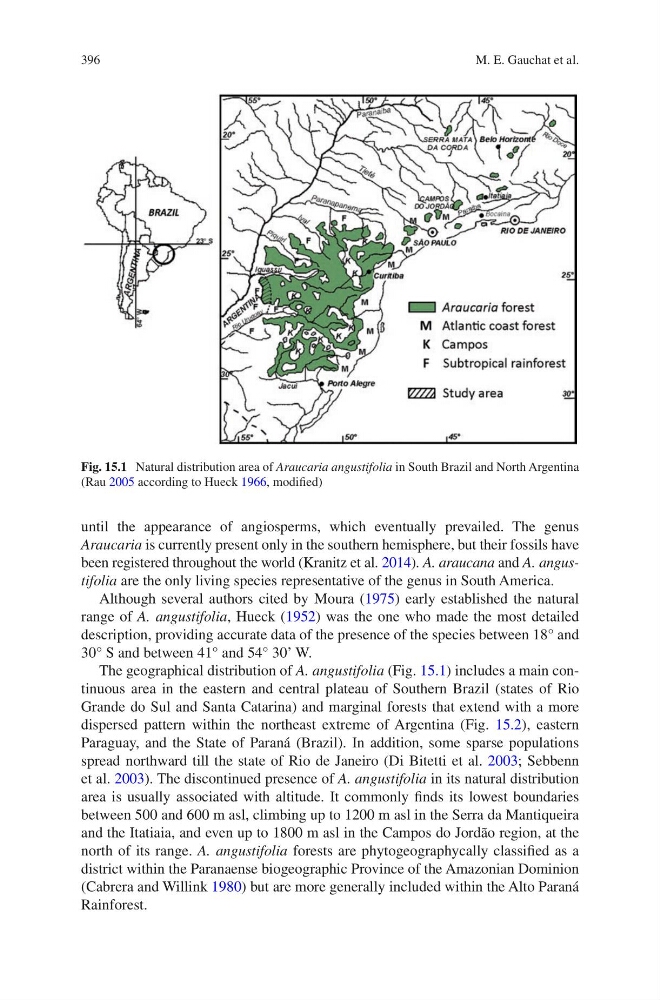
The geographical distribution of A. angustifolia (Fig. 15.1) includes a main continuous area in the eastern and central plateau of Southern Brazil (states of Rio
Grande do Sul and Santa Catarina) and marginal forests that extend with a more
dispersed pattern within the northeast extreme of Argentina (Fig. 15.2), eastern
Paraguay, and the State of Paraná (Brazil). In addition, some sparse populations
spread northward till the state of Rio de Janeiro (Di Bitetti et al. 2003; Sebbenn
et al. 2003). The discontinued presence of A. angustifolia in its natural distribution
area is usually associated with altitude. It commonly finds its lowest boundaries
between 500 and 600 m asl, climbing up to 1200 m asl in the Serra da Mantiqueira
and the Itatiaia, and even up to 1800 m asl in the Campos do Jordão region, at the
north of its range. A. angustifolia forests are phytogeographycally classified as a
district within the Paranaense biogeographic Province of the Amazonian Dominion
(Cabrera and Willink 1980) but are more generally included within the Alto Paraná
Rainforest.
Fig. 15.1 Natural distribution area of Araucaria angustifolia in South Brazil and North Argentina
(Rau 2005 according to Hueck 1966, modified)
M. E. Gauchat et al.
until the appearance of angiosperms, which eventually prevailed. The genus
Araucaria is currently present only in the southern hemisphere, but their fossils have
been registered throughout the world (Kranitz et al. 2014). A. araucana and A. angustifolia are the only living species representative of the genus in South America.
Although several authors cited by Moura (1975) early established the natural
range of A. angustifolia, Hueck (1952) was the one who made the most detailed
description, providing accurate data of the presence of the species between 18° and
30° S and between 41° and 54° 30’ W.
The geographical distribution of A. angustifolia (Fig. 15.1) includes a main continuous area in the eastern and central plateau of Southern Brazil (states of Rio
Grande do Sul and Santa Catarina) and marginal forests that extend with a more
dispersed pattern within the northeast extreme of Argentina (Fig. 15.2), eastern
Paraguay, and the State of Paraná (Brazil). In addition, some sparse populations
spread northward till the state of Rio de Janeiro (Di Bitetti et al. 2003; Sebbenn
et al. 2003). The discontinued presence of A. angustifolia in its natural distribution
area is usually associated with altitude. It commonly finds its lowest boundaries
between 500 and 600 m asl, climbing up to 1200 m asl in the Serra da Mantiqueira
and the Itatiaia, and even up to 1800 m asl in the Campos do Jordão region, at the
north of its range. A. angustifolia forests are phytogeographycally classified as a
district within the Paranaense biogeographic Province of the Amazonian Dominion
(Cabrera and Willink 1980) but are more generally included within the Alto Paraná
Rainforest.
Fig. 15.1 Natural distribution area of Araucaria angustifolia in South Brazil and North Argentina
(Rau 2005 according to Hueck 1966, modified)
M. E. Gauchat et al.