

366
population compared to the other populations, showing a clear separation of this
population (data shown in Soldati et al. 2014b).
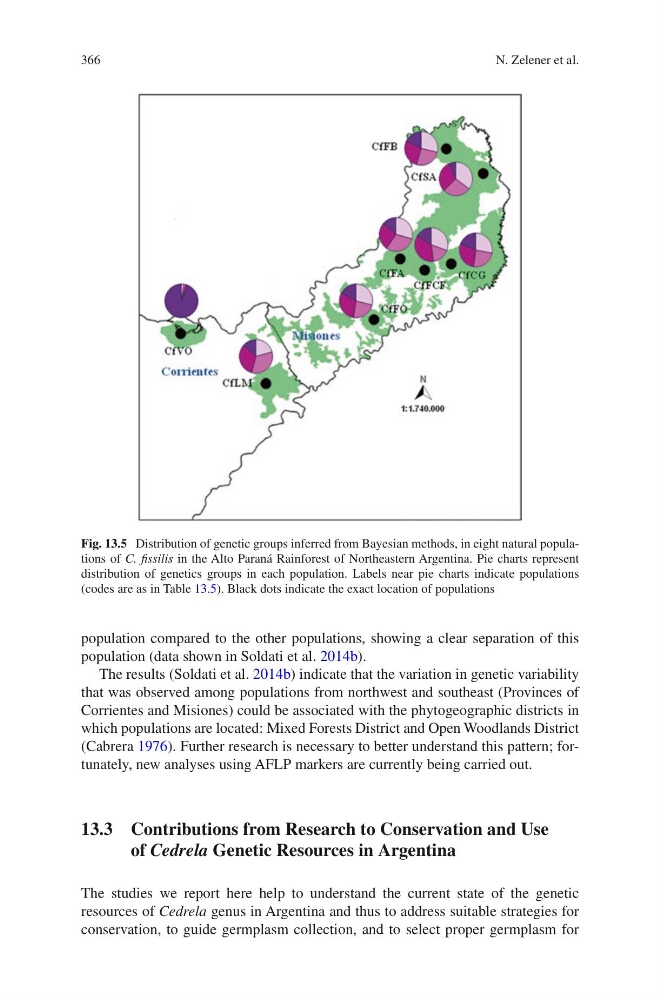
The results (Soldati et al. 2014b) indicate that the variation in genetic variability
that was observed among populations from northwest and southeast (Provinces of
Corrientes and Misiones) could be associated with the phytogeographic districts in
which populations are located: Mixed Forests District and Open Woodlands District
(Cabrera 1976). Further research is necessary to better understand this pattern; fortunately, new analyses using AFLP markers are currently being carried out.
13.3 Contributions from Research to Conservation and Use
of Cedrela Genetic Resources in Argentina
The studies we report here help to understand the current state of the genetic
resources of Cedrela genus in Argentina and thus to address suitable strategies for
conservation, to guide germplasm collection, and to select proper germplasm for
Fig. 13.5 Distribution of genetic groups inferred from Bayesian methods, in eight natural populations of C. fissilis in the Alto Paraná Rainforest of Northeastern Argentina. Pie charts represent
distribution of genetics groups in each population. Labels near pie charts indicate populations
(codes are as in Table 13.5). Black dots indicate the exact location of populations
N. Zelener et al.
population compared to the other populations, showing a clear separation of this
population (data shown in Soldati et al. 2014b).
The results (Soldati et al. 2014b) indicate that the variation in genetic variability
that was observed among populations from northwest and southeast (Provinces of
Corrientes and Misiones) could be associated with the phytogeographic districts in
which populations are located: Mixed Forests District and Open Woodlands District
(Cabrera 1976). Further research is necessary to better understand this pattern; fortunately, new analyses using AFLP markers are currently being carried out.
13.3 Contributions from Research to Conservation and Use
of Cedrela Genetic Resources in Argentina
The studies we report here help to understand the current state of the genetic
resources of Cedrela genus in Argentina and thus to address suitable strategies for
conservation, to guide germplasm collection, and to select proper germplasm for
Fig. 13.5 Distribution of genetic groups inferred from Bayesian methods, in eight natural populations of C. fissilis in the Alto Paraná Rainforest of Northeastern Argentina. Pie charts represent
distribution of genetics groups in each population. Labels near pie charts indicate populations
(codes are as in Table 13.5). Black dots indicate the exact location of populations
N. Zelener et al.