

344
(MR), and (iii) Piedmont Rainforest (PR) (Brown et al. 2001; Grau et al. 2006;
SAyDS 2007). Both TMF and PR strata concentrate species of interest for forestry
(Brown and Pacheco 2006). Furthermore, the Yungas is ecologically subdivided
into northern, central, and southern sectors according to the north-south orographic
pattern (Brown et al. 2001). These latitudinal sectors exhibit a clear decrease of
taxonomic diversity with increasing latitude (Brown et al. 2001; Juárez et al. 2007).
In addition, glacial refuges in northern Yungas during the Pleistocene (Pennington
et al. 2000) would have contributed to shape the current pattern of biological diversity, revealed from the geographic distribution of endemic species in this region
(Brown et al. 2001, 2006).
The Yungas plays an important role in providing many environmental services;
even so, in the second half of the last century, the Yungas has faced depletion processes. Most Piedmont Rainforest surface has been modified by anthropogenic
intervention (e.g., Brown et al. 2006; SAyDS 2007, 2008; Seghezzo et al. 2011).
The historical overexploitation of Yungas, selective logging, illegal cutting, and lack
of control and transparency of local market led to habitat disturbance of accessible
forests. Additionally, urban expansion and conversion to agricultural use led to
increasing depletion and habitat loss processes (Aide and Grau 2004; Muellner
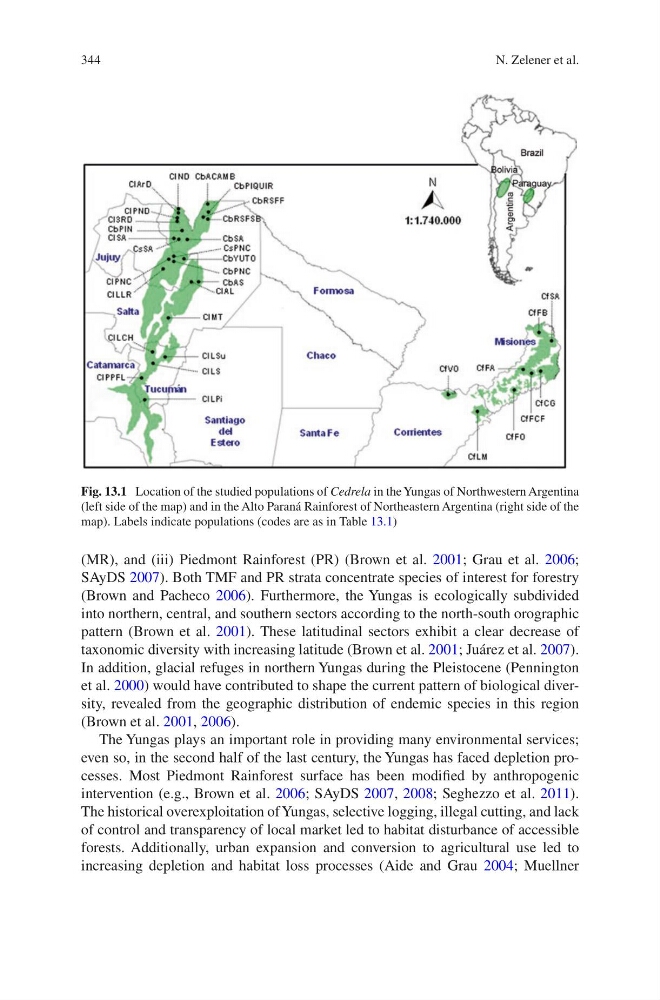
Fig. 13.1 Location of the studied populations of Cedrela in the Yungas of Northwestern Argentina
(left side of the map) and in the Alto Paraná Rainforest of Northeastern Argentina (right side of the
map). Labels indicate populations (codes are as in Table 13.1)
N. Zelener et al.
(MR), and (iii) Piedmont Rainforest (PR) (Brown et al. 2001; Grau et al. 2006;
SAyDS 2007). Both TMF and PR strata concentrate species of interest for forestry
(Brown and Pacheco 2006). Furthermore, the Yungas is ecologically subdivided
into northern, central, and southern sectors according to the north-south orographic
pattern (Brown et al. 2001). These latitudinal sectors exhibit a clear decrease of
taxonomic diversity with increasing latitude (Brown et al. 2001; Juárez et al. 2007).
In addition, glacial refuges in northern Yungas during the Pleistocene (Pennington
et al. 2000) would have contributed to shape the current pattern of biological diversity, revealed from the geographic distribution of endemic species in this region
(Brown et al. 2001, 2006).
The Yungas plays an important role in providing many environmental services;
even so, in the second half of the last century, the Yungas has faced depletion processes. Most Piedmont Rainforest surface has been modified by anthropogenic
intervention (e.g., Brown et al. 2006; SAyDS 2007, 2008; Seghezzo et al. 2011).
The historical overexploitation of Yungas, selective logging, illegal cutting, and lack
of control and transparency of local market led to habitat disturbance of accessible
forests. Additionally, urban expansion and conversion to agricultural use led to
increasing depletion and habitat loss processes (Aide and Grau 2004; Muellner
Fig. 13.1 Location of the studied populations of Cedrela in the Yungas of Northwestern Argentina
(left side of the map) and in the Alto Paraná Rainforest of Northeastern Argentina (right side of the
map). Labels indicate populations (codes are as in Table 13.1)
N. Zelener et al.