

308
(considering those climatic variables of biological importance, such as mean temperature of most humid quarter, specific humidity mean of coldest quarter, annual
mean specific humidity and annual mean temperature). Since no current environmental factors seem to influence the distribution of the genetic variation in
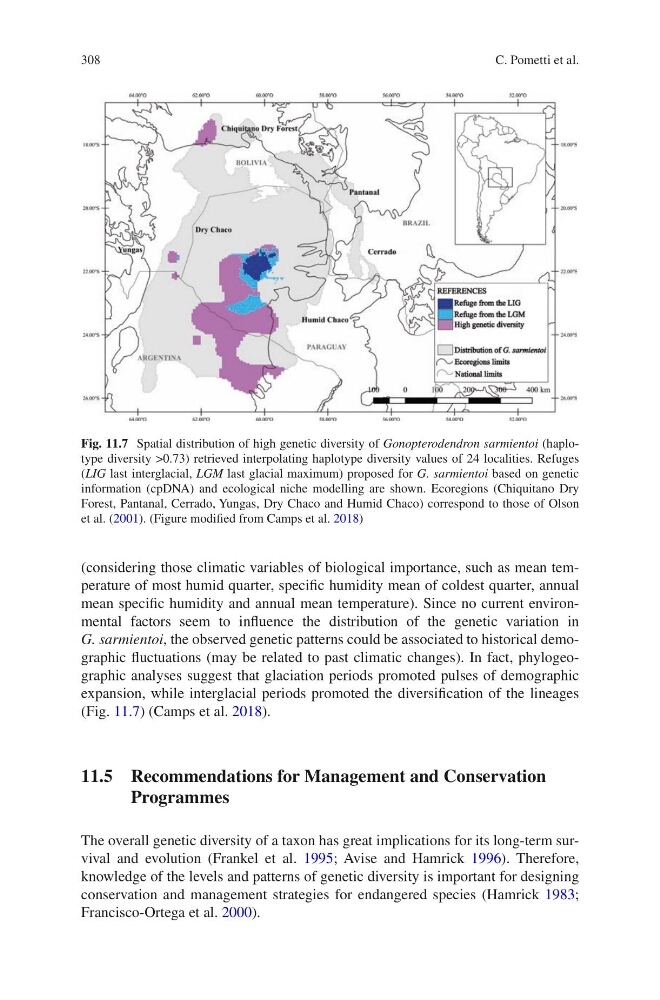
G. sarmientoi, the observed genetic patterns could be associated to historical demographic fluctuations (may be related to past climatic changes). In fact, phylogeographic analyses suggest that glaciation periods promoted pulses of demographic
expansion, while interglacial periods promoted the diversification of the lineages
(Fig. 11.7) (Camps et al. 2018).
11.5 Recommendations for Management and Conservation
Programmes
The overall genetic diversity of a taxon has great implications for its long-term survival and evolution (Frankel et al. 1995; Avise and Hamrick 1996). Therefore,
knowledge of the levels and patterns of genetic diversity is important for designing
conservation and management strategies for endangered species (Hamrick 1983;
Francisco-Ortega et al. 2000).
Fig. 11.7 Spatial distribution of high genetic diversity of Gonopterodendron sarmientoi (haplotype diversity >0.73) retrieved interpolating haplotype diversity values of 24 localities. Refuges
(LIG last interglacial, LGM last glacial maximum) proposed for G. sarmientoi based on genetic
information (cpDNA) and ecological niche modelling are shown. Ecoregions (Chiquitano Dry
Forest, Pantanal, Cerrado, Yungas, Dry Chaco and Humid Chaco) correspond to those of Olson
et al. (2001). (Figure modified from Camps et al. 2018)
C. Pometti et al.
(considering those climatic variables of biological importance, such as mean temperature of most humid quarter, specific humidity mean of coldest quarter, annual
mean specific humidity and annual mean temperature). Since no current environmental factors seem to influence the distribution of the genetic variation in
G. sarmientoi, the observed genetic patterns could be associated to historical demographic fluctuations (may be related to past climatic changes). In fact, phylogeographic analyses suggest that glaciation periods promoted pulses of demographic
expansion, while interglacial periods promoted the diversification of the lineages
(Fig. 11.7) (Camps et al. 2018).
11.5 Recommendations for Management and Conservation
Programmes
The overall genetic diversity of a taxon has great implications for its long-term survival and evolution (Frankel et al. 1995; Avise and Hamrick 1996). Therefore,
knowledge of the levels and patterns of genetic diversity is important for designing
conservation and management strategies for endangered species (Hamrick 1983;
Francisco-Ortega et al. 2000).
Fig. 11.7 Spatial distribution of high genetic diversity of Gonopterodendron sarmientoi (haplotype diversity >0.73) retrieved interpolating haplotype diversity values of 24 localities. Refuges
(LIG last interglacial, LGM last glacial maximum) proposed for G. sarmientoi based on genetic
information (cpDNA) and ecological niche modelling are shown. Ecoregions (Chiquitano Dry
Forest, Pantanal, Cerrado, Yungas, Dry Chaco and Humid Chaco) correspond to those of Olson
et al. (2001). (Figure modified from Camps et al. 2018)
C. Pometti et al.