

306
in three of the six populations (up to 530 m). The neighbourhood size ranged from
15.2 to 64.3 individuals. The estimation of gene dispersal (σ g ) was conducted considering four different effective densities in populations where SGS was significant
and ranged from 67 m to 864 m.
In Prosopis affinis genetic differentiation among the analysed fragments of populations by AMOVA was moderate (F ST : 0.080 – p ≤ 0.001). Through Bayesian
methods (STRUCTURE), it was possible to identify two genetic groups heterogeneously distributed.
So far, there are very few populations of P. caldenia studied through genetic
markers; therefore the results of genetic diversity of the species are preliminary.
Three populations of P. caldenia were studied in the Province of San Luis, 20 km
apart from each other, resulting very low differentiated (F ST = 0.014) (Velasco
2018). Pérez Díaz (2014) also showed low interpopulation variation of this species
by sampling two populations located in the north and in the south of Villa Mercedes
City. Despite a general degradation scenario, which includes overgrazing, fragmentation due to the advance of agriculture over native forests, deforestation and fires,
this study showed a high intrapopulation genetic variability, which is of great value
for the conservation of the species. Velasco (2018) found hybrid swarms in sympatric
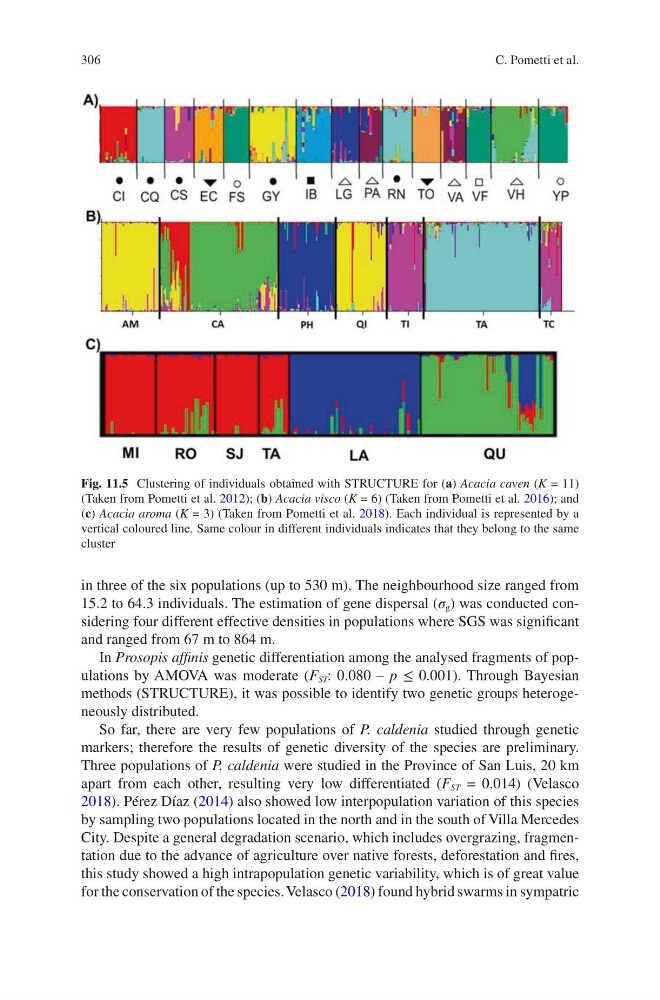
Fig. 11.5 Clustering of individuals obtained with STRUCTURE for (a) Acacia caven (K = 11)
(Taken from Pometti et al. 2012); (b) Acacia visco (K = 6) (Taken from Pometti et al. 2016); and
(c) Acacia aroma (K = 3) (Taken from Pometti et al. 2018). Each individual is represented by a
vertical coloured line. Same colour in different individuals indicates that they belong to the same
cluster
C. Pometti et al.
in three of the six populations (up to 530 m). The neighbourhood size ranged from
15.2 to 64.3 individuals. The estimation of gene dispersal (σ g ) was conducted considering four different effective densities in populations where SGS was significant
and ranged from 67 m to 864 m.
In Prosopis affinis genetic differentiation among the analysed fragments of populations by AMOVA was moderate (F ST : 0.080 – p ≤ 0.001). Through Bayesian
methods (STRUCTURE), it was possible to identify two genetic groups heterogeneously distributed.
So far, there are very few populations of P. caldenia studied through genetic
markers; therefore the results of genetic diversity of the species are preliminary.
Three populations of P. caldenia were studied in the Province of San Luis, 20 km
apart from each other, resulting very low differentiated (F ST = 0.014) (Velasco
2018). Pérez Díaz (2014) also showed low interpopulation variation of this species
by sampling two populations located in the north and in the south of Villa Mercedes
City. Despite a general degradation scenario, which includes overgrazing, fragmentation due to the advance of agriculture over native forests, deforestation and fires,
this study showed a high intrapopulation genetic variability, which is of great value
for the conservation of the species. Velasco (2018) found hybrid swarms in sympatric
Fig. 11.5 Clustering of individuals obtained with STRUCTURE for (a) Acacia caven (K = 11)
(Taken from Pometti et al. 2012); (b) Acacia visco (K = 6) (Taken from Pometti et al. 2016); and
(c) Acacia aroma (K = 3) (Taken from Pometti et al. 2018). Each individual is represented by a
vertical coloured line. Same colour in different individuals indicates that they belong to the same
cluster
C. Pometti et al.