

280
10.3 High-Intensity Breeding
The primary goal of Prosopis species breeding has traditionally been related to
wood production. Growth traits (total height and diameter) and trunk shape and bole
length have been the focus of improvement. However, as mentioned in the first section of this chapter, the objectives of different Prosopis breeding programs can be
diverse. In addition to the wood volume yield, the objectives can be oriented to
improve wood quality, fruits production and quality, resistance to pests and diseases, adaptability to marginal (e.g., dry) environments, or degraded (e.g., salinized)
soils, among others. Improvement programs can contemplate one or more of the
aforementioned goals, and in all cases, they must have the premise of maintaining a
wide genetic diversity to guarantee that the genetic gains do not decrease, even in
advanced generations.
Forest tree breeding has been successful at delivering genetically improved
material for multiple traits based on recurrent cycles of selection, mating, and testing (Grattapaglia et al. 2018). Pedigree-based phenotypic selection, rather than
genetic dissection approaches such as quantitative trait mapping and association
genetics, is currently the main approach in Prosopis breeding programs of Argentina.
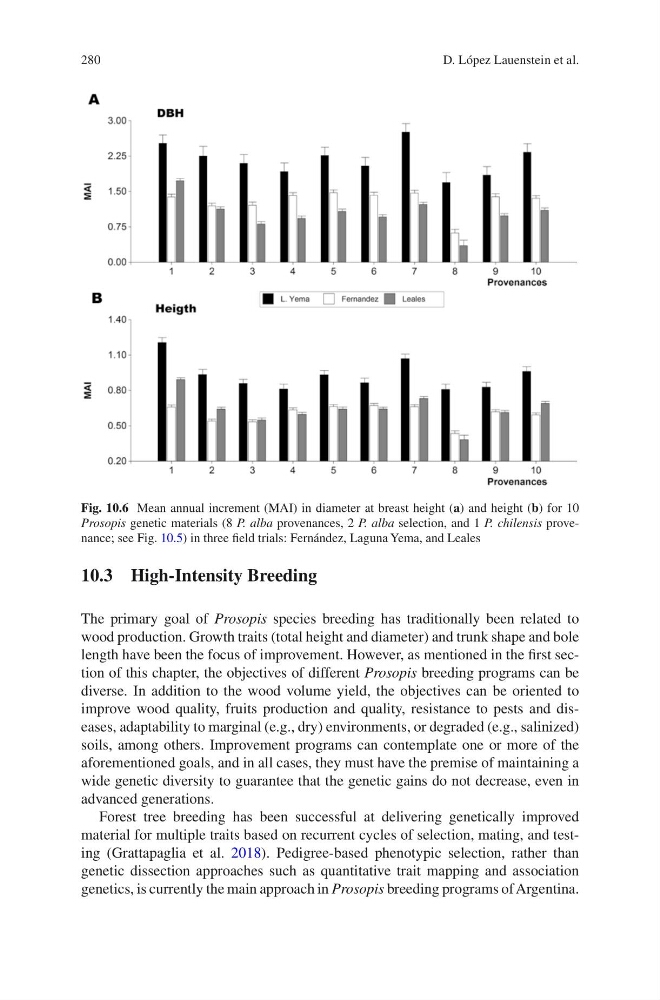
Fig. 10.6 Mean annual increment (MAI) in diameter at breast height (a) and height (b) for 10
Prosopis genetic materials (8 P. alba provenances, 2 P. alba selection, and 1 P. chilensis provenance; see Fig. 10.5) in three field trials: Fernández, Laguna Yema, and Leales
D. López Lauenstein et al.
10.3 High-Intensity Breeding
The primary goal of Prosopis species breeding has traditionally been related to
wood production. Growth traits (total height and diameter) and trunk shape and bole
length have been the focus of improvement. However, as mentioned in the first section of this chapter, the objectives of different Prosopis breeding programs can be
diverse. In addition to the wood volume yield, the objectives can be oriented to
improve wood quality, fruits production and quality, resistance to pests and diseases, adaptability to marginal (e.g., dry) environments, or degraded (e.g., salinized)
soils, among others. Improvement programs can contemplate one or more of the
aforementioned goals, and in all cases, they must have the premise of maintaining a
wide genetic diversity to guarantee that the genetic gains do not decrease, even in
advanced generations.
Forest tree breeding has been successful at delivering genetically improved
material for multiple traits based on recurrent cycles of selection, mating, and testing (Grattapaglia et al. 2018). Pedigree-based phenotypic selection, rather than
genetic dissection approaches such as quantitative trait mapping and association
genetics, is currently the main approach in Prosopis breeding programs of Argentina.
Fig. 10.6 Mean annual increment (MAI) in diameter at breast height (a) and height (b) for 10
Prosopis genetic materials (8 P. alba provenances, 2 P. alba selection, and 1 P. chilensis provenance; see Fig. 10.5) in three field trials: Fernández, Laguna Yema, and Leales
D. López Lauenstein et al.