

279
et al. 2016). This evaluation was done 3 years after implanting the field trials and
was based on growth and shape characters, highlighting the value of early selection
and the high heritability of the chosen characters. It is worth noting that Campo
Durán natural provenance, represented by open-pollinated seeds from unselected
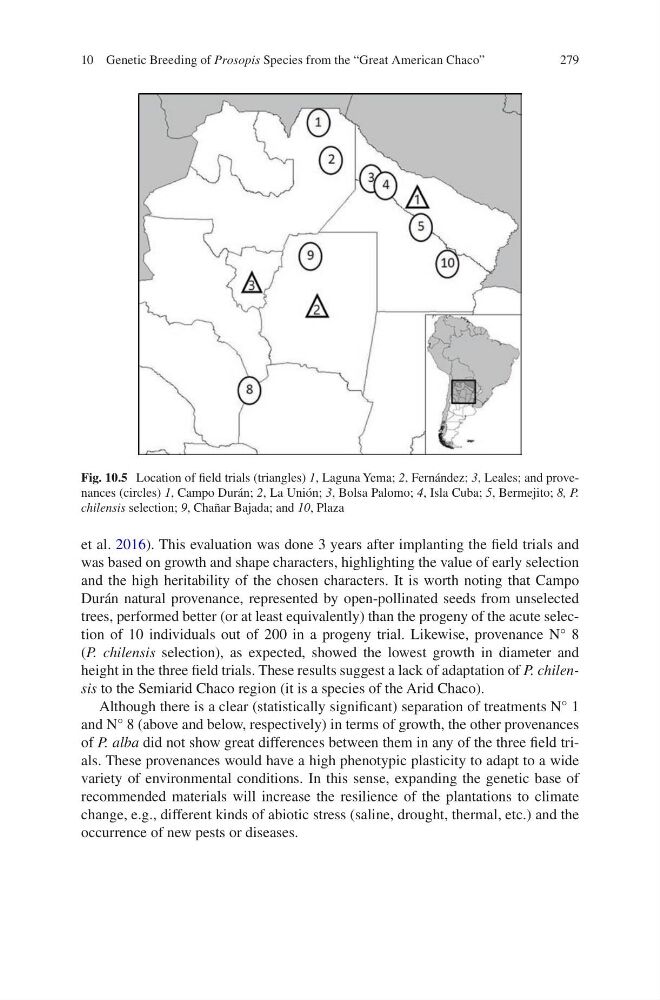
trees, performed better (or at least equivalently) than the progeny of the acute selection of 10 individuals out of 200 in a progeny trial. Likewise, provenance N° 8
(P. chilensis selection), as expected, showed the lowest growth in diameter and
height in the three field trials. These results suggest a lack of adaptation of P. chilensis to the Semiarid Chaco region (it is a species of the Arid Chaco).
Although there is a clear (statistically significant) separation of treatments N° 1
and N° 8 (above and below, respectively) in terms of growth, the other provenances
of P. alba did not show great differences between them in any of the three field trials. These provenances would have a high phenotypic plasticity to adapt to a wide
variety of environmental conditions. In this sense, expanding the genetic base of
recommended materials will increase the resilience of the plantations to climate
change, e.g., different kinds of abiotic stress (saline, drought, thermal, etc.) and the
occurrence of new pests or diseases.
Fig. 10.5 Location of field trials (triangles) 1, Laguna Yema; 2, Fernández; 3, Leales; and provenances (circles) 1, Campo Durán; 2, La Unión; 3, Bolsa Palomo; 4, Isla Cuba; 5, Bermejito; 8, P.
chilensis selection; 9, Chañar Bajada; and 10, Plaza
10 Genetic Breeding of Prosopis Species from the “Great American Chaco”
et al. 2016). This evaluation was done 3 years after implanting the field trials and
was based on growth and shape characters, highlighting the value of early selection
and the high heritability of the chosen characters. It is worth noting that Campo
Durán natural provenance, represented by open-pollinated seeds from unselected
trees, performed better (or at least equivalently) than the progeny of the acute selection of 10 individuals out of 200 in a progeny trial. Likewise, provenance N° 8
(P. chilensis selection), as expected, showed the lowest growth in diameter and
height in the three field trials. These results suggest a lack of adaptation of P. chilensis to the Semiarid Chaco region (it is a species of the Arid Chaco).
Although there is a clear (statistically significant) separation of treatments N° 1
and N° 8 (above and below, respectively) in terms of growth, the other provenances
of P. alba did not show great differences between them in any of the three field trials. These provenances would have a high phenotypic plasticity to adapt to a wide
variety of environmental conditions. In this sense, expanding the genetic base of
recommended materials will increase the resilience of the plantations to climate
change, e.g., different kinds of abiotic stress (saline, drought, thermal, etc.) and the
occurrence of new pests or diseases.
Fig. 10.5 Location of field trials (triangles) 1, Laguna Yema; 2, Fernández; 3, Leales; and provenances (circles) 1, Campo Durán; 2, La Unión; 3, Bolsa Palomo; 4, Isla Cuba; 5, Bermejito; 8, P.
chilensis selection; 9, Chañar Bajada; and 10, Plaza
10 Genetic Breeding of Prosopis Species from the “Great American Chaco”