

250
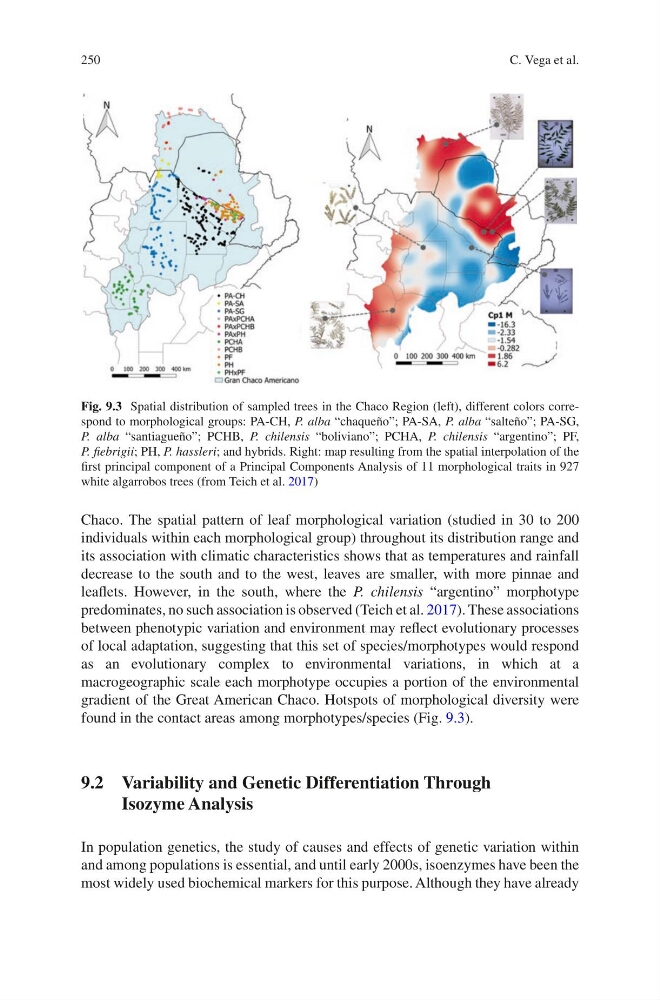
Chaco. The spatial pattern of leaf morphological variation (studied in 30 to 200
individuals within each morphological group) throughout its distribution range and
its association with climatic characteristics shows that as temperatures and rainfall
decrease to the south and to the west, leaves are smaller, with more pinnae and
leaflets. However, in the south, where the P. chilensis “argentino” morphotype
predominates, no such association is observed (Teich et al. 2017). These associations
between phenotypic variation and environment may reflect evolutionary processes
of local adaptation, suggesting that this set of species/morphotypes would respond
as an evolutionary complex to environmental variations, in which at a
macrogeographic scale each morphotype occupies a portion of the environmental
gradient of the Great American Chaco. Hotspots of morphological diversity were
found in the contact areas among morphotypes/species (Fig. 9.3).
9.2 Variability and Genetic Differentiation Through
Isozyme Analysis
In population genetics, the study of causes and effects of genetic variation within
and among populations is essential, and until early 2000s, isoenzymes have been the
most widely used biochemical markers for this purpose. Although they have already
Fig. 9.3 Spatial distribution of sampled trees in the Chaco Region (left), different colors correspond to morphological groups: PA-CH, P. alba “chaqueño”; PA-SA, P. alba “salteño”; PA-SG,
P. alba “santiagueño”; PCHB, P. chilensis “boliviano”; PCHA, P. chilensis “argentino”; PF,
P. fiebrigii; PH, P. hassleri; and hybrids. Right: map resulting from the spatial interpolation of the
first principal component of a Principal Components Analysis of 11 morphological traits in 927
white algarrobos trees (from Teich et al. 2017)
C. Vega et al.
Chaco. The spatial pattern of leaf morphological variation (studied in 30 to 200
individuals within each morphological group) throughout its distribution range and
its association with climatic characteristics shows that as temperatures and rainfall
decrease to the south and to the west, leaves are smaller, with more pinnae and
leaflets. However, in the south, where the P. chilensis “argentino” morphotype
predominates, no such association is observed (Teich et al. 2017). These associations
between phenotypic variation and environment may reflect evolutionary processes
of local adaptation, suggesting that this set of species/morphotypes would respond
as an evolutionary complex to environmental variations, in which at a
macrogeographic scale each morphotype occupies a portion of the environmental
gradient of the Great American Chaco. Hotspots of morphological diversity were
found in the contact areas among morphotypes/species (Fig. 9.3).
9.2 Variability and Genetic Differentiation Through
Isozyme Analysis
In population genetics, the study of causes and effects of genetic variation within
and among populations is essential, and until early 2000s, isoenzymes have been the
most widely used biochemical markers for this purpose. Although they have already
Fig. 9.3 Spatial distribution of sampled trees in the Chaco Region (left), different colors correspond to morphological groups: PA-CH, P. alba “chaqueño”; PA-SA, P. alba “salteño”; PA-SG,
P. alba “santiagueño”; PCHB, P. chilensis “boliviano”; PCHA, P. chilensis “argentino”; PF,
P. fiebrigii; PH, P. hassleri; and hybrids. Right: map resulting from the spatial interpolation of the
first principal component of a Principal Components Analysis of 11 morphological traits in 927
white algarrobos trees (from Teich et al. 2017)
C. Vega et al.