

248
shape (FSh), the fruit edge shape (FESh), and the color (FrC) (Burkart 1976;
Palacios and Brizuela 2005). The classes of the last three variables (FSh, FESh, and
FrC) represent a continuum in shape (from straight to curly) and in color (from
yellow to black) and are therefore usually considered ordinal (Joseau et al. 2013).
The software HOJA 3.4 (Verga 2015) has facilitated measuring these traits and is
widely used in Prosopis studies (Ferreyra et al. 2013; Joseau et al. 2013). It is wellknown that arrangement, size, shape, and anatomy of leaves and fruits differ greatly
in plants growing in different environments. These often easy-to-measure traits,
such as leaf shape, size, or thickness, are associated to plant physiological responses
to their immediate environment (e.g., through photosynthetic rates), which in turn
affect performance, growth, and survival and are often regarded as “functional
traits” (Geber and Griffen 2003; Reich et al. 2003).
The ways in which functional traits indirectly affect fitness vary with the environmental context, and environmentally linked differences in leaf size and shape are
often thought to reflect a legacy of adaptive evolution in plants. Broad-scale correlations between traits and environments could arise through a combination of
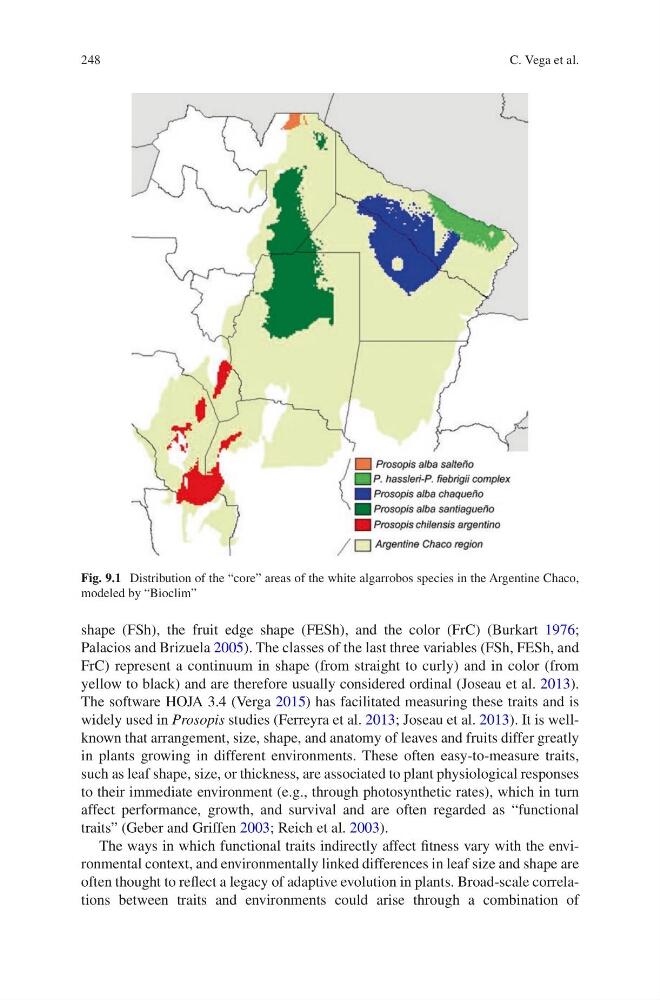
Fig. 9.1 Distribution of the “core” areas of the white algarrobos species in the Argentine Chaco,
modeled by “Bioclim”
C. Vega et al.
shape (FSh), the fruit edge shape (FESh), and the color (FrC) (Burkart 1976;
Palacios and Brizuela 2005). The classes of the last three variables (FSh, FESh, and
FrC) represent a continuum in shape (from straight to curly) and in color (from
yellow to black) and are therefore usually considered ordinal (Joseau et al. 2013).
The software HOJA 3.4 (Verga 2015) has facilitated measuring these traits and is
widely used in Prosopis studies (Ferreyra et al. 2013; Joseau et al. 2013). It is wellknown that arrangement, size, shape, and anatomy of leaves and fruits differ greatly
in plants growing in different environments. These often easy-to-measure traits,
such as leaf shape, size, or thickness, are associated to plant physiological responses
to their immediate environment (e.g., through photosynthetic rates), which in turn
affect performance, growth, and survival and are often regarded as “functional
traits” (Geber and Griffen 2003; Reich et al. 2003).
The ways in which functional traits indirectly affect fitness vary with the environmental context, and environmentally linked differences in leaf size and shape are
often thought to reflect a legacy of adaptive evolution in plants. Broad-scale correlations between traits and environments could arise through a combination of
Fig. 9.1 Distribution of the “core” areas of the white algarrobos species in the Argentine Chaco,
modeled by “Bioclim”
C. Vega et al.