

178
ecosystems on the western side of the Andes to the altitudinal tree-line and the semiarid Patagonian steppe on the eastern slope of the Andes (Veblen et al. 1995).
Fire is the main disturbance in Araucaria forest where annual synchrony of
regional widespread wildfires reflects the interannual climate variability. Years of
widespread fire occurred with above-mean summer temperatures during the previous and current growing seasons concurrent with low rainfall in current spring,
conditions associated with negative deviations of both “Niño” 3.4 and Pacific
Decadal Oscillation indexes (i.e. “La Niña” conditions), as well as coincident
phases of positive Southern Annular Mode (SAM) and “La Niña” events (Mundo
et al. 2013). Temporal variation in the Araucaria fire history in Argentina clearly
shows the combined effect of human and climate influences on fire regimes. A comparison with previous fire history studies in the Araucaria forests of Chile reveals
substantial divergences related to differences in human activities on both sides of
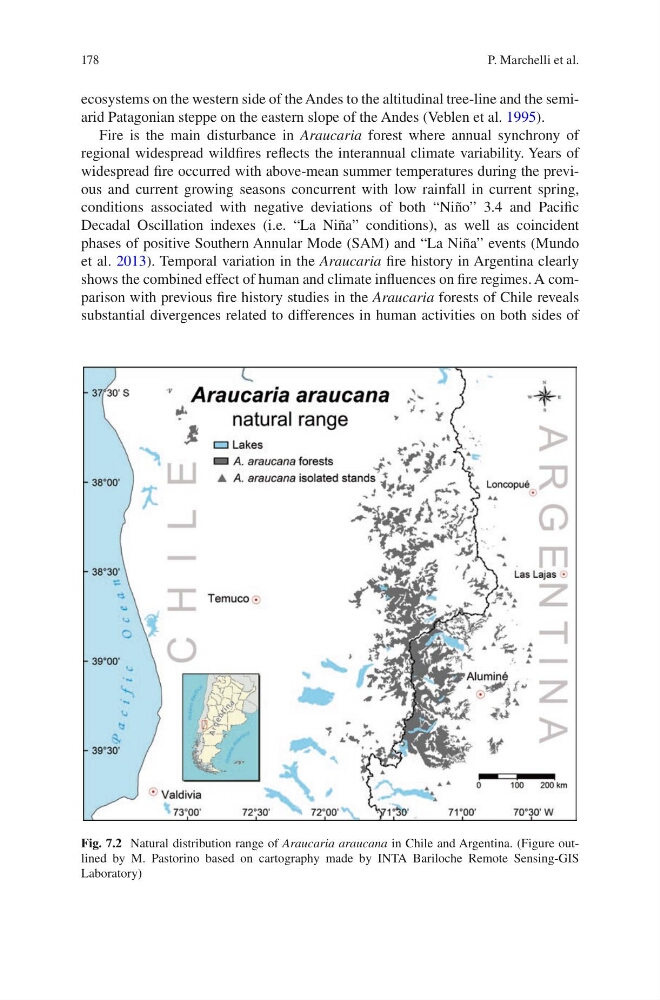
Fig. 7.2 Natural distribution range of Araucaria araucana in Chile and Argentina. (Figure outlined by M. Pastorino based on cartography made by INTA Bariloche Remote Sensing-GIS
Laboratory)
P. Marchelli et al.
ecosystems on the western side of the Andes to the altitudinal tree-line and the semiarid Patagonian steppe on the eastern slope of the Andes (Veblen et al. 1995).
Fire is the main disturbance in Araucaria forest where annual synchrony of
regional widespread wildfires reflects the interannual climate variability. Years of
widespread fire occurred with above-mean summer temperatures during the previous and current growing seasons concurrent with low rainfall in current spring,
conditions associated with negative deviations of both “Niño” 3.4 and Pacific
Decadal Oscillation indexes (i.e. “La Niña” conditions), as well as coincident
phases of positive Southern Annular Mode (SAM) and “La Niña” events (Mundo
et al. 2013). Temporal variation in the Araucaria fire history in Argentina clearly
shows the combined effect of human and climate influences on fire regimes. A comparison with previous fire history studies in the Araucaria forests of Chile reveals
substantial divergences related to differences in human activities on both sides of
Fig. 7.2 Natural distribution range of Araucaria araucana in Chile and Argentina. (Figure outlined by M. Pastorino based on cartography made by INTA Bariloche Remote Sensing-GIS
Laboratory)
P. Marchelli et al.