

165
species for the conservation of its genetic resources but also points to a latitudinal
break with regard to the structuring of the additive variance within cypress populations, at least for its arid edge. For the cessation and duration of the annual growth
period, the majority of the marginal populations seemed to retain enough levels of
additive variation to allow in situ adaptation, for example, in the face of changes in
summer aridity due to altered patterns of seasonality.
Climate change implies increases in the amplitude and/or frequency of extreme
weather events (Mitchell et al. 2006), whose impacts are expected to be stronger at
the margins of the current ranges of trees. The survival of tree regeneration can be
interpreted as the result of the expression of multiple functional traits to the environmental conditions, which with certain frequency can be extreme. In those circumstances, the acclimation capacities of seedlings are exceeded, thus leading to
persistent effects on performance and eventually to death. Therefore, if variation
exists in traits underlying survival, this could vary between or within populations. In
the context of the study of the arid margins of cypress range, two progeny field trials
were planted using the material presented in Table 6.4. Fortunately, in one of them
(N = 161 open-pollinated families; n = 2415 plants), it was possible to evaluate the
effects of one summer heat wave and drought and of one extreme winter cold. These
events produced two clearly defined waves of seedling mortality, allowing a survival
analysis under such infrequent conditions (Aparicio et al. 2012). One main result
was that survival was not explained by the effect of population, suggesting that on a
regional scale, cypress could be under homogenizing selection for drought and
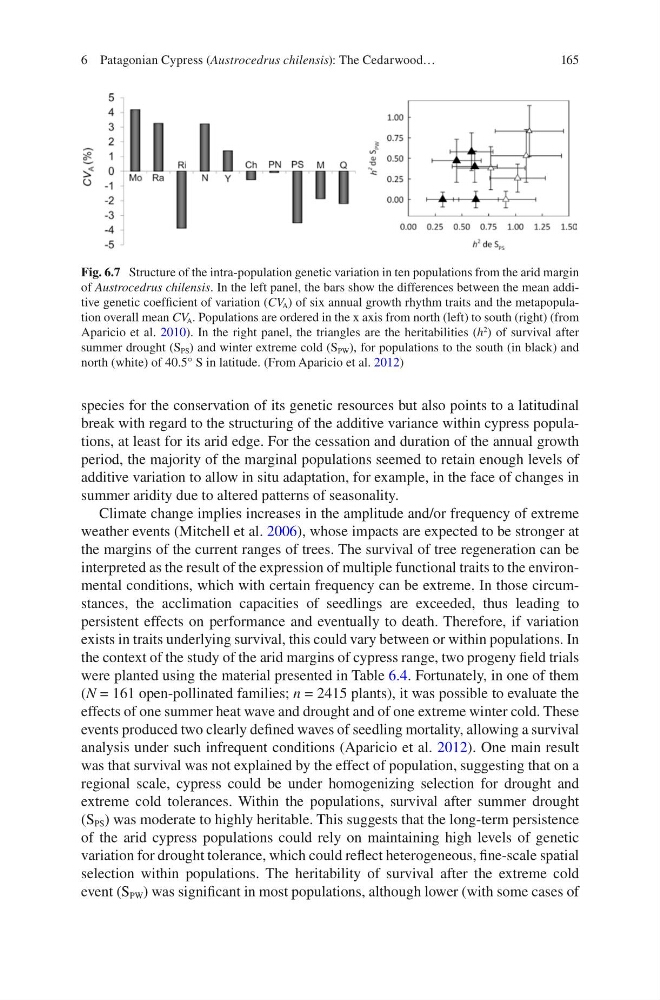
extreme cold tolerances. Within the populations, survival after summer drought
(S PS ) was moderate to highly heritable. This suggests that the long-term persistence
of the arid cypress populations could rely on maintaining high levels of genetic
variation for drought tolerance, which could reflect heterogeneous, fine-scale spatial
selection within populations. The heritability of survival after the extreme cold
event (S PW ) was significant in most populations, although lower (with some cases of
Fig. 6.7 Structure of the intra-population genetic variation in ten populations from the arid margin
of Austrocedrus chilensis. In the left panel, the bars show the differences between the mean additive genetic coefficient of variation (CV A ) of six annual growth rhythm traits and the metapopulation overall mean CV A . Populations are ordered in the x axis from north (left) to south (right) (from
Aparicio et al. 2010). In the right panel, the triangles are the heritabilities (h
2 ) of survival after
summer drought (S PS ) and winter extreme cold (S PW ), for populations to the south (in black) and
north (white) of 40.5° S in latitude. (From Aparicio et al. 2012)
6 Patagonian Cypress (Austrocedrus chilensis): The Cedarwood…
species for the conservation of its genetic resources but also points to a latitudinal
break with regard to the structuring of the additive variance within cypress populations, at least for its arid edge. For the cessation and duration of the annual growth
period, the majority of the marginal populations seemed to retain enough levels of
additive variation to allow in situ adaptation, for example, in the face of changes in
summer aridity due to altered patterns of seasonality.
Climate change implies increases in the amplitude and/or frequency of extreme
weather events (Mitchell et al. 2006), whose impacts are expected to be stronger at
the margins of the current ranges of trees. The survival of tree regeneration can be
interpreted as the result of the expression of multiple functional traits to the environmental conditions, which with certain frequency can be extreme. In those circumstances, the acclimation capacities of seedlings are exceeded, thus leading to
persistent effects on performance and eventually to death. Therefore, if variation
exists in traits underlying survival, this could vary between or within populations. In
the context of the study of the arid margins of cypress range, two progeny field trials
were planted using the material presented in Table 6.4. Fortunately, in one of them
(N = 161 open-pollinated families; n = 2415 plants), it was possible to evaluate the
effects of one summer heat wave and drought and of one extreme winter cold. These
events produced two clearly defined waves of seedling mortality, allowing a survival
analysis under such infrequent conditions (Aparicio et al. 2012). One main result
was that survival was not explained by the effect of population, suggesting that on a
regional scale, cypress could be under homogenizing selection for drought and
extreme cold tolerances. Within the populations, survival after summer drought
(S PS ) was moderate to highly heritable. This suggests that the long-term persistence
of the arid cypress populations could rely on maintaining high levels of genetic
variation for drought tolerance, which could reflect heterogeneous, fine-scale spatial
selection within populations. The heritability of survival after the extreme cold
event (S PW ) was significant in most populations, although lower (with some cases of
Fig. 6.7 Structure of the intra-population genetic variation in ten populations from the arid margin
of Austrocedrus chilensis. In the left panel, the bars show the differences between the mean additive genetic coefficient of variation (CV A ) of six annual growth rhythm traits and the metapopulation overall mean CV A . Populations are ordered in the x axis from north (left) to south (right) (from
Aparicio et al. 2010). In the right panel, the triangles are the heritabilities (h
2 ) of survival after
summer drought (S PS ) and winter extreme cold (S PW ), for populations to the south (in black) and
north (white) of 40.5° S in latitude. (From Aparicio et al. 2012)
6 Patagonian Cypress (Austrocedrus chilensis): The Cedarwood…