

156
regeneration offers the highest levels of diploid genetic variation (with the exception of the embryo stage), and over this variation selection acts early. Fertility, which
is defined as a parent’s ability to produce successful gametes, can be assessed
through the adaptability of the offspring, and the quantitative variation of early traits
could be therefore used for low-intensity breeding programs.
6.3.1 Quantitative Genetic Variation at the Regional Scale
In a first broad-scale approach to the quantitative variation of cypress, we have
installed a network of six provenance trials, with the general objective of describing
the patterns of variation in survival and initial growth, which are the integrative
result of multiple morphological, physiological, and biochemical responses to the
environment. For this, we used seedlings with maternal identification from 14 populations of three forest types, which are in turn defined by their rainfall regimes: (1)
marginal (MA), with up to 600 mm in mean annual precipitation (MAP); (2) mesic
(ME), from 600 to 1000 mm in MAP; and (3) humid (H), with more than 1000 mm
in MAP (Table 6.1). The sites were chosen at several locations within the distribution area of cypress in Argentina, covering latitude, altitude, and rainfall zones
(Table 6.2). Under the hypothesis that cypress is adapted according to a generalist
strategy based on the evolution of plasticity, we predicted similar behavior between
the humid, mesic, and marginal rainfall zones (i.e., forest types), as well as a nonsignificant participation of the effect of population on the phenotypic variation of
survival and growth. The details on the experimental design and statistical analyses
are in Aparicio (2013).
Our predictions were confirmed throughout the trial network, with the exception
of trial N° 6. That is, under the environmental conditions of most trials, the variation
in survival and initial growth was largely attributable to residual variance, i.e.,
between individuals within the populations, nested within the forest types. Table 6.3
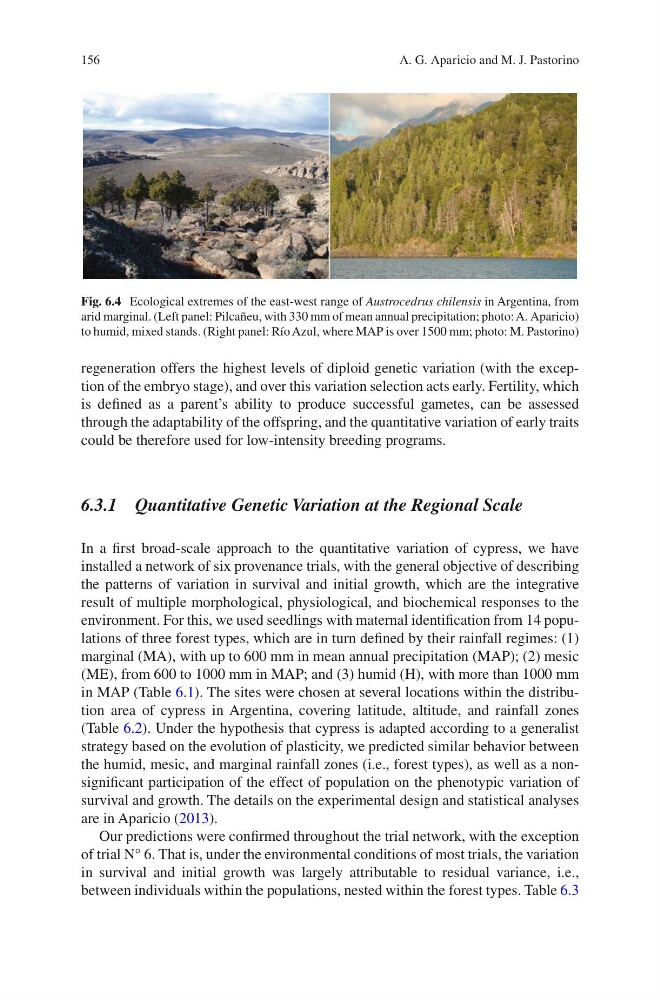
Fig. 6.4 Ecological extremes of the east-west range of Austrocedrus chilensis in Argentina, from
arid marginal. (Left panel: Pilcañeu, with 330 mm of mean annual precipitation; photo: A. Aparicio)
to humid, mixed stands. (Right panel: Río Azul, where MAP is over 1500 mm; photo: M. Pastorino)
A. G. Aparicio and M. J. Pastorino
regeneration offers the highest levels of diploid genetic variation (with the exception of the embryo stage), and over this variation selection acts early. Fertility, which
is defined as a parent’s ability to produce successful gametes, can be assessed
through the adaptability of the offspring, and the quantitative variation of early traits
could be therefore used for low-intensity breeding programs.
6.3.1 Quantitative Genetic Variation at the Regional Scale
In a first broad-scale approach to the quantitative variation of cypress, we have
installed a network of six provenance trials, with the general objective of describing
the patterns of variation in survival and initial growth, which are the integrative
result of multiple morphological, physiological, and biochemical responses to the
environment. For this, we used seedlings with maternal identification from 14 populations of three forest types, which are in turn defined by their rainfall regimes: (1)
marginal (MA), with up to 600 mm in mean annual precipitation (MAP); (2) mesic
(ME), from 600 to 1000 mm in MAP; and (3) humid (H), with more than 1000 mm
in MAP (Table 6.1). The sites were chosen at several locations within the distribution area of cypress in Argentina, covering latitude, altitude, and rainfall zones
(Table 6.2). Under the hypothesis that cypress is adapted according to a generalist
strategy based on the evolution of plasticity, we predicted similar behavior between
the humid, mesic, and marginal rainfall zones (i.e., forest types), as well as a nonsignificant participation of the effect of population on the phenotypic variation of
survival and growth. The details on the experimental design and statistical analyses
are in Aparicio (2013).
Our predictions were confirmed throughout the trial network, with the exception
of trial N° 6. That is, under the environmental conditions of most trials, the variation
in survival and initial growth was largely attributable to residual variance, i.e.,
between individuals within the populations, nested within the forest types. Table 6.3
Fig. 6.4 Ecological extremes of the east-west range of Austrocedrus chilensis in Argentina, from
arid marginal. (Left panel: Pilcañeu, with 330 mm of mean annual precipitation; photo: A. Aparicio)
to humid, mixed stands. (Right panel: Río Azul, where MAP is over 1500 mm; photo: M. Pastorino)
A. G. Aparicio and M. J. Pastorino