

135
162 individual growth curves from these data (Boltzmann model). Then, several
variables were derived: initial (H 0 ) height, time to growth initiation (t 10 ), cessation
(t 90 ) and to reach 50% of growth (t 50 ), total length of the growing period (Dur), and
the maximum growth rate through the slope of the curves (S) (Fig. 5.5). Plant
architecture at the end of the second season was characterized by measuring collar
diameter (d), total height (H), H/d ratio, number of buds in the main stem (NBu),
apical meristem necrosis (AN, binary trait), forking (F, binary trait), first- and
second-order branch length (BL1, BL2), number of branches of the first and second
order (NB1, NB2), apical dominance (H/BL1), branchiness (H/NB1), internode
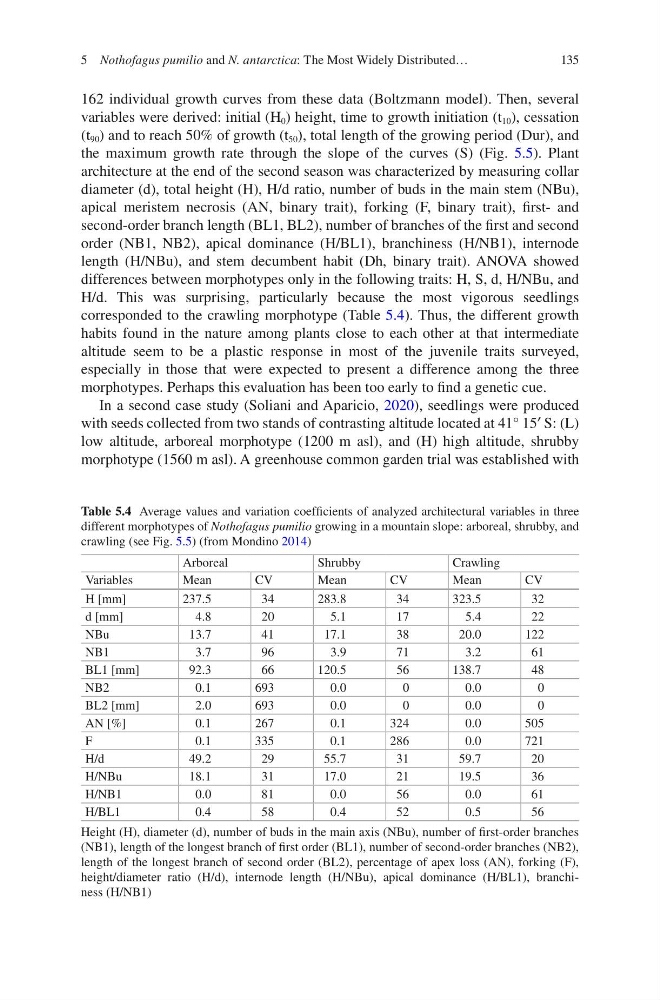
length (H/NBu), and stem decumbent habit (Dh, binary trait). ANOVA showed
differences between morphotypes only in the following traits: H, S, d, H/NBu, and
H/d. This was surprising, particularly because the most vigorous seedlings
corresponded to the crawling morphotype (Table 5.4). Thus, the different growth
habits found in the nature among plants close to each other at that intermediate
altitude seem to be a plastic response in most of the juvenile traits surveyed,
especially in those that were expected to present a difference among the three
morphotypes. Perhaps this evaluation has been too early to find a genetic cue.
In a second case study (Soliani and Aparicio, 2020), seedlings were produced
with seeds collected from two stands of contrasting altitude located at 41° 15′ S: (L)
low altitude, arboreal morphotype (1200 m asl), and (H) high altitude, shrubby
morphotype (1560 m asl). A greenhouse common garden trial was established with
Table 5.4 Average values and variation coefficients of analyzed architectural variables in three
different morphotypes of Nothofagus pumilio growing in a mountain slope: arboreal, shrubby, and
crawling (see Fig. 5.5) (from Mondino 2014)
Arboreal
Shrubby
Crawling
Variables
Mean
CV
Mean
CV
Mean
CV
H [mm]
237.5
34
283.8
34
323.5
32
d [mm]
4.8
20
5.1
17
5.4
22
NBu
13.7
41
17.1
38
20.0
122
NB1
3.7
96
3.9
71
3.2
61
BL1 [mm]
92.3
66
120.5
56
138.7
48
NB2
0.1
693
0.0
0
0.0
0
BL2 [mm]
2.0
693
0.0
0
0.0
0
AN [%]
0.1
267
0.1
324
0.0
505
F
0.1
335
0.1
286
0.0
721
H/d
49.2
29
55.7
31
59.7
20
H/NBu
18.1
31
17.0
21
19.5
36
H/NB1
0.0
81
0.0
56
0.0
61
H/BL1
0.4
58
0.4
52
0.5
56
Height (H), diameter (d), number of buds in the main axis (NBu), number of first-order branches
(NB1), length of the longest branch of first order (BL1), number of second-order branches (NB2),
length of the longest branch of second order (BL2), percentage of apex loss (AN), forking (F),
height/diameter ratio (H/d), internode length (H/NBu), apical dominance (H/BL1), branchiness (H/NB1)
5 Nothofagus pumilio and N. antarctica: The Most Widely Distributed…
162 individual growth curves from these data (Boltzmann model). Then, several
variables were derived: initial (H 0 ) height, time to growth initiation (t 10 ), cessation
(t 90 ) and to reach 50% of growth (t 50 ), total length of the growing period (Dur), and
the maximum growth rate through the slope of the curves (S) (Fig. 5.5). Plant
architecture at the end of the second season was characterized by measuring collar
diameter (d), total height (H), H/d ratio, number of buds in the main stem (NBu),
apical meristem necrosis (AN, binary trait), forking (F, binary trait), first- and
second-order branch length (BL1, BL2), number of branches of the first and second
order (NB1, NB2), apical dominance (H/BL1), branchiness (H/NB1), internode
length (H/NBu), and stem decumbent habit (Dh, binary trait). ANOVA showed
differences between morphotypes only in the following traits: H, S, d, H/NBu, and
H/d. This was surprising, particularly because the most vigorous seedlings
corresponded to the crawling morphotype (Table 5.4). Thus, the different growth
habits found in the nature among plants close to each other at that intermediate
altitude seem to be a plastic response in most of the juvenile traits surveyed,
especially in those that were expected to present a difference among the three
morphotypes. Perhaps this evaluation has been too early to find a genetic cue.
In a second case study (Soliani and Aparicio, 2020), seedlings were produced
with seeds collected from two stands of contrasting altitude located at 41° 15′ S: (L)
low altitude, arboreal morphotype (1200 m asl), and (H) high altitude, shrubby
morphotype (1560 m asl). A greenhouse common garden trial was established with
Table 5.4 Average values and variation coefficients of analyzed architectural variables in three
different morphotypes of Nothofagus pumilio growing in a mountain slope: arboreal, shrubby, and
crawling (see Fig. 5.5) (from Mondino 2014)
Arboreal
Shrubby
Crawling
Variables
Mean
CV
Mean
CV
Mean
CV
H [mm]
237.5
34
283.8
34
323.5
32
d [mm]
4.8
20
5.1
17
5.4
22
NBu
13.7
41
17.1
38
20.0
122
NB1
3.7
96
3.9
71
3.2
61
BL1 [mm]
92.3
66
120.5
56
138.7
48
NB2
0.1
693
0.0
0
0.0
0
BL2 [mm]
2.0
693
0.0
0
0.0
0
AN [%]
0.1
267
0.1
324
0.0
505
F
0.1
335
0.1
286
0.0
721
H/d
49.2
29
55.7
31
59.7
20
H/NBu
18.1
31
17.0
21
19.5
36
H/NB1
0.0
81
0.0
56
0.0
61
H/BL1
0.4
58
0.4
52
0.5
56
Height (H), diameter (d), number of buds in the main axis (NBu), number of first-order branches
(NB1), length of the longest branch of first order (BL1), number of second-order branches (NB2),
length of the longest branch of second order (BL2), percentage of apex loss (AN), forking (F),
height/diameter ratio (H/d), internode length (H/NBu), apical dominance (H/BL1), branchiness (H/NB1)
5 Nothofagus pumilio and N. antarctica: The Most Widely Distributed…