

134
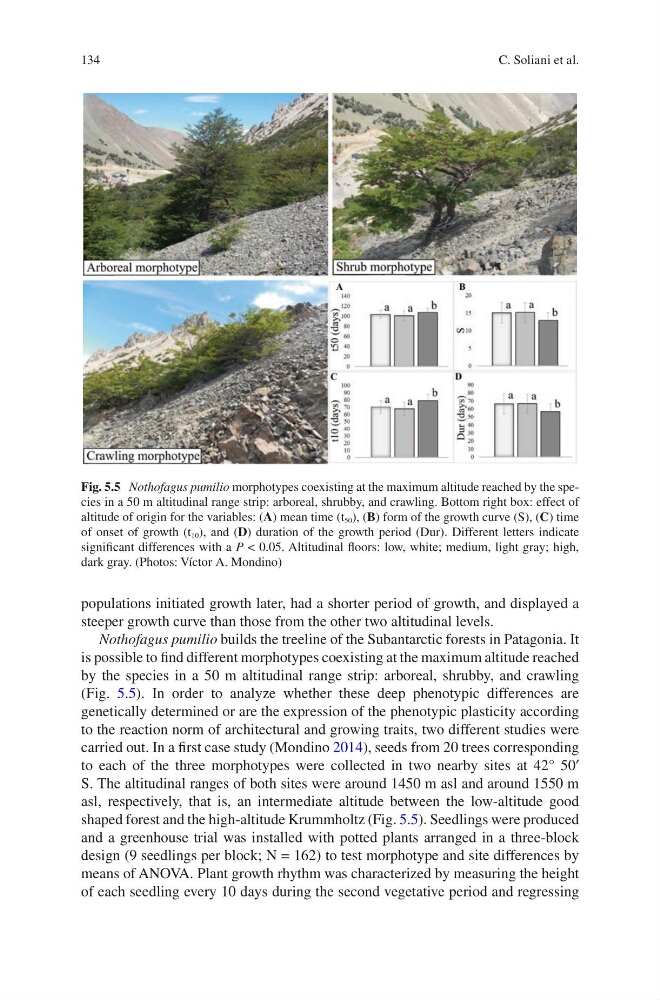
populations initiated growth later, had a shorter period of growth, and displayed a
steeper growth curve than those from the other two altitudinal levels.
Nothofagus pumilio builds the treeline of the Subantarctic forests in Patagonia. It
is possible to find different morphotypes coexisting at the maximum altitude reached
by the species in a 50 m altitudinal range strip: arboreal, shrubby, and crawling
(Fig. 5.5). In order to analyze whether these deep phenotypic differences are
genetically determined or are the expression of the phenotypic plasticity according
to the reaction norm of architectural and growing traits, two different studies were
carried out. In a first case study (Mondino 2014), seeds from 20 trees corresponding
to each of the three morphotypes were collected in two nearby sites at 42° 50′
S. The altitudinal ranges of both sites were around 1450 m asl and around 1550 m
asl, respectively, that is, an intermediate altitude between the low-altitude good
shaped forest and the high-altitude Krummholtz (Fig. 5.5). Seedlings were produced
and a greenhouse trial was installed with potted plants arranged in a three-block
design (9 seedlings per block; N = 162) to test morphotype and site differences by
means of ANOVA. Plant growth rhythm was characterized by measuring the height
of each seedling every 10 days during the second vegetative period and regressing
Fig. 5.5 Nothofagus pumilio morphotypes coexisting at the maximum altitude reached by the species in a 50 m altitudinal range strip: arboreal, shrubby, and crawling. Bottom right box: effect of
altitude of origin for the variables: (A) mean time (t 50 ), (B) form of the growth curve (S), (C) time
of onset of growth (t 10 ), and (D) duration of the growth period (Dur). Different letters indicate
significant differences with a P < 0.05. Altitudinal floors: low, white; medium, light gray; high,
dark gray. (Photos: Víctor A. Mondino)
C. Soliani et al.
populations initiated growth later, had a shorter period of growth, and displayed a
steeper growth curve than those from the other two altitudinal levels.
Nothofagus pumilio builds the treeline of the Subantarctic forests in Patagonia. It
is possible to find different morphotypes coexisting at the maximum altitude reached
by the species in a 50 m altitudinal range strip: arboreal, shrubby, and crawling
(Fig. 5.5). In order to analyze whether these deep phenotypic differences are
genetically determined or are the expression of the phenotypic plasticity according
to the reaction norm of architectural and growing traits, two different studies were
carried out. In a first case study (Mondino 2014), seeds from 20 trees corresponding
to each of the three morphotypes were collected in two nearby sites at 42° 50′
S. The altitudinal ranges of both sites were around 1450 m asl and around 1550 m
asl, respectively, that is, an intermediate altitude between the low-altitude good
shaped forest and the high-altitude Krummholtz (Fig. 5.5). Seedlings were produced
and a greenhouse trial was installed with potted plants arranged in a three-block
design (9 seedlings per block; N = 162) to test morphotype and site differences by
means of ANOVA. Plant growth rhythm was characterized by measuring the height
of each seedling every 10 days during the second vegetative period and regressing
Fig. 5.5 Nothofagus pumilio morphotypes coexisting at the maximum altitude reached by the species in a 50 m altitudinal range strip: arboreal, shrubby, and crawling. Bottom right box: effect of
altitude of origin for the variables: (A) mean time (t 50 ), (B) form of the growth curve (S), (C) time
of onset of growth (t 10 ), and (D) duration of the growth period (Dur). Different letters indicate
significant differences with a P < 0.05. Altitudinal floors: low, white; medium, light gray; high,
dark gray. (Photos: Víctor A. Mondino)
C. Soliani et al.