

109
directly proportional to shoot size; the number of pistillate inflorescences per shoot
is more dependent upon shoot size than the number of staminate inflorescences
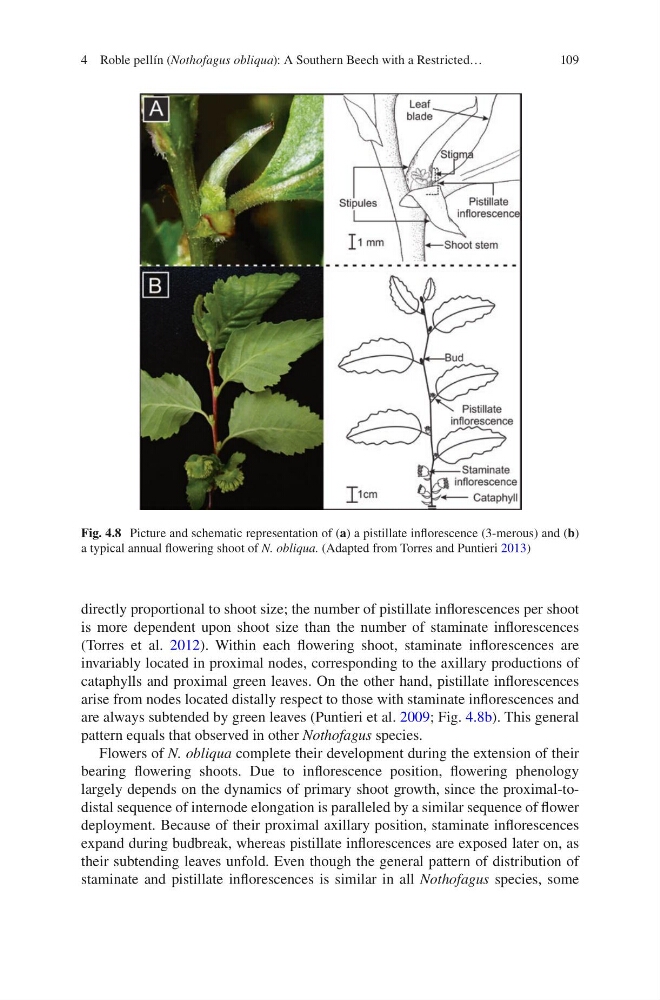
(Torres et al. 2012). Within each flowering shoot, staminate inflorescences are
invariably located in proximal nodes, corresponding to the axillary productions of
cataphylls and proximal green leaves. On the other hand, pistillate inflorescences
arise from nodes located distally respect to those with staminate inflorescences and
are always subtended by green leaves (Puntieri et al. 2009; Fig. 4.8b). This general
pattern equals that observed in other Nothofagus species.
Flowers of N. obliqua complete their development during the extension of their
bearing flowering shoots. Due to inflorescence position, flowering phenology
largely depends on the dynamics of primary shoot growth, since the proximal-todistal sequence of internode elongation is paralleled by a similar sequence of flower
deployment. Because of their proximal axillary position, staminate inflorescences
expand during budbreak, whereas pistillate inflorescences are exposed later on, as
their subtending leaves unfold. Even though the general pattern of distribution of
staminate and pistillate inflorescences is similar in all Nothofagus species, some
Fig. 4.8 Picture and schematic representation of (a) a pistillate inflorescence (3-merous) and (b)
a typical annual flowering shoot of N. obliqua. (Adapted from Torres and Puntieri 2013)
4 Roble pellín (Nothofagus obliqua): A Southern Beech with a Restricted…
directly proportional to shoot size; the number of pistillate inflorescences per shoot
is more dependent upon shoot size than the number of staminate inflorescences
(Torres et al. 2012). Within each flowering shoot, staminate inflorescences are
invariably located in proximal nodes, corresponding to the axillary productions of
cataphylls and proximal green leaves. On the other hand, pistillate inflorescences
arise from nodes located distally respect to those with staminate inflorescences and
are always subtended by green leaves (Puntieri et al. 2009; Fig. 4.8b). This general
pattern equals that observed in other Nothofagus species.
Flowers of N. obliqua complete their development during the extension of their
bearing flowering shoots. Due to inflorescence position, flowering phenology
largely depends on the dynamics of primary shoot growth, since the proximal-todistal sequence of internode elongation is paralleled by a similar sequence of flower
deployment. Because of their proximal axillary position, staminate inflorescences
expand during budbreak, whereas pistillate inflorescences are exposed later on, as
their subtending leaves unfold. Even though the general pattern of distribution of
staminate and pistillate inflorescences is similar in all Nothofagus species, some
Fig. 4.8 Picture and schematic representation of (a) a pistillate inflorescence (3-merous) and (b)
a typical annual flowering shoot of N. obliqua. (Adapted from Torres and Puntieri 2013)
4 Roble pellín (Nothofagus obliqua): A Southern Beech with a Restricted…