

Appendix 245
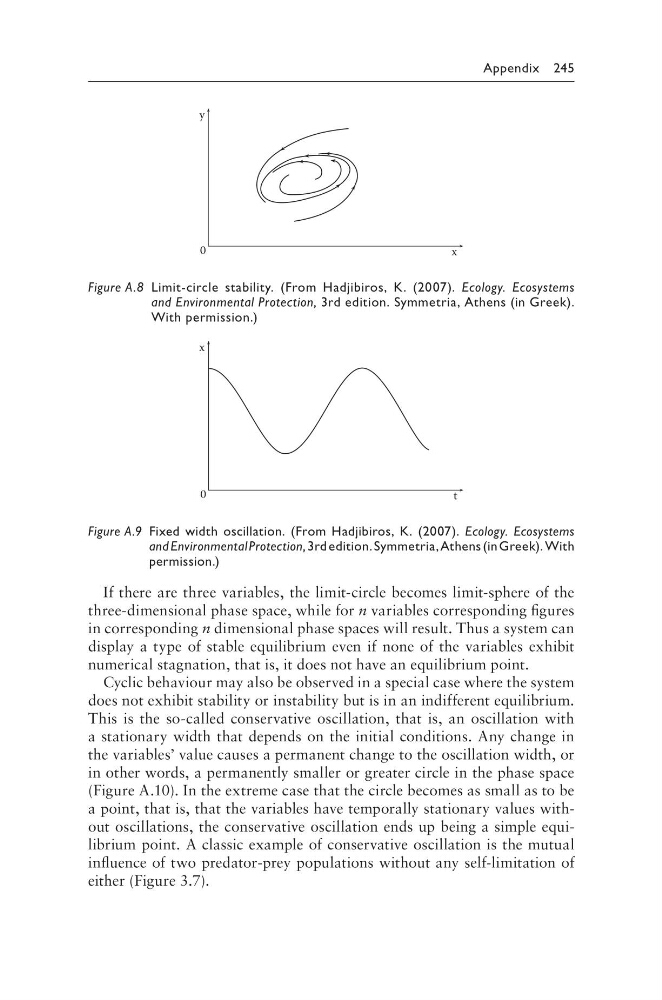
If there are three variables, the limit-circle becomes limit-sphere of the
three-dimensional phase space, while for n variables corresponding figures
in corresponding n dimensional phase spaces will result. Thus a system can
display a type of stable equilibrium even if none of the variables exhibit
numerical stagnation, that is, it does not have an equilibrium point.
Cyclic behaviour may also be observed in a special case where the system
does not exhibit stability or instability but is in an indifferent equilibrium.
This is the so-called conservative oscillation, that is, an oscillation with
a stationary width that depends on the initial conditions. Any change in
the variables’ value causes a permanent change to the oscillation width, or
in other words, a permanently smaller or greater circle in the phase space
(Figure A.10). In the extreme case that the circle becomes as small as to be
out oscillations, the conservative oscillation ends up being a simple equilibrium point. A classic example of conservative oscillation is the mutual
influence of two predator-prey populations without any self-limitation of
either (Figure 3.7).
0
x
y
Figure A.8 Limit-circle stability. (From Hadjibiros, K. (2007). Ecology. Ecosystems
and Environmental Protection, 3rd edition. Symmetria, Athens (in Greek).
With permission.)
0
t
x
Figure A.9 Fixed width oscillation. (From Hadjibiros, K. (2007). Ecology. Ecosystems
and Environmental Protection, 3rd edition. Symmetria, Athens (in Greek). With
permission.)
If there are three variables, the limit-circle becomes limit-sphere of the
three-dimensional phase space, while for n variables corresponding figures
in corresponding n dimensional phase spaces will result. Thus a system can
display a type of stable equilibrium even if none of the variables exhibit
numerical stagnation, that is, it does not have an equilibrium point.
Cyclic behaviour may also be observed in a special case where the system
does not exhibit stability or instability but is in an indifferent equilibrium.
This is the so-called conservative oscillation, that is, an oscillation with
a stationary width that depends on the initial conditions. Any change in
the variables’ value causes a permanent change to the oscillation width, or
in other words, a permanently smaller or greater circle in the phase space
(Figure A.10). In the extreme case that the circle becomes as small as to be
out oscillations, the conservative oscillation ends up being a simple equilibrium point. A classic example of conservative oscillation is the mutual
influence of two predator-prey populations without any self-limitation of
either (Figure 3.7).
0
x
y
Figure A.8 Limit-circle stability. (From Hadjibiros, K. (2007). Ecology. Ecosystems
and Environmental Protection, 3rd edition. Symmetria, Athens (in Greek).
With permission.)
0
t
x
Figure A.9 Fixed width oscillation. (From Hadjibiros, K. (2007). Ecology. Ecosystems
and Environmental Protection, 3rd edition. Symmetria, Athens (in Greek). With
permission.)