

244 Appendix
leads the system to convergence towards the equilibrium point, which is
something that serves the control. In the case of positive feedback, the
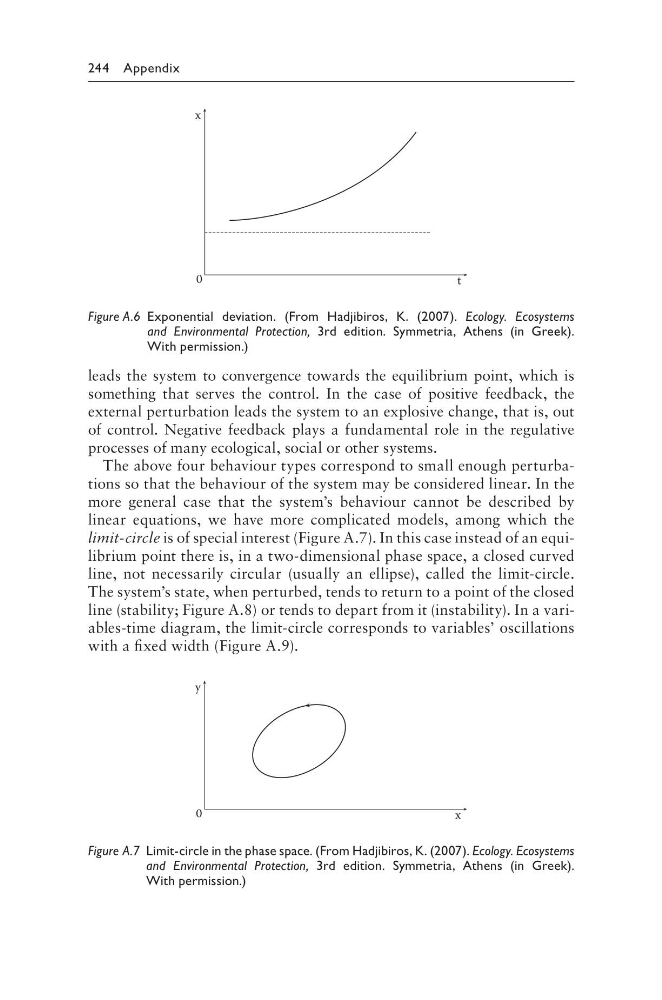
external perturbation leads the system to an explosive change, that is, out
of control. Negative feedback plays a fundamental role in the regulative
processes of many ecological, social or other systems.
The above four behaviour types correspond to small enough perturbations so that the behaviour of the system may be considered linear. In the
more general case that the system’s behaviour cannot be described by
linear equations, we have more complicated models, among which the
limit-circle is of special interest (Figure A.7). In this case instead of an equilibrium point there is, in a two-dimensional phase space, a closed curved
line, not necessarily circular (usually an ellipse), called the limit-circle.
The system’s state, when perturbed, tends to return to a point of the closed
line (stability; Figure A.8) or tends to depart from it (instability). In a variables-time diagram, the limit-circle corresponds to variables’ oscillations
with a fixed width (Figure A.9).
0
x
y
Figure A.7 Limit-circle in the phase space. (From Hadjibiros, K. (2007). Ecology. Eco systems
and Environmental Protection, 3rd edition. Symmetria, Athens (in Greek).
With permission.)
0
t
x
Figure A.6 Exponential deviation. (From Hadjibiros, K. (2007). Ecology. Ecosystems
and Environmental Protection, 3rd edition. Symmetria, Athens (in Greek).
With permission.)
leads the system to convergence towards the equilibrium point, which is
something that serves the control. In the case of positive feedback, the
external perturbation leads the system to an explosive change, that is, out
of control. Negative feedback plays a fundamental role in the regulative
processes of many ecological, social or other systems.
The above four behaviour types correspond to small enough perturbations so that the behaviour of the system may be considered linear. In the
more general case that the system’s behaviour cannot be described by
linear equations, we have more complicated models, among which the
limit-circle is of special interest (Figure A.7). In this case instead of an equilibrium point there is, in a two-dimensional phase space, a closed curved
line, not necessarily circular (usually an ellipse), called the limit-circle.
The system’s state, when perturbed, tends to return to a point of the closed
line (stability; Figure A.8) or tends to depart from it (instability). In a variables-time diagram, the limit-circle corresponds to variables’ oscillations
with a fixed width (Figure A.9).
0
x
y
Figure A.7 Limit-circle in the phase space. (From Hadjibiros, K. (2007). Ecology. Eco systems
and Environmental Protection, 3rd edition. Symmetria, Athens (in Greek).
With permission.)
0
t
x
Figure A.6 Exponential deviation. (From Hadjibiros, K. (2007). Ecology. Ecosystems
and Environmental Protection, 3rd edition. Symmetria, Athens (in Greek).
With permission.)