

Pollution Control Technology 191
by aerobic microorganisms in the presence of oxygen; it takes place at a
relatively high speed and the greatest part of the organic matter is used for
synthesis. In the second, disintegration takes place via the help of anaerobic
microorganisms, while the greatest part of organic matter is transformed
to inorganic compounds and methane. For wastewater treatment, aerobic
biological processes are usually used. Anaerobic processes are generally
used less often, but are used more often for sludge treatment.
The possibility for biological treatment mainly depends on the following factors:
• The degree of wastewater’s ability for disintegration
• The presence of necessary nutrients, such as nitrogen, phosphorus,
vitamins and various trace elements
• The pH, which should range between 6 and 9
• The absence of toxic substances; their concentrations should not exceed
certain limits beyond which they are destructive for the microorganisms
In many industrial liquid wastes, as opposed to the usual urban wastewater, the above preconditions are not met. Thus special pre-treatment
processes are often required for industrial liquid waste as for example for
metal and other toxic substance removal or for pH neutralization. After
this, those wastes can usually undergo biological treatment.
The most often used processes for biological treatment of wastewater are
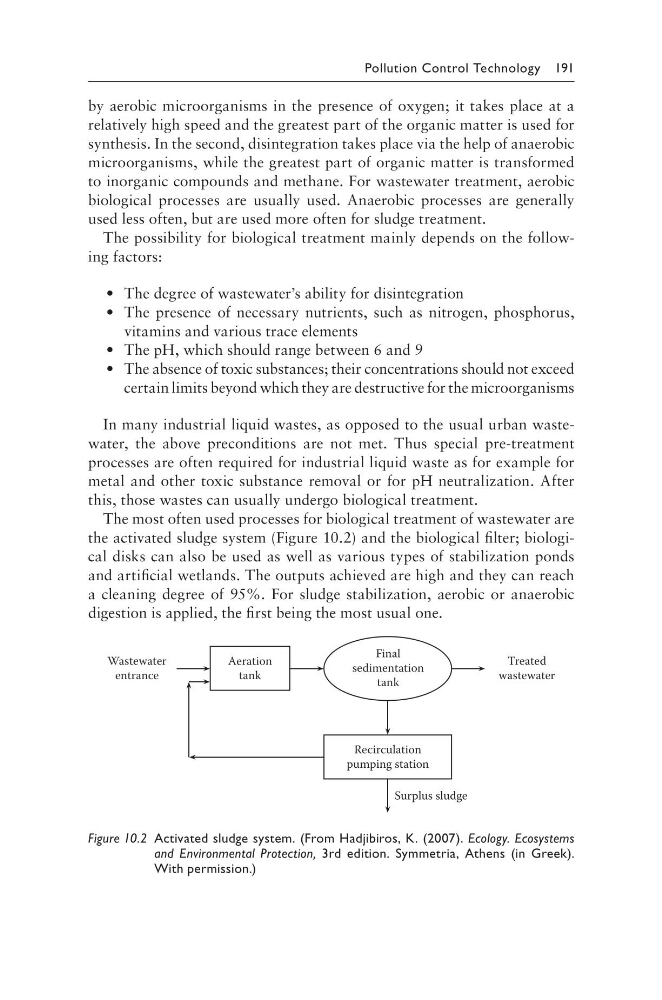
the activated sludge system (Figure 10.2) and the biological filter; biological disks can also be used as well as various types of stabilization ponds
and artificial wetlands. The outputs achieved are high and they can reach
a cleaning degree of 95%. For sludge stabilization, aerobic or anaerobic
digestion is applied, the first being the most usual one.
Wastewater
entrance
Aeration
tank
Final
sedimentation
tank
Treated
wastewater
Recirculation
pumping station
Surplus sludge
Figure 10.2 Activated sludge system. (From Hadjibiros, K. (2007). Ecology. Ecosystems
and Environmental Protection, 3rd edition. Symmetria, Athens (in Greek).
With permission.)
by aerobic microorganisms in the presence of oxygen; it takes place at a
relatively high speed and the greatest part of the organic matter is used for
synthesis. In the second, disintegration takes place via the help of anaerobic
microorganisms, while the greatest part of organic matter is transformed
to inorganic compounds and methane. For wastewater treatment, aerobic
biological processes are usually used. Anaerobic processes are generally
used less often, but are used more often for sludge treatment.
The possibility for biological treatment mainly depends on the following factors:
• The degree of wastewater’s ability for disintegration
• The presence of necessary nutrients, such as nitrogen, phosphorus,
vitamins and various trace elements
• The pH, which should range between 6 and 9
• The absence of toxic substances; their concentrations should not exceed
certain limits beyond which they are destructive for the microorganisms
In many industrial liquid wastes, as opposed to the usual urban wastewater, the above preconditions are not met. Thus special pre-treatment
processes are often required for industrial liquid waste as for example for
metal and other toxic substance removal or for pH neutralization. After
this, those wastes can usually undergo biological treatment.
The most often used processes for biological treatment of wastewater are
the activated sludge system (Figure 10.2) and the biological filter; biological disks can also be used as well as various types of stabilization ponds
and artificial wetlands. The outputs achieved are high and they can reach
a cleaning degree of 95%. For sludge stabilization, aerobic or anaerobic
digestion is applied, the first being the most usual one.
Wastewater
entrance
Aeration
tank
Final
sedimentation
tank
Treated
wastewater
Recirculation
pumping station
Surplus sludge
Figure 10.2 Activated sludge system. (From Hadjibiros, K. (2007). Ecology. Ecosystems
and Environmental Protection, 3rd edition. Symmetria, Athens (in Greek).
With permission.)