

190 Ecology and Applied Environmental Science
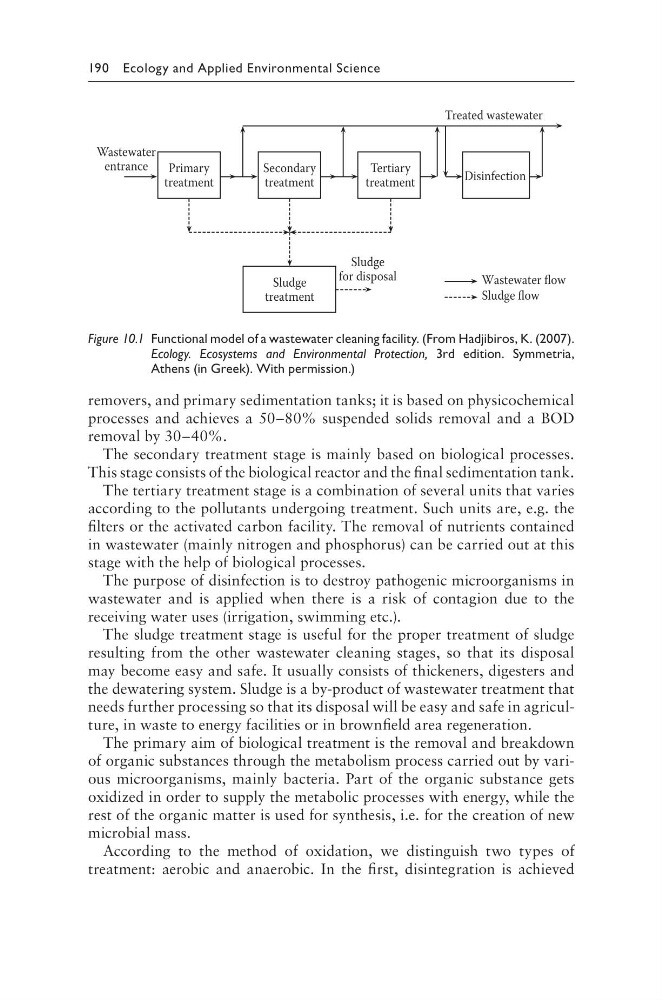
removers, and primary sedimentation tanks; it is based on physicochemical
processes and achieves a 50–80% suspended solids removal and a BOD
removal by 30–40%.
The secondary treatment stage is mainly based on biological processes.
This stage consists of the biological reactor and the final sedimentation tank.
The tertiary treatment stage is a combination of several units that varies
according to the pollutants undergoing treatment. Such units are, e.g. the
filters or the activated carbon facility. The removal of nutrients contained
in wastewater (mainly nitrogen and phosphorus) can be carried out at this
stage with the help of biological processes.
The purpose of disinfection is to destroy pathogenic microorganisms in
wastewater and is applied when there is a risk of contagion due to the
receiving water uses (irrigation, swimming etc.).
The sludge treatment stage is useful for the proper treatment of sludge
resulting from the other wastewater cleaning stages, so that its disposal
may become easy and safe. It usually consists of thickeners, digesters and
the dewatering system. Sludge is a by-product of wastewater treatment that
needs further processing so that its disposal will be easy and safe in agriculture, in waste to energy facilities or in brownfield area regeneration.
The primary aim of biological treatment is the removal and breakdown
of organic substances through the metabolism process carried out by various microorganisms, mainly bacteria. Part of the organic substance gets
oxidized in order to supply the metabolic processes with energy, while the
rest of the organic matter is used for synthesis, i.e. for the creation of new
microbial mass.
According to the method of oxidation, we distinguish two types of
treatment: aerobic and anaerobic. In the first, disintegration is achieved
Primary
treatment
Secondary
treatment
Tertiary
treatment
Wastewater
entrance
Sludge
treatment
Sludge
for disposal
Disinfection
Treated wastewater
Wastewater flow
Sludge flow
Figure 10.1 Functional model of a wastewater cleaning facility. (From Hadjibiros, K. (2007).
Ecology. Ecosystems and Environmental Protection, 3rd edition. Symmetria,
Athens (in Greek). With permission.)
removers, and primary sedimentation tanks; it is based on physicochemical
processes and achieves a 50–80% suspended solids removal and a BOD
removal by 30–40%.
The secondary treatment stage is mainly based on biological processes.
This stage consists of the biological reactor and the final sedimentation tank.
The tertiary treatment stage is a combination of several units that varies
according to the pollutants undergoing treatment. Such units are, e.g. the
filters or the activated carbon facility. The removal of nutrients contained
in wastewater (mainly nitrogen and phosphorus) can be carried out at this
stage with the help of biological processes.
The purpose of disinfection is to destroy pathogenic microorganisms in
wastewater and is applied when there is a risk of contagion due to the
receiving water uses (irrigation, swimming etc.).
The sludge treatment stage is useful for the proper treatment of sludge
resulting from the other wastewater cleaning stages, so that its disposal
may become easy and safe. It usually consists of thickeners, digesters and
the dewatering system. Sludge is a by-product of wastewater treatment that
needs further processing so that its disposal will be easy and safe in agriculture, in waste to energy facilities or in brownfield area regeneration.
The primary aim of biological treatment is the removal and breakdown
of organic substances through the metabolism process carried out by various microorganisms, mainly bacteria. Part of the organic substance gets
oxidized in order to supply the metabolic processes with energy, while the
rest of the organic matter is used for synthesis, i.e. for the creation of new
microbial mass.
According to the method of oxidation, we distinguish two types of
treatment: aerobic and anaerobic. In the first, disintegration is achieved
Primary
treatment
Secondary
treatment
Tertiary
treatment
Wastewater
entrance
Sludge
treatment
Sludge
for disposal
Disinfection
Treated wastewater
Wastewater flow
Sludge flow
Figure 10.1 Functional model of a wastewater cleaning facility. (From Hadjibiros, K. (2007).
Ecology. Ecosystems and Environmental Protection, 3rd edition. Symmetria,
Athens (in Greek). With permission.)