

180 Ecology and Applied Environmental Science
the surface of the Earth entails an increase of the tropospheric O 3 as well
as a decrease of the sea algae photosynthesis. Both these changes entail an
amplification of the greenhouse effect.
In the beginning of the 1990s, a significant deceleration of CO 2 , CH 4 ,
and CFC’s increase rate was observed. For the first two gases, a probable
cause is considered to be the great eruption of the volcano Pinatubo in the
Philippines in June 1991; it supplied large quantities of SO 2 to the stratosphere causing significant physicochemical changes. Also, the improvement
of the control of the natural gas escapes has probably contributed to the
reduction of CH 4 increase.
The significant reduction of CFC’s increase rate observed today is
undoubtedly due to the international agreements for their reduction,
which decelerate amplification of the greenhouse effect. Reduction of CH 4
emissions is also an important issue. However, long-term control of CO 2
increase remains the greatest challenge for dealing with the greenhouse
effect. Reducing energy needs, promoting material recycling and CO 2 storage in geological formations (CCS, carbon capture and storage) would give
positive results. The issue of energy production is decisive, especially that
of electricity production and energy saving. Renewable energy sources are
a promising alternative that offers environmental security and can cover
5
0
15
10
“Smog” ozone
Tropospheric ozone
20 25
5
10
15
20
Altitude (kilometers)
25
30
35
Stratospheric ozone
((e ozone layer)
Atmospheric ozone
Οzone amount
(pressure, milli – Pascals)
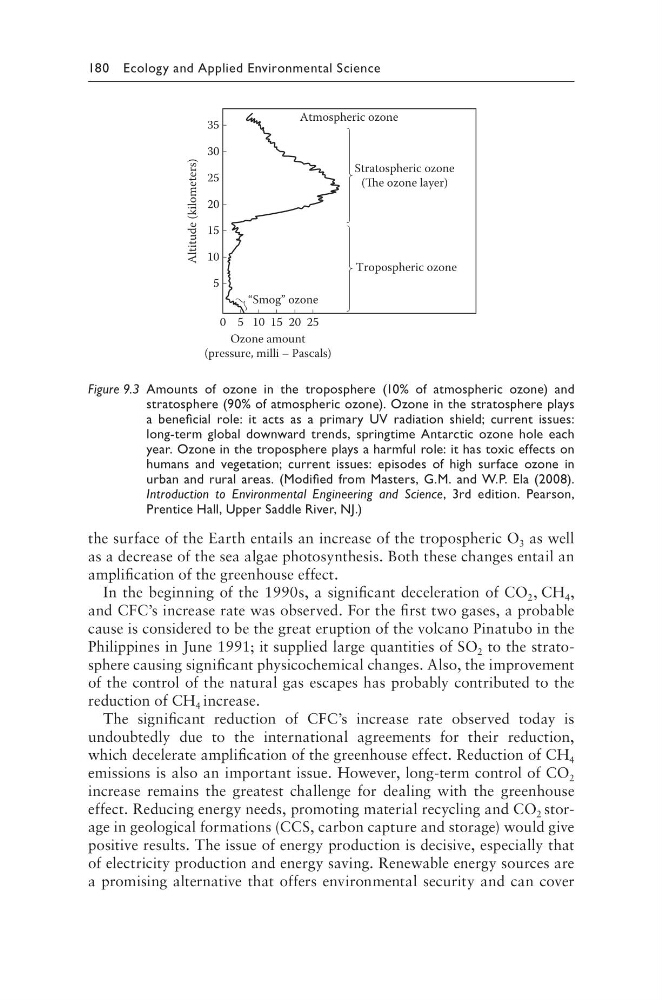
Figure 9.3 Amounts of ozone in the troposphere (10% of atmospheric ozone) and
stratosphere (90% of atmospheric ozone). Ozone in the stratosphere plays
a beneficial role: it acts as a primary UV radiation shield; current issues:
long-term global downward trends, springtime Antarctic ozone hole each
year. Ozone in the troposphere plays a harmful role: it has toxic effects on
humans and vegetation; current issues: episodes of high surface ozone in
urban and rural areas. (Modified from Masters, G.M. and W.P. Ela (2008).
Introduction to Environmental Engineering and Science, 3rd edition. Pearson,
Prentice Hall, Upper Saddle River, NJ.)
the surface of the Earth entails an increase of the tropospheric O 3 as well
as a decrease of the sea algae photosynthesis. Both these changes entail an
amplification of the greenhouse effect.
In the beginning of the 1990s, a significant deceleration of CO 2 , CH 4 ,
and CFC’s increase rate was observed. For the first two gases, a probable
cause is considered to be the great eruption of the volcano Pinatubo in the
Philippines in June 1991; it supplied large quantities of SO 2 to the stratosphere causing significant physicochemical changes. Also, the improvement
of the control of the natural gas escapes has probably contributed to the
reduction of CH 4 increase.
The significant reduction of CFC’s increase rate observed today is
undoubtedly due to the international agreements for their reduction,
which decelerate amplification of the greenhouse effect. Reduction of CH 4
emissions is also an important issue. However, long-term control of CO 2
increase remains the greatest challenge for dealing with the greenhouse
effect. Reducing energy needs, promoting material recycling and CO 2 storage in geological formations (CCS, carbon capture and storage) would give
positive results. The issue of energy production is decisive, especially that
of electricity production and energy saving. Renewable energy sources are
a promising alternative that offers environmental security and can cover
5
0
15
10
“Smog” ozone
Tropospheric ozone
20 25
5
10
15
20
Altitude (kilometers)
25
30
35
Stratospheric ozone
((e ozone layer)
Atmospheric ozone
Οzone amount
(pressure, milli – Pascals)
Figure 9.3 Amounts of ozone in the troposphere (10% of atmospheric ozone) and
stratosphere (90% of atmospheric ozone). Ozone in the stratosphere plays
a beneficial role: it acts as a primary UV radiation shield; current issues:
long-term global downward trends, springtime Antarctic ozone hole each
year. Ozone in the troposphere plays a harmful role: it has toxic effects on
humans and vegetation; current issues: episodes of high surface ozone in
urban and rural areas. (Modified from Masters, G.M. and W.P. Ela (2008).
Introduction to Environmental Engineering and Science, 3rd edition. Pearson,
Prentice Hall, Upper Saddle River, NJ.)