

178 Ecology and Applied Environmental Science
natural phenomenon, now has become the most serious environmental
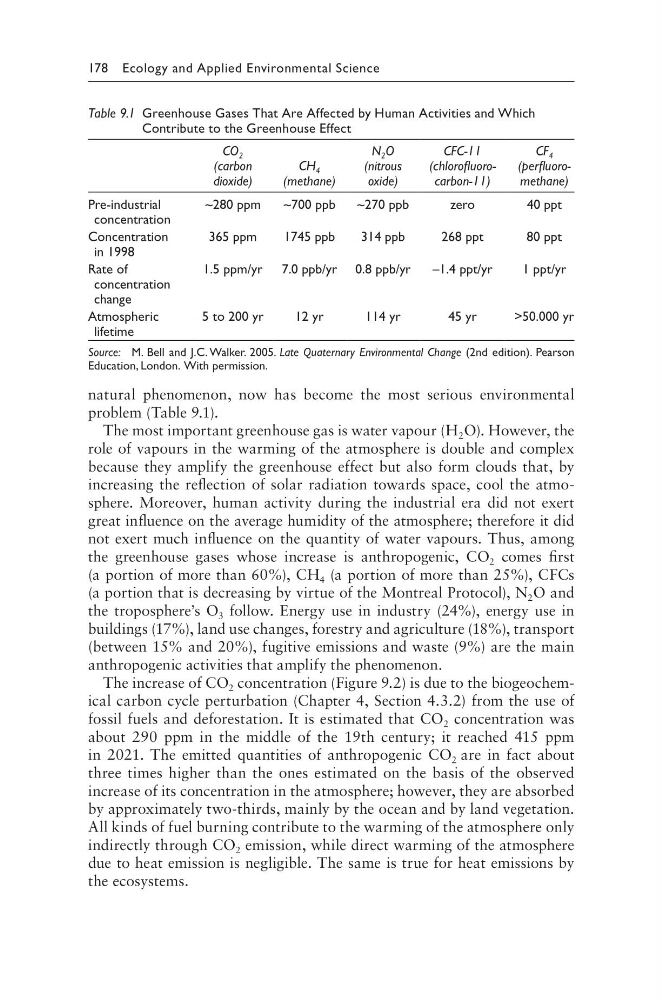
problem (Table 9.1).
The most important greenhouse gas is water vapour (H 2 O). However, the
role of vapours in the warming of the atmosphere is double and complex
because they amplify the greenhouse effect but also form clouds that, by
increasing the reflection of solar radiation towards space, cool the atmosphere. Moreover, human activity during the industrial era did not exert
great influence on the average humidity of the atmosphere; therefore it did
not exert much influence on the quantity of water vapours. Thus, among
the greenhouse gases whose increase is anthropogenic, CO 2 comes first
(a portion of more than 60%), CH 4 (a portion of more than 25%), CFCs
(a portion that is decreasing by virtue of the Montreal Protocol), N 2 O and
the troposphere’s O 3 follow. Energy use in industry (24%), energy use in
buildings (17%), land use changes, forestry and agriculture (18%), transport
(between 15% and 20%), fugitive emissions and waste (9%) are the main
anthropogenic activities that amplify the phenomenon.
The increase of CO 2 concentration (Figure 9.2) is due to the biogeochemical carbon cycle perturbation (Chapter 4, Section 4.3.2) from the use of
fossil fuels and deforestation. It is estimated that CO 2 concentration was
about 290 ppm in the middle of the 19th century; it reached 415 ppm
in 2021. The emitted quantities of anthropogenic CO 2 are in fact about
three times higher than the ones estimated on the basis of the observed
increase of its concentration in the atmosphere; however, they are absorbed
by approximately two-thirds, mainly by the ocean and by land vegetation.
All kinds of fuel burning contribute to the warming of the atmosphere only
indirectly through CO 2 emission, while direct warming of the atmosphere
due to heat emission is negligible. The same is true for heat emissions by
the ecosystems.
Table 9.1 Greenhouse Gases That Are Affected by Human Activities and Which
Contribute to the Greenhouse Effect
CO 2
(carbon
dioxide)
CH 4
(methane)
N 2 O
(nitrous
oxide)
CFC-11
(chlorofluorocarbon-11)
CF 4
(perfluoromethane)
Pre-industrial
concentration
~280 ppm
~700 ppb
~270 ppb
zero
40 ppt
Concentration
in 1998
365 ppm
1745 ppb
314 ppb
268 ppt
80 ppt
Rate of
concentration
change
1.5 ppm/yr 7.0 ppb/yr 0.8 ppb/yr
–1.4 ppt/yr
1 ppt/yr
Atmospheric
lifetime
5 to 200 yr
12 yr
114 yr
45 yr
>50.000 yr
Source: M. Bell and J.C. Walker. 2005. Late Quaternary Environmental Change (2nd edition). Pearson
Education, London. With permission.
natural phenomenon, now has become the most serious environmental
problem (Table 9.1).
The most important greenhouse gas is water vapour (H 2 O). However, the
role of vapours in the warming of the atmosphere is double and complex
because they amplify the greenhouse effect but also form clouds that, by
increasing the reflection of solar radiation towards space, cool the atmosphere. Moreover, human activity during the industrial era did not exert
great influence on the average humidity of the atmosphere; therefore it did
not exert much influence on the quantity of water vapours. Thus, among
the greenhouse gases whose increase is anthropogenic, CO 2 comes first
(a portion of more than 60%), CH 4 (a portion of more than 25%), CFCs
(a portion that is decreasing by virtue of the Montreal Protocol), N 2 O and
the troposphere’s O 3 follow. Energy use in industry (24%), energy use in
buildings (17%), land use changes, forestry and agriculture (18%), transport
(between 15% and 20%), fugitive emissions and waste (9%) are the main
anthropogenic activities that amplify the phenomenon.
The increase of CO 2 concentration (Figure 9.2) is due to the biogeochemical carbon cycle perturbation (Chapter 4, Section 4.3.2) from the use of
fossil fuels and deforestation. It is estimated that CO 2 concentration was
about 290 ppm in the middle of the 19th century; it reached 415 ppm
in 2021. The emitted quantities of anthropogenic CO 2 are in fact about
three times higher than the ones estimated on the basis of the observed
increase of its concentration in the atmosphere; however, they are absorbed
by approximately two-thirds, mainly by the ocean and by land vegetation.
All kinds of fuel burning contribute to the warming of the atmosphere only
indirectly through CO 2 emission, while direct warming of the atmosphere
due to heat emission is negligible. The same is true for heat emissions by
the ecosystems.
Table 9.1 Greenhouse Gases That Are Affected by Human Activities and Which
Contribute to the Greenhouse Effect
CO 2
(carbon
dioxide)
CH 4
(methane)
N 2 O
(nitrous
oxide)
CFC-11
(chlorofluorocarbon-11)
CF 4
(perfluoromethane)
Pre-industrial
concentration
~280 ppm
~700 ppb
~270 ppb
zero
40 ppt
Concentration
in 1998
365 ppm
1745 ppb
314 ppb
268 ppt
80 ppt
Rate of
concentration
change
1.5 ppm/yr 7.0 ppb/yr 0.8 ppb/yr
–1.4 ppt/yr
1 ppt/yr
Atmospheric
lifetime
5 to 200 yr
12 yr
114 yr
45 yr
>50.000 yr
Source: M. Bell and J.C. Walker. 2005. Late Quaternary Environmental Change (2nd edition). Pearson
Education, London. With permission.