

162 Ecology and Applied Environmental Science
It is important to note that a body of water is not polluted with atoms
or molecules of P or N, but with inorganic or organic compounds containing phosphorus or nitrogen. The use of fertilizers in quantities that
exceed plant uptake causes excess P and N salts to be carried to surface and
underground water bodies via surface runoff and infiltration. Urban and
stock-raising wastewater as well as many industrial wastes contain substantial quantities of P and N in inorganic and organic forms. Through the
operation of decomposing microorganisms in wastewater treatment plants
and in natural ecosystems (aquatic or terrestrial), organic nitrogen undergoes ammonification followed by nitrification, and organic phosphorus is
converted into phosphates. Thus the whole P and N content can in principle end up in the ground and in bodies of water, in the form of phosphate
anions PO 4
– , ammonium nitrogen NH 4
+ or NH 3 and nitrate anions NO 3
– .
With the usual cations Ca ++ , Al +++ , Fe +++ , phosphates form insoluble compounds and this greatly restricts the movement of inorganic phosphorus
from the ground towards surface and particularly towards underground
bodies of water. This is why pollution of water bodies with phosphorus is
usually due not so much to overfertilisation of fields as to discharge of wastewater through outfalls.
For usual pH values, ammonium nitrogen occurs mainly as ammonium
NH 4
+ , which is held by negative colloids in the soil. In aerobic conditions,
however, nitrifying bacteria convert it into NO 3
– . In this form it is mobile
and easily pollutes surface and underground bodies of water. Ammonium
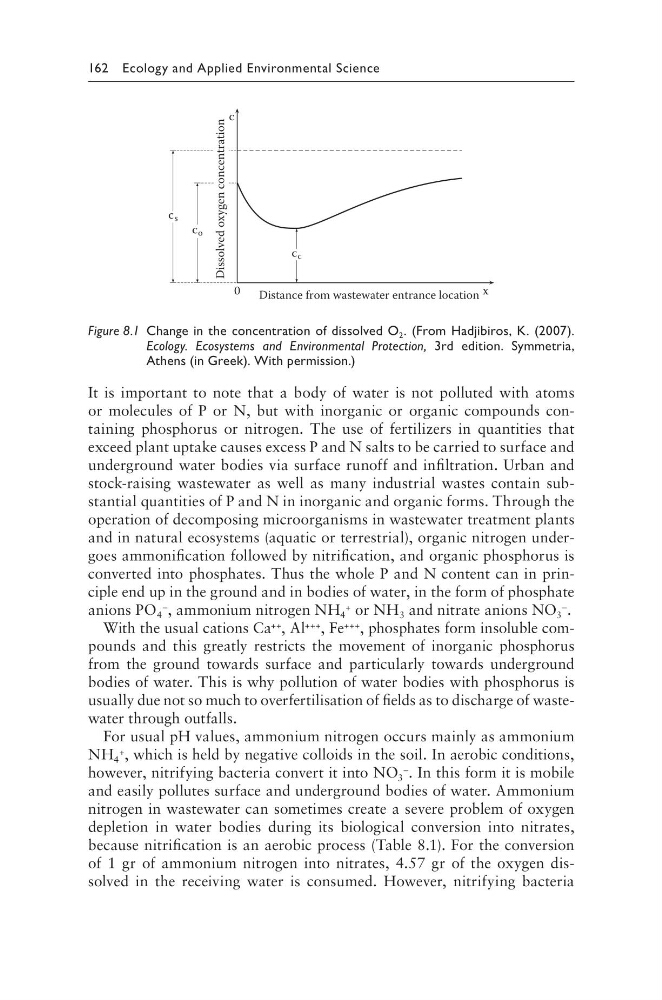
nitrogen in wastewater can sometimes create a severe problem of oxygen
depletion in water bodies during its biological conversion into nitrates,
because nitrification is an aerobic process (Table 8.1). For the conversion
of 1 gr of ammonium nitrogen into nitrates, 4.57 gr of the oxygen dissolved in the receiving water is consumed. However, nitrifying bacteria
Distance from wastewater entrance location
0
x
c c
c ο
c s
c
Dissolved oxygen concentration
Figure 8.1 Change in the concentration of dissolved O 2 . (From Hadjibiros, K. (2007).
Ecology. Ecosystems and Environmental Protection, 3rd edition. Symmetria,
Athens (in Greek). With permission.)
It is important to note that a body of water is not polluted with atoms
or molecules of P or N, but with inorganic or organic compounds containing phosphorus or nitrogen. The use of fertilizers in quantities that
exceed plant uptake causes excess P and N salts to be carried to surface and
underground water bodies via surface runoff and infiltration. Urban and
stock-raising wastewater as well as many industrial wastes contain substantial quantities of P and N in inorganic and organic forms. Through the
operation of decomposing microorganisms in wastewater treatment plants
and in natural ecosystems (aquatic or terrestrial), organic nitrogen undergoes ammonification followed by nitrification, and organic phosphorus is
converted into phosphates. Thus the whole P and N content can in principle end up in the ground and in bodies of water, in the form of phosphate
anions PO 4
– , ammonium nitrogen NH 4
+ or NH 3 and nitrate anions NO 3
– .
With the usual cations Ca ++ , Al +++ , Fe +++ , phosphates form insoluble compounds and this greatly restricts the movement of inorganic phosphorus
from the ground towards surface and particularly towards underground
bodies of water. This is why pollution of water bodies with phosphorus is
usually due not so much to overfertilisation of fields as to discharge of wastewater through outfalls.
For usual pH values, ammonium nitrogen occurs mainly as ammonium
NH 4
+ , which is held by negative colloids in the soil. In aerobic conditions,
however, nitrifying bacteria convert it into NO 3
– . In this form it is mobile
and easily pollutes surface and underground bodies of water. Ammonium
nitrogen in wastewater can sometimes create a severe problem of oxygen
depletion in water bodies during its biological conversion into nitrates,
because nitrification is an aerobic process (Table 8.1). For the conversion
of 1 gr of ammonium nitrogen into nitrates, 4.57 gr of the oxygen dissolved in the receiving water is consumed. However, nitrifying bacteria
Distance from wastewater entrance location
0
x
c c
c ο
c s
c
Dissolved oxygen concentration
Figure 8.1 Change in the concentration of dissolved O 2 . (From Hadjibiros, K. (2007).
Ecology. Ecosystems and Environmental Protection, 3rd edition. Symmetria,
Athens (in Greek). With permission.)