

Values, Alterations and Degradation of the Natural Landscape 111
The uneven—temporally and spatially—rainfall distribution, in combination with geomorphology, has led to the formation of many and varied
drainage basins. There are many small rivers, lakes and swamps, as well
as artificial reservoirs. In many of these freshwater ecosystems there is rich
riparian and aquatic vegetation and the animal world, especially fish and
birds, presents great biodiversity with many rare species. Of special ecological interest are the mountain lakes in alpine regions, as well as river or
torrent ravines that have been formed by the erosion of steep calcareous
slopes. Marine ecosystems include open seas and closed bays, with a large
variety of fish and invertebrates.
The condition of biotopes, flora and fauna species remains very good
tion tendencies are strong and the percentage of threatened biotopes is constantly and rapidly increasing. The fact that many ecosystems are mostly
characterized by a small scale, which renders them vulnerable to pressures,
contributes to the above. Moreover, a significant part of the flora and fauna
species are endemic, that is, they occur only in Greece and not in the rest of
the biosphere; their populations are not large and the need for their protection is imperative. The local endemic species, that is, those whose biotope
is confined to a unique area of the country, have an even greater need for
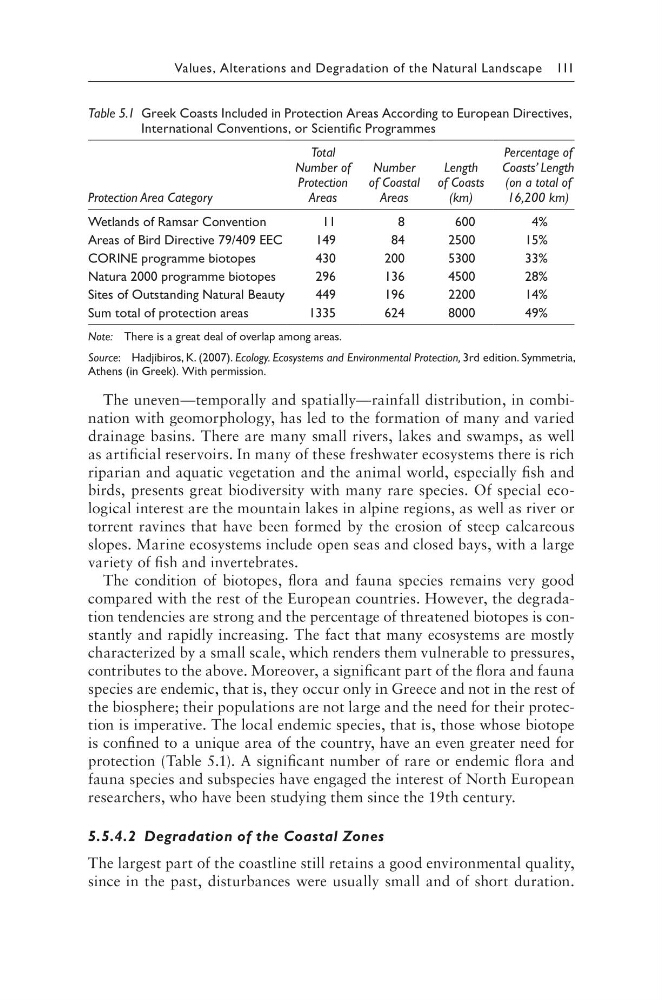
protection (Table 5.1). A significant number of rare or endemic flora and
fauna species and subspecies have engaged the interest of North European
researchers, who have been studying them since the 19th century.
5.5.4.2 Degradation of the Coastal Zones
The largest part of the coastline still retains a good environmental quality,
since in the past, disturbances were usually small and of short duration.
Table 5.1 Greek Coasts Included in Protection Areas According to European Directives,
International Conventions, or Scientific Programmes
Protection Area Category
Total
Number of
Protection
Areas
Number
of Coastal
Areas
Length
of Coasts
(km)
Percentage of
Coasts’ Length
(on a total of
16,200 km)
Wetlands of Ramsar Convention
11
8
600
4%
Areas of Bird Directive 79/409 EEC
149
84
2500
15%
CORINE programme biotopes
430
200
5300
33%
Natura 2000 programme biotopes
296
136
4500
28%
Sites of Outstanding Natural Beauty
449
196
2200
14%
Sum total of protection areas
1335
624
8000
49%
Note: There is a great deal of overlap among areas.
Source: Hadjibiros, K. (2007). Ecology. Ecosystems and Environmental Protection, 3rd edition. Symmetria,
Athens (in Greek). With permission.
The uneven—temporally and spatially—rainfall distribution, in combination with geomorphology, has led to the formation of many and varied
drainage basins. There are many small rivers, lakes and swamps, as well
as artificial reservoirs. In many of these freshwater ecosystems there is rich
riparian and aquatic vegetation and the animal world, especially fish and
birds, presents great biodiversity with many rare species. Of special ecological interest are the mountain lakes in alpine regions, as well as river or
torrent ravines that have been formed by the erosion of steep calcareous
slopes. Marine ecosystems include open seas and closed bays, with a large
variety of fish and invertebrates.
The condition of biotopes, flora and fauna species remains very good
tion tendencies are strong and the percentage of threatened biotopes is constantly and rapidly increasing. The fact that many ecosystems are mostly
characterized by a small scale, which renders them vulnerable to pressures,
contributes to the above. Moreover, a significant part of the flora and fauna
species are endemic, that is, they occur only in Greece and not in the rest of
the biosphere; their populations are not large and the need for their protection is imperative. The local endemic species, that is, those whose biotope
is confined to a unique area of the country, have an even greater need for
protection (Table 5.1). A significant number of rare or endemic flora and
fauna species and subspecies have engaged the interest of North European
researchers, who have been studying them since the 19th century.
5.5.4.2 Degradation of the Coastal Zones
The largest part of the coastline still retains a good environmental quality,
since in the past, disturbances were usually small and of short duration.
Table 5.1 Greek Coasts Included in Protection Areas According to European Directives,
International Conventions, or Scientific Programmes
Protection Area Category
Total
Number of
Protection
Areas
Number
of Coastal
Areas
Length
of Coasts
(km)
Percentage of
Coasts’ Length
(on a total of
16,200 km)
Wetlands of Ramsar Convention
11
8
600
4%
Areas of Bird Directive 79/409 EEC
149
84
2500
15%
CORINE programme biotopes
430
200
5300
33%
Natura 2000 programme biotopes
296
136
4500
28%
Sites of Outstanding Natural Beauty
449
196
2200
14%
Sum total of protection areas
1335
624
8000
49%
Note: There is a great deal of overlap among areas.
Source: Hadjibiros, K. (2007). Ecology. Ecosystems and Environmental Protection, 3rd edition. Symmetria,
Athens (in Greek). With permission.