

dispar) population in north forests by viral and nosemose infection. The information
about the vital role of conservation BC has neglected mostly.
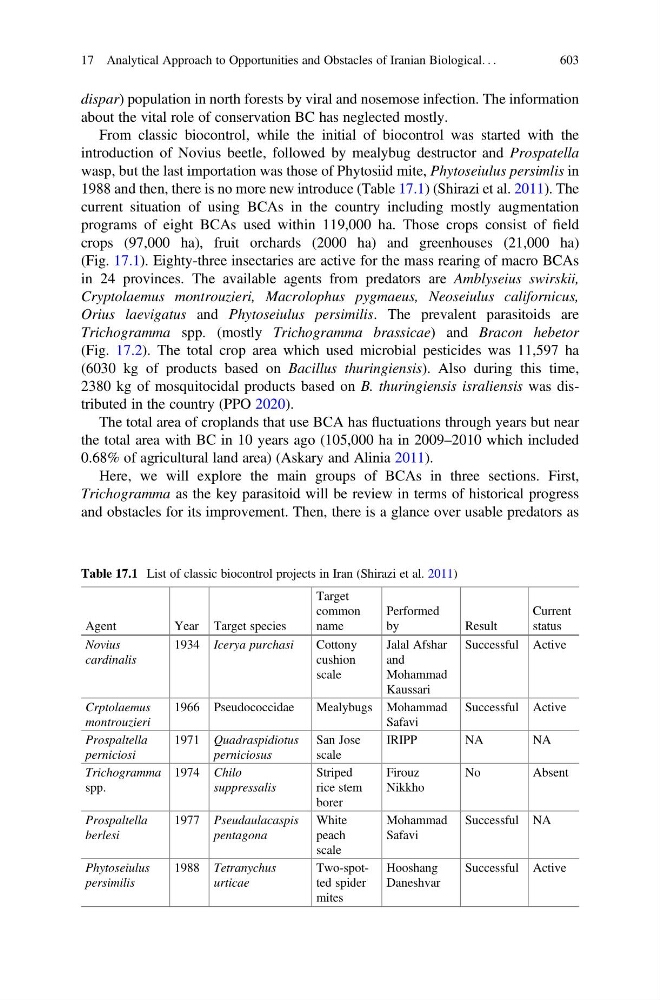
From classic biocontrol, while the initial of biocontrol was started with the
introduction of Novius beetle, followed by mealybug destructor and Prospatella
wasp, but the last importation was those of Phytosiid mite, Phytoseiulus persimlis in
1988 and then, there is no more new introduce (Table 17.1) (Shirazi et al. 2011). The
current situation of using BCAs in the country including mostly augmentation
programs of eight BCAs used within 119,000 ha. Those crops consist of field
crops (97,000 ha), fruit orchards (2000 ha) and greenhouses (21,000 ha)
(Fig. 17.1). Eighty-three insectaries are active for the mass rearing of macro BCAs
in 24 provinces. The available agents from predators are Amblyseius swirskii,
Cryptolaemus montrouzieri, Macrolophus pygmaeus, Neoseiulus californicus,
Orius laevigatus and Phytoseiulus persimilis. The prevalent parasitoids are
Trichogramma spp. (mostly Trichogramma brassicae) and Bracon hebetor
(Fig. 17.2). The total crop area which used microbial pesticides was 11,597 ha
(6030 kg of products based on Bacillus thuringiensis). Also during this time,
2380 kg of mosquitocidal products based on B. thuringiensis israliensis was distributed in the country (PPO 2020).
The total area of croplands that use BCA has fluctuations through years but near
the total area with BC in 10 years ago (105,000 ha in 2009–2010 which included
0.68% of agricultural land area) (Askary and Alinia 2011).
Here, we will explore the main groups of BCAs in three sections. First,
Trichogramma as the key parasitoid will be review in terms of historical progress
and obstacles for its improvement. Then, there is a glance over usable predators as
Table 17.1 List of classic biocontrol projects in Iran (Shirazi et al. 2011)
Agent
Year Target species
Target
common
name
Performed
by
Result
Current
status
Novius
cardinalis
1934 Icerya purchasi
Cottony
cushion
scale
Jalal Afshar
and
Mohammad
Kaussari
Successful Active
Crptolaemus
montrouzieri
1966 Pseudococcidae
Mealybugs Mohammad
Safavi
Successful Active
Prospaltella
perniciosi
1971 Quadraspidiotus
perniciosus
San Jose
scale
IRIPP
NA
NA
Trichogramma
spp.
1974 Chilo
suppressalis
Striped
rice stem
borer
Firouz
Nikkho
No
Absent
Prospaltella
berlesi
1977 Pseudaulacaspis
pentagona
White
peach
scale
Mohammad
Safavi
Successful NA
Phytoseiulus
persimilis
1988 Tetranychus
urticae
Two-spotted spider
mites
Hooshang
Daneshvar
Successful Active
17 Analytical Approach to Opportunities and Obstacles of Iranian Biological. . .
603