

16.2.1.2.2 Insect Pathogens
Immature stages of Anopheline mosquitoes suffer from some microbial pathogens
such as fungi, viruses and some protozoans (Walker and Lynch 2007).
Vast array of insect pathogens have been collected from naturally infected
mosquitoes but some of them aren’t amenable in applied biological control. The
low rate of infection, difficult mass rearing and application are main reasons for few
number of mosquitoes’ microbial control agents. Some of the pathogens can kill
mosquitoes in laboratory but they are not effective in wild. Factors which limit the
effectiveness of these microbial agents under natural conditions include organic
contamination of larval breeding sites, water hardness, water pH, rate of dissolved
oxygen, light intensity, temperature and draught (Basseri 1988). Interaction between
environmental conditions and mosquito pathogens remains largely unknown.
16.2.1.2.3 Entomopathogenic Bacteria
Ishiwata (1902) isolated an air-borne bacillus from diseased silkworm larvae and
Iwabuch called the bacterium Bacillus sotto Ishiwata (Tanada and Kaya 1993) but
the name was later ruled invalid. Berliner (1915) found similar Bacillus in Thuringia
region of Germany from larvae of Ephestia kuehniella (Lepidoptera: Pyralidae)
which he named Bacillus thuringiensis (Bt) (Milner 1994).
B. thuringiensis subsp. israelensis (Bti) (Bacillaceae) a soil bacterium has been
found in Neger desert of Israel in 1976 and has been tested on the various genus of
Culicine (Goldbery et al. 1977). This strain act as a natural pathogen of immature
stages of mosquitoes (Walker and Lynch 2007). Spores of Bti produce crystal toxins
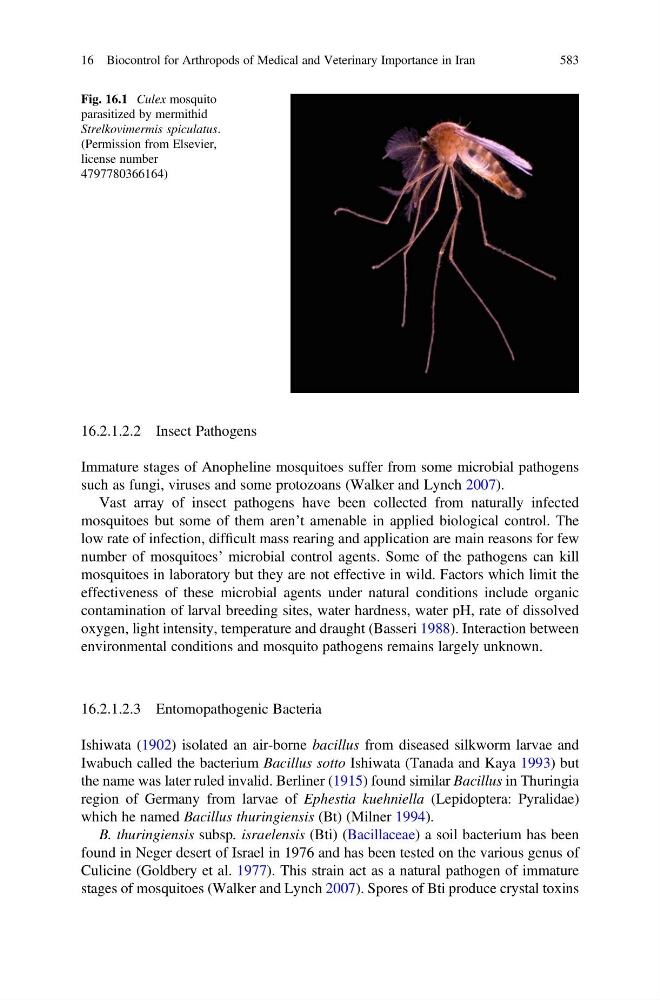
Fig. 16.1 Culex mosquito
parasitized by mermithid
Strelkovimermis spiculatus.
(Permission from Elsevier,
license number
4797780366164)
16 Biocontrol for Arthropods of Medical and Veterinary Importance in Iran
583
Immature stages of Anopheline mosquitoes suffer from some microbial pathogens
such as fungi, viruses and some protozoans (Walker and Lynch 2007).
Vast array of insect pathogens have been collected from naturally infected
mosquitoes but some of them aren’t amenable in applied biological control. The
low rate of infection, difficult mass rearing and application are main reasons for few
number of mosquitoes’ microbial control agents. Some of the pathogens can kill
mosquitoes in laboratory but they are not effective in wild. Factors which limit the
effectiveness of these microbial agents under natural conditions include organic
contamination of larval breeding sites, water hardness, water pH, rate of dissolved
oxygen, light intensity, temperature and draught (Basseri 1988). Interaction between
environmental conditions and mosquito pathogens remains largely unknown.
16.2.1.2.3 Entomopathogenic Bacteria
Ishiwata (1902) isolated an air-borne bacillus from diseased silkworm larvae and
Iwabuch called the bacterium Bacillus sotto Ishiwata (Tanada and Kaya 1993) but
the name was later ruled invalid. Berliner (1915) found similar Bacillus in Thuringia
region of Germany from larvae of Ephestia kuehniella (Lepidoptera: Pyralidae)
which he named Bacillus thuringiensis (Bt) (Milner 1994).
B. thuringiensis subsp. israelensis (Bti) (Bacillaceae) a soil bacterium has been
found in Neger desert of Israel in 1976 and has been tested on the various genus of
Culicine (Goldbery et al. 1977). This strain act as a natural pathogen of immature
stages of mosquitoes (Walker and Lynch 2007). Spores of Bti produce crystal toxins
Fig. 16.1 Culex mosquito
parasitized by mermithid
Strelkovimermis spiculatus.
(Permission from Elsevier,
license number
4797780366164)
16 Biocontrol for Arthropods of Medical and Veterinary Importance in Iran
583