

Accoring to the results, A. swirskii required an average of 17.69, 32.33, 27.87, and
18.04 prey to produce a single predator egg on date+T. urticae, bee pollen
+T. urticae, T. urticae, and almond+T. urticae, respectively. Overall, A. swirskii
had greater control potential of T. urticae in the presence of almond pollen than other
diets (Riahi et al. 2017). The intrinsic rate of increase (r m ) of minute pirate bug,
O. niger a predator of T. urticae was reported 0.1184 day
À1 (Nojumian et al. 2015).
Scolothrips longicornis Priesner (Thysanoptera: Thripidae) is a native beneficial
thrips in Iran. It is considered to be an important predator of numerous spider mite
species such as T. urticae (Pakyari et al. 2008). This predator achieved higher
predation (16.1 preys/day) at a higher temperature (35
C). Therefore it may be
more effective for biological control of two spotted spider mite on bean in warmer
conditions. The efficiency of this predator was evaluated against T. urticae on four
host plants (cucumber, tomato, sweet pepper and eggplant) (Kheradpir et al. 2009).
Predacious thrips preferred T. urticae on host plants (such as eggplant) with rational
dense trichomes, which are arranged in clusters and leave some space for the
predator to walk, search prey and also oviposition.
The ladybird beetles of the genus Stethorus (Coleoptera: Coccinellidae) are one
the best candidates for controlling T. urticae in the world and Iran. In Iran, Stethorus
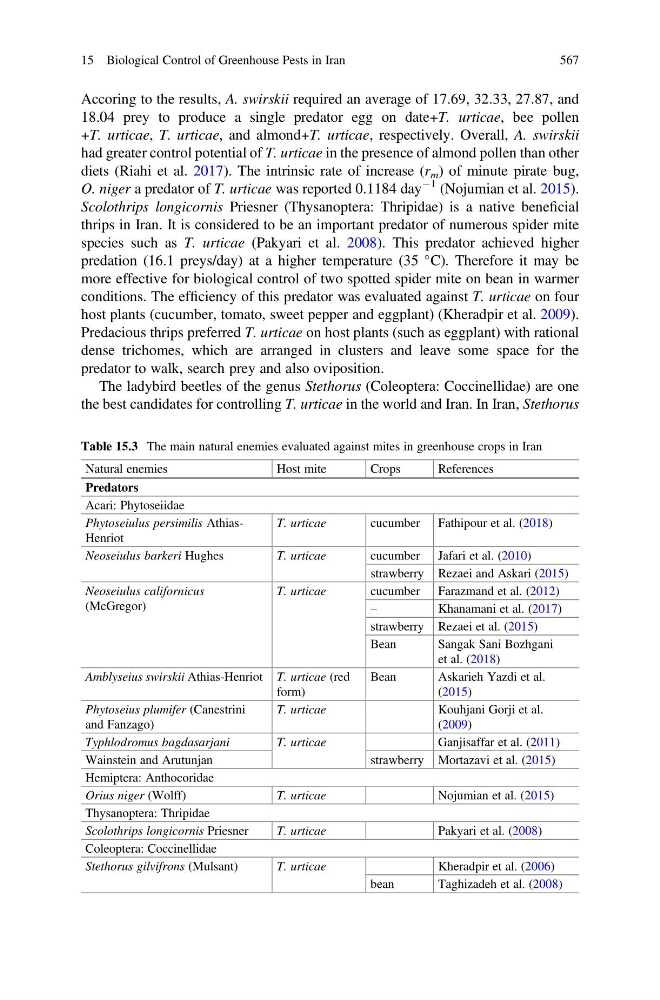
Table 15.3 The main natural enemies evaluated against mites in greenhouse crops in Iran
Natural enemies
Host mite
Crops
References
Predators
Acari: Phytoseiidae
Phytoseiulus persimilis AthiasHenriot
T. urticae
cucumber Fathipour et al. (2018)
Neoseiulus barkeri Hughes
T. urticae
cucumber Jafari et al. (2010)
strawberry Rezaei and Askari (2015)
Neoseiulus californicus
(McGregor)
T. urticae
cucumber Farazmand et al. (2012)
–
Khanamani et al. (2017)
strawberry Rezaei et al. (2015)
Bean
Sangak Sani Bozhgani
et al. (2018)
Amblyseius swirskii Athias-Henriot T. urticae (red
form)
Bean
Askarieh Yazdi et al.
(2015)
Phytoseius plumifer (Canestrini
and Fanzago)
T. urticae
Kouhjani Gorji et al.
(2009)
Typhlodromus bagdasarjani
T. urticae
Ganjisaffar et al. (2011)
Wainstein and Arutunjan
strawberry Mortazavi et al. (2015)
Hemiptera: Anthocoridae
Orius niger (Wolff)
T. urticae
Nojumian et al. (2015)
Thysanoptera: Thripidae
Scolothrips longicornis Priesner
T. urticae
Pakyari et al. (2008)
Coleoptera: Coccinellidae
Stethorus gilvifrons (Mulsant)
T. urticae
Kheradpir et al. (2006)
bean
Taghizadeh et al. (2008)
15 Biological Control of Greenhouse Pests in Iran
567
18.04 prey to produce a single predator egg on date+T. urticae, bee pollen
+T. urticae, T. urticae, and almond+T. urticae, respectively. Overall, A. swirskii
had greater control potential of T. urticae in the presence of almond pollen than other
diets (Riahi et al. 2017). The intrinsic rate of increase (r m ) of minute pirate bug,
O. niger a predator of T. urticae was reported 0.1184 day
À1 (Nojumian et al. 2015).
Scolothrips longicornis Priesner (Thysanoptera: Thripidae) is a native beneficial
thrips in Iran. It is considered to be an important predator of numerous spider mite
species such as T. urticae (Pakyari et al. 2008). This predator achieved higher
predation (16.1 preys/day) at a higher temperature (35
C). Therefore it may be
more effective for biological control of two spotted spider mite on bean in warmer
conditions. The efficiency of this predator was evaluated against T. urticae on four
host plants (cucumber, tomato, sweet pepper and eggplant) (Kheradpir et al. 2009).
Predacious thrips preferred T. urticae on host plants (such as eggplant) with rational
dense trichomes, which are arranged in clusters and leave some space for the
predator to walk, search prey and also oviposition.
The ladybird beetles of the genus Stethorus (Coleoptera: Coccinellidae) are one
the best candidates for controlling T. urticae in the world and Iran. In Iran, Stethorus
Table 15.3 The main natural enemies evaluated against mites in greenhouse crops in Iran
Natural enemies
Host mite
Crops
References
Predators
Acari: Phytoseiidae
Phytoseiulus persimilis AthiasHenriot
T. urticae
cucumber Fathipour et al. (2018)
Neoseiulus barkeri Hughes
T. urticae
cucumber Jafari et al. (2010)
strawberry Rezaei and Askari (2015)
Neoseiulus californicus
(McGregor)
T. urticae
cucumber Farazmand et al. (2012)
–
Khanamani et al. (2017)
strawberry Rezaei et al. (2015)
Bean
Sangak Sani Bozhgani
et al. (2018)
Amblyseius swirskii Athias-Henriot T. urticae (red
form)
Bean
Askarieh Yazdi et al.
(2015)
Phytoseius plumifer (Canestrini
and Fanzago)
T. urticae
Kouhjani Gorji et al.
(2009)
Typhlodromus bagdasarjani
T. urticae
Ganjisaffar et al. (2011)
Wainstein and Arutunjan
strawberry Mortazavi et al. (2015)
Hemiptera: Anthocoridae
Orius niger (Wolff)
T. urticae
Nojumian et al. (2015)
Thysanoptera: Thripidae
Scolothrips longicornis Priesner
T. urticae
Pakyari et al. (2008)
Coleoptera: Coccinellidae
Stethorus gilvifrons (Mulsant)
T. urticae
Kheradpir et al. (2006)
bean
Taghizadeh et al. (2008)
15 Biological Control of Greenhouse Pests in Iran
567