

et al. 2014). In the three hoverfly species, about 70% consumptions occurred during
the third larval instars (Fathipour et al. 2005). Each larva of S. albomaculata ate
516.167 Æ 73.17 aphids (M. rosae) during larval period. There were significant
differences (P < 0.01) between daily feeding rates of larval instars. The third instar
larvae had an important role in feeding rate and 78.32% of total larval feeding was
due to this instar (Jalilian 2015).
These predators are suggested to control mentioned aphid pests in greenhouses in
Iran. Intrinsic rate of increase (r m ) of A. aphidimyza on A. gossypii ranged from
0.110 Æ 0.016 to 0.166 Æ 0.014 day
À1 with increasing prey density (5, 10, 20, 40,
60, 80) (Madahi et al. 2013).
The maximum mean fecundity per female of C. carnea was 478.50 Æ 8.38 eggs
when larvae fed on M. persicae followed by 409.33 Æ 8.16 eggs on A. gossypii
(Takalloozadeh 2015).
Theoretical maximum attack rates (T/T h ) of Orious laevigatus on A. gossypii on
cucumber were estimated to be 55.58, 54.74, 61.98 and 64.64 aphids/day in 1st, 2nd,
3rd and 4th days of the adult lifetime, respectively (Rostamian et al. 2014).
15.4.1.2 Parasitoids
All members of the subfamily Aphidiinae (Hymenoptera: Braconidae) are solitary
endoparasitoids of aphids (Starý 1970). They are among the most important natural
enemies of aphids, which can effectively regulate the aphid populations and prevent
serious outbreaks (Hagvar and Hofsvang 1991; Karami et al. 2018b). Several species
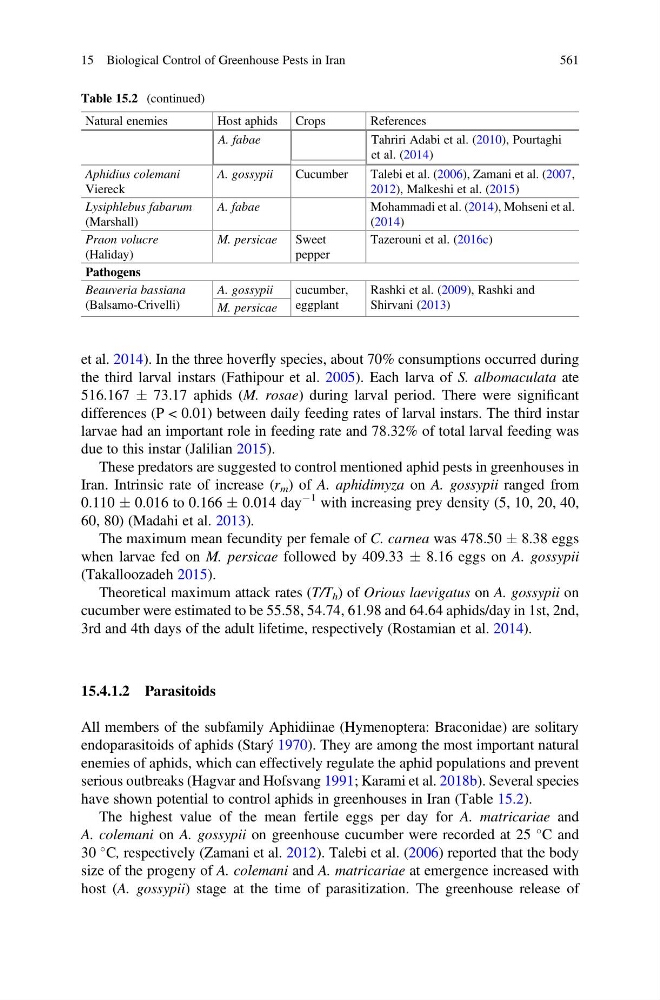
have shown potential to control aphids in greenhouses in Iran (Table 15.2).
The highest value of the mean fertile eggs per day for A. matricariae and
A. colemani on A. gossypii on greenhouse cucumber were recorded at 25
C and
30
C, respectively (Zamani et al. 2012). Talebi et al. (2006) reported that the body
size of the progeny of A. colemani and A. matricariae at emergence increased with
host (A. gossypii) stage at the time of parasitization. The greenhouse release of
Table 15.2 (continued)
Natural enemies
Host aphids Crops
References
A. fabae
Tahriri Adabi et al. (2010), Pourtaghi
et al. (2014)
Aphidius colemani
Viereck
A. gossypii
Cucumber
Talebi et al. (2006), Zamani et al. (2007,
2012), Malkeshi et al. (2015)
Lysiphlebus fabarum
(Marshall)
A. fabae
Mohammadi et al. (2014), Mohseni et al.
(2014)
Praon volucre
(Haliday)
M. persicae Sweet
pepper
Tazerouni et al. (2016c)
Pathogens
Beauveria bassiana
(Balsamo-Crivelli)
A. gossypii
cucumber,
eggplant
Rashki et al. (2009), Rashki and
Shirvani (2013)
M. persicae
15 Biological Control of Greenhouse Pests in Iran
561
the third larval instars (Fathipour et al. 2005). Each larva of S. albomaculata ate
516.167 Æ 73.17 aphids (M. rosae) during larval period. There were significant
differences (P < 0.01) between daily feeding rates of larval instars. The third instar
larvae had an important role in feeding rate and 78.32% of total larval feeding was
due to this instar (Jalilian 2015).
These predators are suggested to control mentioned aphid pests in greenhouses in
Iran. Intrinsic rate of increase (r m ) of A. aphidimyza on A. gossypii ranged from
0.110 Æ 0.016 to 0.166 Æ 0.014 day
À1 with increasing prey density (5, 10, 20, 40,
60, 80) (Madahi et al. 2013).
The maximum mean fecundity per female of C. carnea was 478.50 Æ 8.38 eggs
when larvae fed on M. persicae followed by 409.33 Æ 8.16 eggs on A. gossypii
(Takalloozadeh 2015).
Theoretical maximum attack rates (T/T h ) of Orious laevigatus on A. gossypii on
cucumber were estimated to be 55.58, 54.74, 61.98 and 64.64 aphids/day in 1st, 2nd,
3rd and 4th days of the adult lifetime, respectively (Rostamian et al. 2014).
15.4.1.2 Parasitoids
All members of the subfamily Aphidiinae (Hymenoptera: Braconidae) are solitary
endoparasitoids of aphids (Starý 1970). They are among the most important natural
enemies of aphids, which can effectively regulate the aphid populations and prevent
serious outbreaks (Hagvar and Hofsvang 1991; Karami et al. 2018b). Several species
have shown potential to control aphids in greenhouses in Iran (Table 15.2).
The highest value of the mean fertile eggs per day for A. matricariae and
A. colemani on A. gossypii on greenhouse cucumber were recorded at 25
C and
30
C, respectively (Zamani et al. 2012). Talebi et al. (2006) reported that the body
size of the progeny of A. colemani and A. matricariae at emergence increased with
host (A. gossypii) stage at the time of parasitization. The greenhouse release of
Table 15.2 (continued)
Natural enemies
Host aphids Crops
References
A. fabae
Tahriri Adabi et al. (2010), Pourtaghi
et al. (2014)
Aphidius colemani
Viereck
A. gossypii
Cucumber
Talebi et al. (2006), Zamani et al. (2007,
2012), Malkeshi et al. (2015)
Lysiphlebus fabarum
(Marshall)
A. fabae
Mohammadi et al. (2014), Mohseni et al.
(2014)
Praon volucre
(Haliday)
M. persicae Sweet
pepper
Tazerouni et al. (2016c)
Pathogens
Beauveria bassiana
(Balsamo-Crivelli)
A. gossypii
cucumber,
eggplant
Rashki et al. (2009), Rashki and
Shirvani (2013)
M. persicae
15 Biological Control of Greenhouse Pests in Iran
561